Don’t—
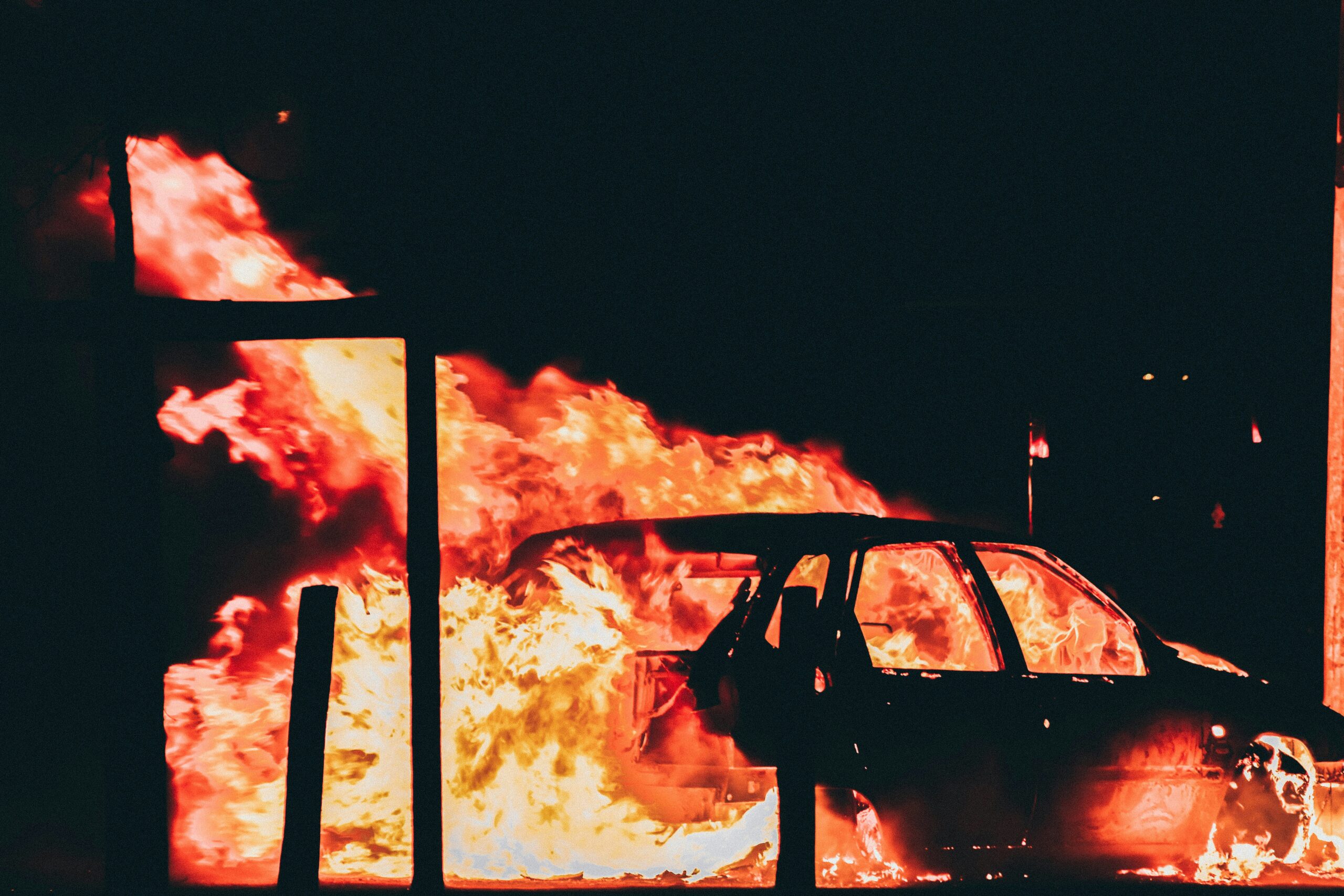
I don’t remember if it rained that day. What I do remember was the smoke in the distance. No, not the sight of smoke, the smell, that piercing odor similar to the first few stages of decay, of rot—and maybe rot wasn’t so far off, maybe it was a corpse that burned.
Don’t worry—
Was there rain? No, I don’t think so. If it rained, I would’ve stayed inside with my cousin Gabriel. We would’ve played “tepok nyamuk in the bedroom,” hide-and-seek inside the house, or run around in the living room, dragging our makeshift car toy made of cardboard box and rounded watermelon skins. But I believe it did rain that day. I remember having a pack of pink and purple bubble gums in my pocket, the one with the cartoon superhero on the cover. I would’ve bought it from the warung at Pulo Asem street, just across my house. If I could find 500 rupiah from floor, usually underneath tables and chairs, I would treat myself to two packs of sweets, one for Gabriel, one for me.
That week, my whole family was away in the mountains for a retreat. My parents worked with the church to take kids from Christian high schools all over the city to the mountains, teaching them leadership and communication skills. The program went on for several years before it was permanently defunded. That year of 1998 was the program’s last year. I would come with them, but I managed to stay at home by myself with some volunteers by making up a stupid excuse. Something along the lines of “I want to play with Gabriel.”
Don’t worry, mommy—
Gabriel’s parents both worked. His mom taught sociology at the country’s most prestigious university. His dad, who was mostly at home, worked as a writer and critic, and would want the space at home to himself. After school, Gabriel would come over to my place and stay after dinner, until one of his parents picked him up with a bicycle that had a passenger seat at the rear.
Our friendship began before I was born. When I was still in my mother’s womb, Gabriel was already around. My mother’s maternity leave meant she could take care of Gabriel while his parents were working. I remember hearing a story of how Gabriel at two years old was afraid that my mother, whom he regarded as his mother as well, would no longer love him once I was born. My mother assured him: not only would she continue to love and take care of him, but he would have a baby brother as well. Because our age difference, the proper term for “older cousin” or “older brother” wasn’t important. In Indonesian, the word saudara covers all there is for relative, cousin, brother, and so on.
Although my dear cousin and I are no longer close (we have our own separate group of friends and interests), for more than a decade he was my only friend; the only idea I had of a friend.
Don’t worry, mommy. God—
My family’s experience with grief and loss in the United States gave them a sensitivity to the suffering of those around them, especially those struggling with poverty. By the time my parents, brother, and sister resettled in Jakarta, they decided to turn the house into a community center and shelter.
My childhood house doors were open to anyone who couldn’t afford rent. We had many community members, workers, and volunteers living at our house at any given time. Having twenty to thirty people under one old roof wasn’t that rare. The people living with us would get assigned alternate chores from cooking and cleaning, to taking care of the children. How my parents paid for all the groceries and mattresses, I have no idea.
I remember playing kites, hiding underneath cars, riding on the passenger seat of Dutch bicycle rides, marking on sleeping volunteers’ faces, playing with the hose outside and spraying water at disgruntled passersby—I was a two-legged, spoiled demon, but no one dared to scold me because of my parents generosity.
A lot of Indonesian “parenting” revolves around letting children do whatever they want until they hurt themselves or others, after which the parent or caretaker scares the child into obedience. To learn scissors weren’t toys, I had to slice the skin off my thumb open; to know flames are dangerous, I had to burn my feet with the shattered shards of a bottle I lit on the stove; and to know I could die, I had to drown and stay drowned for almost a minute.
Don’t worry, mommy. God will—
I was four. While my family was away, I stayed at home. Mama Ade – whose name comes from the Indonesian custom of naming mothers based off their child’s first name – cooked and took care of me.
I remember never finishing my rice: not because I wasn’t hungry, but because Gabriel never finished his either. When Gabriel stopped eating the yolk of his eggs, I stopped eating mine too. But day after day, the daily portion of rice and eggs was never enough to satisfy me. I thought I grew hungrier, but the portion decreased. Until one night, our small community had no food left. No harvest from the garden, no food in the storage.
Most of the community members went with my parents to help out with the retreat. The ones who stayed that week went away soon after and never came back. I don’t remember all their names. I would try to list out the faces I remember, but that too, I’m afraid to misremember.
What I remember: Mama Ade told her two kids who were already in college to stay at home, while she carried me with one arm, my own two arms wrapped around her neck like a baby chimpanzee, as we looked for a warung that was opened. The warung across our house was closed, the one at the end of the street was also closed, and so was the one at the end of the next block.
At the edge of the neighborhood, as we approached the gates to the rest of the city, we found the gates had been locked shut. I wiggled the gates with my small hand, rattling the metal and chain, before a soldier appeared from the guard post that was never manned before.
Don’t worry, mommy. God will protect—
A soldier instead of a satpam. The rifle strapped around his shoulders gave his occupation away. “What are you doing out here?” he asked Mama Ade, “It’s not safe.” The stench of smoke became clearer, as if I could almost taste burning plastic in my mouth. I could see the smoke now, not far away from where I was, beyond the gate. “We’re out of rice,” she explained, “We have nothing left to eat.”
The soldier studied the woman and the child she was carrying, our different skin tone and facial structure. He could tell our different ethnicity with a glance, a common ability among Indonesians. “Is this your daughter?” The soldier mistook me for a girl, which I was accustomed to due to my long hair. “Yes,” Mama Ade said.
I don’t remember why she lied, perhaps out of fear, perhaps out of survival, but by lying, she did save her community. By lying, she made sure I could eat. “They’re burning everything, Ibu,” explained the soldier, “streets, stores, signs.”
Ibu, the Indonesian word for mother. Indonesians call older women their mothers, and older men their fathers. “Ibu” works interchangeably as the polite form of address for a woman.
“They? Who are you talking about?” We did have a TV at home, but because the living room also functioned as an office space, rarely anyone ever watched the TV. And even when the living room was empty, out of habit, no one touched the TV remote.
“The rioters,” said the soldier, almost dismayed, “haven’t you heard?” This part, I don’t remember perfectly: the soldier gave in, somehow, and escorted us to the nearest warung that was still open. We got a small bag of rice, more eggs, and some packs of instant noodles; enough to last us for a couple more days. We arrived home. Mama Ade put me down, and retreated to her family as she explained the news. I played on my own until dinner was ready—my first meal of the day.
It wasn’t until two decades later my mind and body could understand what happened that week. The lingering smell of smoke, the lack of food in the neighborhood, why family never seemed to return. My mother did try to call. Her call never seemed to arrive. When it did, much later, her gush of relief sounded as though she just witnessed the resurrection of her youngest child.
Don’t worry, mommy. God will protect me—
I don’t call my mother as often as I would like. Amid writing, teaching, mentoring, volunteering, and my relationship, I forget to keep in touch. I slip and forget her birthday by a few hours or so. My family has terrible communication that way. We resort to the silent treatment, before blowing up when confronted by the offending party. One thing remains consistent however, from my brother, to my sister, and to me: once a family member is out of the country, they are forgotten until it’s time for them to return.
I could describe my mother’s tone that early evening as frightened. Ancestral-trauma-kind-of-frightened. The worst fear one could have: when the people in the country were killing those who looked like you. When she called, Mama Ade picked up. I had the bad habit of listening to people’s calls, since we had two phones attached to the same landline. My mother wanted to speak with me, and I told her I was already on the phone. After Mama Ade closed her end of the line, my mother told me she was going to send someone to pick me up, so I could be with the rest of my family. “It’s not safe at home,” she said.
My parents have always been paranoid regarding my siblings and I’s safety. Don’t ride motorbikes, it’s dangerous. Don’t stay out for too late, you’ll get kidnapped. Don’t smoke cigarettes, you’ll die early. Their rules contradict their lack of parental presence. I purposefully defied their authority to get their attention.
Yet my mother’s fear that night came from a different source; not out of unwarranted fear, but out of experience; as though the sky had torn open her old wound, rained down all that she had tried to keep hidden above the clouds and light.
I don’t remember what got to me that night. Maybe I hated the idea of traveling long distances, although I enjoyed the mountain air before. I have no memory of what I said, but because people around me said it was true, therefore I take their words as truth. How it was as though I became a prophet in my own way. As though divine words filled me, and assured my mother, and with her, my family.
I remember having already finished reading the Bible on my own. I remember the praise and worship sessions my parents would hold with their community members. I remember the feeling safe and at home as I laid my head on my mother’s lap as she sat in a circle with the rest of the group, singing praises and listening to sermons.
“Don’t worry, mommy. God will protect me.”
Don’t worry, mommy. God will protect me and—
During the 1998 economic recession in Indonesia, student demonstrators protested against the 32-year Suharto dictatorship. From the national and international perspective, the riot was a pivotal moment that toppled the regime that rose to power through questionable means. The riots stirred the motherland towards democracy. However, the riot was also ethnically motivated. Rioters burned and looted Chinese-owned stores. Chinese women were mass raped. The Indonesians blamed the Chinese-Indonesian among them, seeing them as better off: wealth-hoarders, leeches, immigrants.
The Chinese-Indonesians remain the smallest ethnic minority in the country. Yet, the wealth a few groups of Chinese Indonesians owned was proportionately off. We have a saying among our kind, that the “Chinese mentality” is to work and work and work. Work until your neighbor gets jealous of you. Work until you make more than your colleagues. Work until you could buy off your competition.
Of course, my parents grew up with a different mentality. Theirs revolved around Christianity and the Gospel, not around money. What little money my mother has, to this day, she would spend supporting her friends and former students’ business, often by buying things she already had or didn’t need: shoes, sweaters, shawls.
By that time, the well-off Chinese Indonesians—the conglomerates, the business tycoons, those who had close relationship with Suharto—had already left. The ones paying the price were the Chinese Indonesians who couldn’t afford a trip overseas, who couldn’t migrate. The “visible Chinese-Indonesians”—the secretary, the taxi driver, the school teacher—were the ones who had to sate the country’s anger, often with their bodies.
May 1998 wasn’t the first ethnically-motivated riot that struck the country. During the communist massacre of 1965, many Chinese Indonesians were harassed at best, killed at worst. Ever since then, many older Indonesians developed the habit of staying at home during protests, my parents included. People see protesters as having no life, as the source of traffic jams, as a nuisance.
It’s difficult to separate where a story ends and another begins. After 1998, my mother went to Australia to start her PhD program in psychology. She took me, her youngest, with her. Gabriel and I tried to keep in contact. We read the same comics, played the same video games; we would call once a month. But Australia is another story.
When I returned to Indonesia, near the age of fifteen, the house had changed. My family moved to a new neighborhood a couple blocks over. We no longer operated as a community center. We closed our doors to strangers. Mama Ade and her family had left. Even Gabriel and I stopped talking to each other, realizing we had little in common.
There was the Indonesia before, the one where I could roam freely, without supervision. And there was the Indonesia after, the one in which I try to remember myself. Often I walk around my old neighborhood. The old community center has been torn down. All the warungs are gone. The gates, however, the gates that guarded the neighborhood are still there, although they are all locked now, limiting the entrance to the neighborhood to only one way.
Don’t worry, mommy. God will protect me and you.
Although I no longer practice religion the same way my family does, I remain grateful for being the child my mother needed me to be. If the only explanation was an angel possessed me that night, then so be it. What I said to my mother on that phone call saved her from irrational and rushed decision-making.
Countless things could’ve gone wrong that week. My family was the only Chinese-Indonesian family in the neighborhood, and although the area was middle-class (or what constituted a middle-class back then), we could’ve easily been sold out by a disgruntled neighbor.
The rest of our community, including Mama Ade and I, left to the mountains in the aftermath. We stayed for a duration I no longer remember. From what I know, Mama Ade and her family never returned. After finishing college, Mama Ade’s daughter secured a managerial position at one of our family friend’s villas.
Not long after, she invited all her family members to come live and work with her. Mama Ade was charged with cooking the homemade Indonesian dishes she was praised for. Ade, her son, worked as a fellow manager and was in charge of transportation. Pak Parma, her husband, helped around as he could, often by answering questions or reminding his daughter of tasks.
My family tried to visit Mama Ade and her family once a year, usually during off-peak season. Living between Indonesia and the United States has made it difficult for me to meet Mama Ade and her family once a year. The last time I visited, Mama Ade cried in front of me. Since the last time I’d seen her, Pak Parma had passed away. Her son-in-law was left with aphasia after a stroke. Her daughter-in-law had left her family and children behind. I stayed quiet as she pondered upon why she had to face such a heavy weight of suffering. Just as quickly as she had cried, she picked herself up, said she was still grateful for the joy that still surrounded her: her many grandchildren.
I wish I could do more for Mama Ade. If I were earning more, sending money would be the least I could do, but she doesn’t need money. Sometimes, I would ask her to cook my favorite meal – coconut-infused rice with fried chicken and shredded eggs – just to relive my childhood.
She never judged me, despite my interfaith relationship, despite my sexuality, despite my gender (which I assume she knew). She only ever gives me one piece of advice: be a good person. And I try. To this day, I try. I try to remember all the stories within me, that have been passed down to me, and I try to honor them. It’s the least I can do. I’m only the product of those who have nurtured and raised me.
“Don’t worry, mommy. God will protect me and you.”
JEDDIE SOPHRONIUS is the author of the poetry collections Interrogation Records (Gaudy Boy, 2024), Happy Poems & Other Lies (Codhill Press, 2024), Love & Sambal (The Word Works, 2024), and the chapbook Blood·Letting (Quarterly West, 2023). A Chinese-Indonesian writer from Jakarta, they received their MFA from the University of Virginia. The recipient of the 2023 Gaudy Boy Poetry Book Prize, their poems have appeared in The Cincinnati Review, The Iowa Review, Prairie Schooner, and elsewhere.
