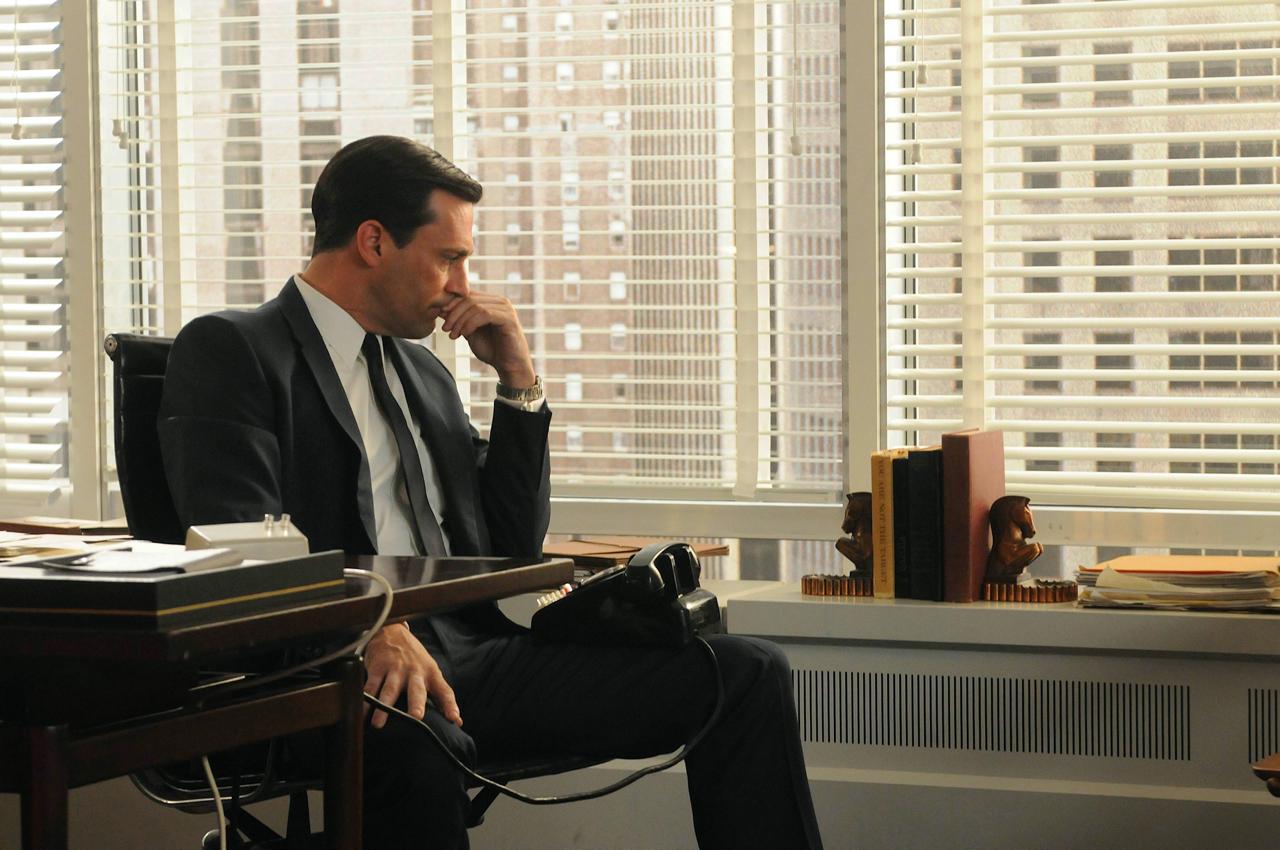
I am obsessed with Don Draper. I like his white shirts and his big, capable hands. I like how his straight black hair sometimes falls across his long, wide forehead and how he has to brush it out of his eyes like a little boy. I like that he’s so tall he towers over everyone. I like his gait as he walks down the hall of the advertising agency, confident but also a little hesitant, like a giant—outsized and wary. Brutal, self-absorbed, almost incapable of empathy, he’s alone as he strides. I´d follow him anywhere, me, the quiet girl he´d never notice if she worked in that ad agency. I´d watch him from my desk, and hope I wouldn’t bump into him in the elevator. I wouldn’t really want anything to happen between us. That girl wouldn’t be able to have a conversation with him. I´d just want to watch him as he careens through life from one woman to the next, searching for something he can never find.
I watched Mad Men for the first time in 2007 when I was 50. Back then, there were other people out there, sitting in the dark, staring at the TV screen each week. But now I’m 68 and the show ended years ago, and you have to hunt for it on Netflix like a book on a high shelf. It´s been abandoned in the online library of Drama. Nobody wants to talk about it anymore, but I’m watching the whole damn thing again—all seven seasons. Always late at night and alone, after my husband has gone to sleep. It’s the same feeling I used to have when I was tucked away in my bed with a candy bar, reading romances when I was fourteen: pure enjoyment tinged with a little guilt. I return every night to the Mad Men world of bright fluorescent lights and wide windows overlooking New York City. I wake up the next day tired, a little ashamed, and annoyed that I’ve deprived myself of sleep again.
I try to figure out why the show is so endlessly fascinating to me. Maybe it’s because I can relate to Don. He has a double life, like I do: after my day job is done and my husband goes to sleep, we both spend time figuring things out. Don puts on his costume in the morning and strides out the door, fully disguised, like me. Even his name, we eventually find out, is not real, like my own hyphenated name that’s never felt like a fit. But at night, when he returns from work, sometimes he thinks about who he really is and what it all means—like me, like most of us. He writes in his journal, by himself, in a little room. Takes long, lonely car trips, stares out the window of the train, airplane, or his office. Smoking and thinking.
Sometimes I think I watch to learn about how a family works, having grown up in the early sixties in a family missing a mother, a family with a hole in the middle, like a donut. I’ve always watched TV and read books to learn about the world. The family Don creates for himself—at least the one he has in the first few seasons before it falls apart—is complete. There’s his wife, Betty, in a crisp dress and manicured nails, and two beautiful children, a boy in shorts and a girl in a little kilt, just like the kids in the “Dick and Jane” books my brothers learned to read with.
The people at his office feel like a family, too, in a strange way. Don Draper is the dad, or at least he seems like the father figure at first, the tall, strong, calm one who everyone turns to in a crisis. Fueled by alcohol and cigarettes, he stays on his feet no matter what havoc occurs around him. His sidekick, Roger, is the wayward uncle. The head of the agency, Bert Cooper, is the eccentric grandfather who holds the memories. The powerful secretary, Joan, is kind of a mom, one who’s too absorbed in her own stuff to pay much attention to the kids. Luckily, there are other moms scattered around the office, calming, soothing, and providing endless comfort to the wayward sons who have all the power. And then there’s Peggy, the wayward daughter waiting for Don’s approval and attention, whom Don neglects and disciplines and sometimes, when he’s at his best, mentors. Peggy, who sees him clearly and tells him the truth.
I have always stared at other people’s families, trying to learn what’s normal and comparing them with my own, whether on TV or in real life. My dad was not confident and bold like Don, and he wasn’t a womanizer. He married one woman, and when she died, he never married or even dated again. He was thoughtful and calm, not impulsive and restless. He was steady and honest, not a liar like Don. But he was as deeply uncertain about how to be a father and husband as Don is. And he worked in advertising from the 1940s until he retired at the age of 79 in 1974. The show takes place from 1960 to 1970—the years when I was home as a child and watched my father come and go from work on the train each day, just like Don does. Watching the show makes me wonder about the world my father inhabited. I wish he was here to tell me about his own cast of characters, but they’re all dead now, and so is he. Only my parents’ ashtrays, Christmas ornaments, and martini glasses remain, retrieved now and then from my closets, drawers, and cupboards where they’re tucked away. But through the alchemy of television, I can always go back to that time just by pressing a few buttons on my remote.
My father’s unmarried sister, Hildegarde, worked in advertising too. For thirty years, she was the executive secretary to the company president in the same big advertising agency where my father worked. My father’s other unmarried sister, Florence, worked as a secretary in the movie industry, at the Philadelphia office of Fox Pictures. My mother died when I was eleven, and after that, Hildegarde and Florence came to our house every Saturday morning to clean and cook dinner for us, taking the train from their tiny apartment in Narberth. After they arrived, my father and aunts sat down at our dining room table over coffee, eggs, and toast, and talked about work for a few hours before they began doing laundry, cleaning toilets, and shopping for groceries. It was the happiest my father was all week. Their conversations were background noise that I never really completely tuned in to, but the snippets I overheard were honest and cynical and made them laugh. I was like one of the wives on Mad Men who had a big stake in how their man’s work was going, but could only listen helplessly. I had no power to change anything. My father had been laid off from his last job in advertising right after my mother died, and although he was only unemployed for a weekend, it was terrifying to imagine him being jobless again. We were teetering on the brink of lower middle class as it was, with not a penny to spare. It was clear to me from what I overheard that the hard part of the work world was the relationships with people, and that mulling it all over with someone was helpful.
The social class that’s portrayed on Mad Men is different from Herman and Hildegarde and Florence’s. Except for Don, all the men on the show have gone to college, and most of them have the connections that come with that college degree. My father, who didn’t go to college, arrived in the advertising business in the olden days without any connections, just desperation. He worked in the industry all through WWII, his poor eyesight enabling him to escape the draft. Don arrived after a stint in Korea, the war my friends’ dads were in, the war that always seemed less weighty and more glamorous. He was younger than my father, bolder than my father, and he was a womanizer, which my father was not. My father wouldn’t have been a character on the show. But the people they talked about at coffee—the “dumb ass”, the “little bit of a guy”, the “sonofabitch”—would have been. The women on the show, all New Yorkers, are different from my aunts, too. The Mad Men women are sexier and more sophisticated than Hildegarde and Florence ever were. But when I watched the show, it reminded me of their coworkers—R.G. Wilder, the president of my Dad’s agency, who I’d seen in pictures in a suit, with slicked back hair; Nancy Wilson, the Operations Manager, who Hildegarde said was climbing the ladder at the firm, like Peggy.
On Mad Men, there’s an orderliness about the work world that is easy to master once you know the culture and the players, and there’s a sense of comfort and community for all those people in suits and ties heading in the same direction every morning. There are unwritten rules that seem to stretch back generations, rules that all the middle-class white men understand. When to shake hands, when to stand in someone’s office and when to sit, who sits where in the boardroom, how to respond to the black elevator operator when he talks to you, how to brush off a secretary, how to order a drink, what drink to order (an old fashioned for Don, a gin and tonic for his wife Betty), what books to be seen reading, how to converse nonchalantly when you’re standing next to someone else at a urinal. Maybe that sense of community that comes from sharing a work culture was comforting for my father and my aunts, and still is for all of us, part of the reason we want to be in the work world.
Don and Peggy and Pete and Joan and everyone else’s lives outside the office mostly take place in dimly lit bedrooms, windowless restaurants, and apartment hallways. Life outside of work has its occasional moments of joy—the characters fall in love, get married, have children—but for the most part, they struggle with relationships with their children, parents, siblings, and partners, just like everyone does. The only two characters who seem like they could be happy outside of work are the bow-tie-wearing founder of the agency, Bert Cooper, who has no family that we know of, and Ken Cosgrove, who, with the support of his wife, secretly writes sci-fi stories that are good enough to be published in The Atlantic. Ken, who wears an eye patch like a pirate after he loses his right eye in a hunting accident while entertaining clients, is warned by Don not to let his writing get in the way of his real work. We keep waiting for the patch to disappear—isn’t his eye better by now? But there it is again in the next season, reminding us of what he—and we—are all willing to give up in return for the ability to earn a living. My father would often sigh and recite a mantra as he stripped off his black socks at the end of the day to get into his pajamas, “I work and I slave. I slave and I work. And for what?” He was kidding, but not completely.
Unlike relationships in real life, which don’t have clear beginnings or endings, the relationships on Mad Men begin when the elevator doors open and the actors emerge in a smartly dressed, sober, and wide-awake cluster. Once they arrive, the environment is tightly controlled: characters are penned behind their office doors where they lounge, smoke, drink, nap, or restlessly pace while their secretaries guard the entrances. The day ends when the lights are turned off, the liquor bottles are replaced in top drawers of heavy wooden desks, the typewriters are covered, and the ashtrays are emptied. There is a beginning and an end to the work, marked, like my father’s, with a train ride and two newspapers—the Philadelphia Inquirer for the trip into the city and the Daily Bulletin for the ride home.
On Mad Men, as at any advertising agency, the work starts with the pitch, then moves through the creative process to the presentation and the big check at the end. Don is one of the “creatives,” and sometimes during the creative process, when he’s working on an ad, he’s also working to figure out himself. It works the other way, too. When he discovers—often by accident or with a sudden revelation while making a pitch to a client—the part of himself that is most filled with longing or conflict, the client and co-workers sitting around the conference table fall silent with awe. He always seems a little surprised at what has come out of his mouth. But on some level, it also seems inevitable, this figuring it all out through the work—because we’re all always figuring it out, even when we don’t know we’re doing it, at work, at home, in the car. Whatever demons haunt us don’t leave us alone when we dress in our costumes and head out the door.
“In Greek, ‘nostalgia’ literally means ‘the pain from an old wound,’” Don tells a client—and us—as we stare at pictures of his early, happy family life on a slide carousel, Kodak’s newest product. This part of his life is over. The pictures remain to tell the story. But how true is that story? Where is the old wound? When Don suddenly decides to go off script and tell the truth about his sad, lonely childhood in a pitch to Hershey’s, the meeting goes off the rails, and the pitch fails. Deception and illusion are what work in his work world. I think of myself, a child who always felt like an outsider, watching other families on TV and growing up to work as a consultant, an observer rather than a participant, just like at that dining room table as a kid. I have always spent a lot of time comparing myself to others, figuring out what “normal” is and how to fit in, just like Don. And like Don, I learned how to disguise myself so I could look like everyone else while I figured it out. It didn’t help me figure out my life outside of work.
At the end of the show, we see Don driving a race car up the spectacularly beautiful coast of California. He has been fired from his job, and he’s alone and feeling reckless, questioning the meaning of it all. On the way to wherever he’s going, he gives the beautiful car away to a random hitchhiker as if the flash and glamor that sustained him are as meaningless as the ex-wives and jilted lovers he left behind in New York. He ends up at the house of a young woman—the niece of his only real friend—someone who knows his real name, not the one he manufactured. She answers the door and invites him to go to sleep on her couch for a while, and the next day, she worriedly insists he come with her to a retreat she’s signed up for to fight off her own demons. The retreat center is filled with hippie women in flowing dresses and men with beards in pine woods overlooking the ocean. “I’m not going to leave you alone,” she tells him, before she leaves him stranded without a ride out.
Back at the office, the story is wrapping up, with people fading away, back into their own lives, the way people do when a job ends, as they realize the people who felt like real friends and family were just companions on the road, some of them more trustworthy than others. Don stumbles to a pay phone and calls Peggy. No answers for him there. “I messed everything up,” he tells her. “I broke all my vows, I scandalized my children, I took another man’s name and made nothing of it.” She tells him to come home, like he’s a naughty child. “Don’t you want to come back to work on the Coke account?” she asks him.
He has finally ground to a halt. His car, the family he’s invented, his suit and tie and hat, his fake name, his bottle of scotch, the desk that served as a barrier to the world—they’re all gone. In the encounter group he is forced to participate in, he looks awkward and out of place with his unshaven face and his flannel shirt and jeans, like someone’s father—like his own drunken, ne’er-do-well father. Another man in the circle confesses movingly that his life feels meaningless, that the world that he and Don and the other men and women of their generation have constructed, isn’t real—his wife and children don’t really see him; they look past him. “I had a dream I was on a shelf in the refrigerator,” he says. “Someone closes the door and the light goes off, and I know everybody’s out there eating. And then they open the door, and you see them smiling. And they’re happy to see you, but maybe they don’t look right at you, and maybe they don’t pick you. Then the door closes again. The light goes off.” Don stares at him, and we see empathy dawning on his face. By cutting his life into sections, he’s managed to keep himself invisible, even to himself.
My father must have felt invisible, too, after he came home to us three kids from that office tower downtown. I remember how completely disinterested we were in his work, how few questions we asked, how rarely he shared any part of his real life with us. Maybe his Saturday morning conversations with his sisters made him feel seen.
I visited my father at his office just once, when I was a sulky teenager, probably to ask for spending money on a downtown outing with friends. I remember taking the train from our house in the green suburbs to the gritty city and walking up Market Street to his office in the PSFS building in Philadelphia. It felt like the elevator was a spaceship transporting me from the high-ceilinged lobby to the sleek, modern reception area of Lewis and Gilman. The brightly dressed receptionist was surprised when I told her who I was there to see. She picked up the phone to buzz him as I waited awkwardly in my jeans, peasant shirt, and sandals on one of the neon couches. My father came out to greet me with the sleeves of his white shirt rolled up and a pipe in his mouth, and we walked slowly to his tiny windowless office, where the walls were covered with old-fashioned black and white etchings and prints he’d picked up at his favorite auction house. I sat in the chair across the desk from him, realizing that he had a whole separate life he was living in that world. I was embarrassed for him, wondering what the young, sharp people walking past the office in the hall thought of his thoughtful ways, his pipe smoking, and his collection of strange old prints. I remember feeling embarrassed for myself, too, in my raggedy clothes and thick glasses, both of us misfits in the sleek space.
In the last scene of Mad Men, Don’s sitting cross-legged with a group on the green grass of a cliff overlooking the ocean. A bearded guru in a kaftan reminds everyone that today is a new beginning and tells Don and the other people to chant “OM.” Don’s still wearing a white shirt, but it’s unbuttoned; he’s shed the props as he searches for enlightenment. He begins to chant, and a slight smile—not his usual ironic or cynical smile, but what seems to be a happy smile—appears on his face. The old ad for Coke begins playing, featuring a group of people from all over the world facing the sun, singing “It’s the real thing…” What does this mean? Maybe it means Don’s going back to the agency to write the Coke ad, like Peggy suggested. Or maybe it means that Don’s come full circle, back to himself. Maybe that’s the whole point of the long story we’ve been watching play out: Don needed to go back in time to accept the family he came from, to accept his failures as a husband and father, before going forward in any real way.
I’m sad to say good-bye, although I know where to find them if I ever want to visit. I exit the trance and remind myself that it’s just a story, like the stories my father and aunts told around that dining room table long ago, like the stories I tell my own self about my life. And like any good story, it’s not bright and crisp like the pictures on a slide projector; it’s often fuzzy and confusing, with long stretches of unconscious forward motion combined with sudden stops: unexpected events, flashes of memory, moments of insight. It’s been good to have Don’s company for a while. Don and his friends have been my night-time family, the company I seek in the darkness when my husband falls asleep. They aren’t exactly real, but they’re real enough for me. I’m entranced.
HOLLY MAURER-KLEIN discovered writing after a long career in the business world as an HR consultant and executive coach. There were lots of things to try to figure out when she was a kid, among them, the profound shock of discovering that a mother could simply disappear, and her firm belief that she was completely different from everyone else in the world. Writing has helped her feel less alone and work on forgiving everyone, including herself, for everything. She writes about home, work, parenting, grandparenting, elder care, and family. Her non-fiction essays have been published in a variety of publications, and links can be found at www.hollymaurerklein.com. She is working on a memoir.
