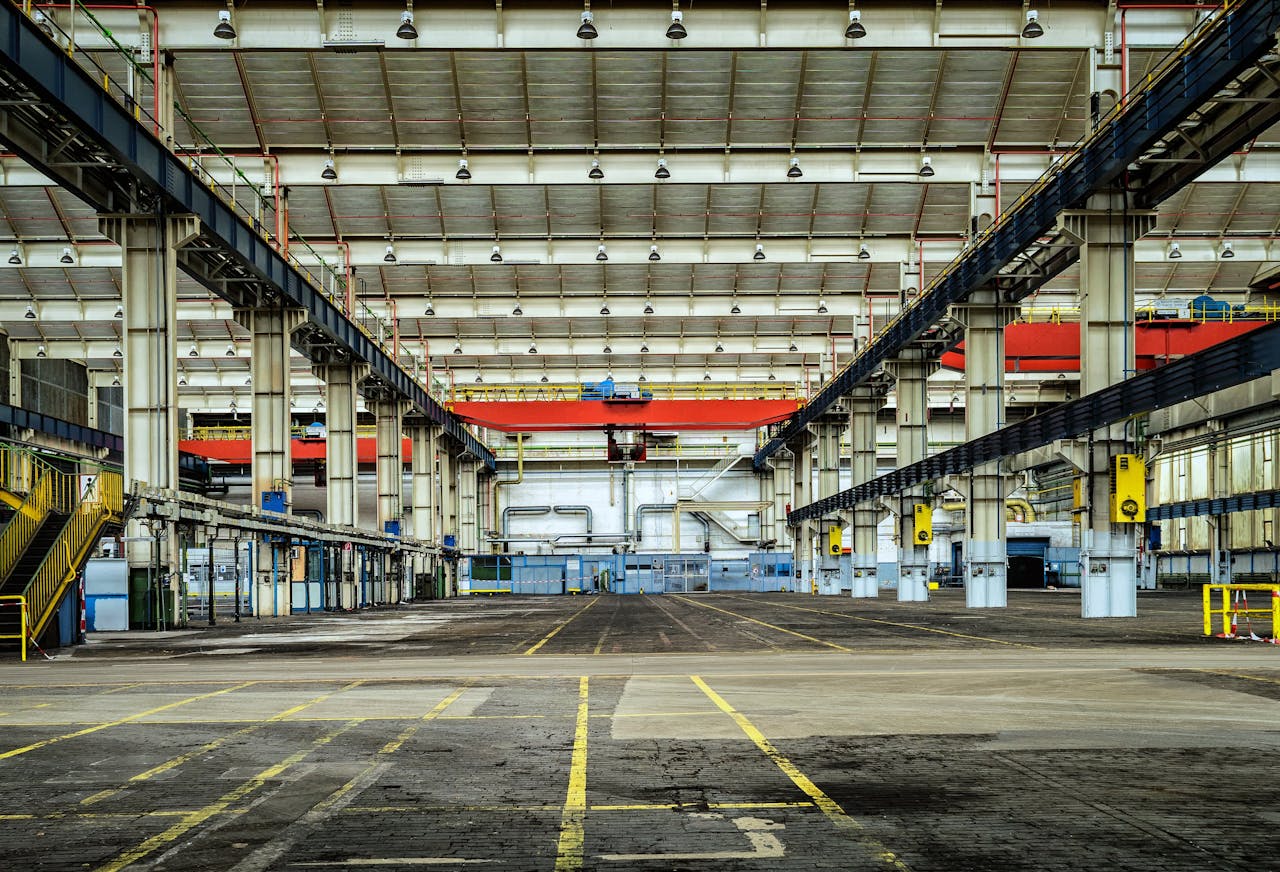
1. You sit for your interview at a cubicle inside a large warehouse. Your interviewer says you’d be a risky hire, as he’s looking to bring someone on with more relevant experience. However he’s open to hearing how your work recycling cheap clothing back to citizens of the Global South, working security at a sticky concert hall, and teaching English in Japan all add up to an aptitude for quality control. That is, managing spreadsheets and having a keen eye for faulty product. You add that your liberal arts degree makes you malleable. Your interviewer shares he said the same thing when he was in your shoes ten years ago. You’re not sure if he’s trying to be relatable or calling you on your bullshit or both. He asks what you think of the assembly lines and the vast inventory bay where two-story shelving looms like giants? A painful fluorescence is already beginning to irritate your eyes, and the noise of the warehouse is a cavernous clunky whir of machine forklifts, tape guns, and keyboard chatter.
You lie and tell him you don’t have a problem with any of it because you’re ready for your first “real” job that’ll show family and friends you’re finally getting on with your life and not failing. No, you don’t want to believe you’ve wasted your advantages in life as you are suburban-raised with a paid-for college education from mom and dad. Had everything you needed provided for you and everything you wanted (within reason) given to you. Everything but the job as a stock-trader on the East Coast or the promising start-up out West. You imagine yourself in one of these jobs—regularly wearing a button-up and tie, leaning back in your office chair while you “kick around ideas” with your colleagues. You even throw a contemplative pen in your mouth for good measure. These are the jobs you see or think you see on the LinkedIn profiles of high school and college classmates who didn’t suffocate their potential on flipping burgers, on-call snow removal, and valeting gigs for the local rich and famous.
2. Your interviewer calls to tell you the more qualified candidate fell through and are you still interested in the position as a temp-to-hire? He reminds you that your lack of experience makes you a potential liability, and he’d really be taking a gamble on you as he’d also be your direct supervisor. You don’t take this as a warning sign. Rather, you accept the position with a generous pay cut because the work will give you valuable professional experience. You convince yourself everyone’s got to start somewhere.
3. The company you work for coordinates manufacturing of imprinted merchandise for U.S.-based clients. They coordinate between those factories that spit out the raw product (almost always overseas) and the imprinters (either located in-house at those very same factories or just down the street). You know all this because the family’s business on your mother’s side was also in the business of ad specialties (though on a much smaller and more local scale). In this way, the new role in quality control makes you feel like you’re hearkening back to some kind of familial craft as you examine the product (promotional tumblers, shot glasses, and plates) for any dings, scratches, discolorings, or inconsistencies in the product’s logo (almost always a sports team).
You train underneath a guy who’s around 30. His life seems to be one of general unpredictability because he doesn’t have enough money to pay for the things he needs to make his life less unpredictable. Like having the money to replace an unreliable car battery. Despite this lack of funds, he acts as if he will just find another job if your mutual supervisor can’t give him a pass for the third, fourth, and fifth time his car refuses to start on his way to work. This attitude mystifies you because your life isn’t unstable and you’d still do everything necessary to keep the job. At least, this is what you tell yourself.
4. This same coworker tells you that when the time comes to replace him, he’ll get transferred to the more laid-back warehouse on the other side of town. When the time comes for this transfer, your mutual supervisor assigns you the job. You obtain a grim satisfaction taking what someone else wanted.
Inside the other warehouse the fluorescent bulbs don’t radiate as strong and hurt your eyes. Your new coworkers seem to smile more here, and the custodian with face tattoos even gives you a welcoming fist bump. Plus, there’s a community coffee pot. But it’s not perfect. The break area is an afterthought in the middle of the warehouse floor. Just a few folding tables and chairs all partitioned off by large yellow safety railings. A few feet away the warehouse inventory sits atop more two-story shelves—an ever-present reminder of the work that will be waiting for you after lunch.
5. You work mostly by yourself until a new guy joins your quality control team. L.T.’s around your age. But unlike you, he has a kid and is trying to sort out his relationship with his kid’s mother. You talk about comic books, movies, and relationships, and compare notes on your respective temp agencies. L.T. must punch in and out each day while you can submit your hours at the end of each workweek. Randomized drug tests no longer apply to you, whereas L.T. must give monthly urine samples to prove he’s walking the straight-and-narrow.
With L.T. around you don’t mind the work so much. The both of you pass the time with good conversation while you comb through boxes for faulty product as your kosher mother might inspect egg yolk for blood. It’s all fairly straightforward, and you believe you’ll have your first “real” job with a wage increase and benefits in no time.
6. The trouble starts with an inconsistent finish on tumblers that come in a glossy spectrum of ROYGBIV. Not one color is safe. Next, there are the degrees of discoloration in what’s supposed to be a university logo. And finally, there are the tumblers wrapped in a woody camo graphic that bleed blue neon like the operatic Diva Plavalaguna from The Fifth Element.
7. The number of unsaleable items is potentially in the thousands. However, instead of sending back the faulty product, the company decides to differentiate between the product that is good enough for throngs of unaware consumers at big box stores (like Walmart and Target), and which product must be near-perfect for small businesses with slimmer profit margins and higher need for customer loyalty.
For the erroneous camo tumblers this means divvying up the worst of the best product and the worst of the worst based on the location and hue of the bleed per your supervisor’s direction. But your supervisor makes exceptions according to his own rules as he picks up tumbler after tumbler and finds reasons to adjust his own standards. A feeling of dread comes over you as you realize the situation is outside even your supervisor’s grasp.
8. Faulty product comes in daily by the truckload. The company believes they can stay ahead of it by hiring more temps. Suddenly, a half-dozen new faces join your quality control team. Your supervisor tells you he wants you behind the computer sending emails and allocating data while L.T. acts as another pair of supervisory eyes with the overbearing title of “floor manager.” As temp workers yourselves, you and L.T. are told to train and subsequently report on the performance of the new temp workers working under you, making the whole thing feel like a kind of kapo responsibility.
These new temp workers are all on-call. This means a constant rotation of new and newer faces, which leads to consistency issues regarding which temps know how to properly inspect which products. You and L.T. spend more of your time retraining the new temps than you do on your actual assigned tasks.
9. After a month the company rents more warehouse bays to store the faulty inventory growing out of control like a tumor. In these bays there are no two-story shelves, just boxes stacked higher than you know is legally permissible. And so these bays become rooms of Jenga pieces with the capacity to crush human beings.
10. Your supervisor instructs you to set up a table with examples of faulty product because some folks from head office want to have a look at the issue for themselves.
11. The following day they arrive—this duo from head office. They walk into the warehouse royally unannounced as your supervisor nervously crab-scrambles around them. This attractive well-dressed duo makes you uneasy not because of their clothes or physical appearance or even your supervisor’s nervousness, but their deliberate forceful steps. It’s a way of moving that lets you know you’re experiencing something rare. How there are people who go years in a job—many an entire career—without ever seeing those making the boardroom power moves.
So, when this duo—these demigods of Production—meet you at your table of beverage containers, you feel both terrified and honored as if you’re being judged in a high-stakes science fair competition. Scholarships and internships and mentorships and any other – ships are all on the line. You black out during your sixty seconds of fame. When you come to, sweat’s pooled under your armpits and along your back. The demigods of Production thank you for your time, and your supervisor escorts them to his office to discuss strategy.
12. The strategy that comes out of that meeting is more of the same. Which means hiring more temp workers to try and keep up with the faulty product. This only exacerbates the problems of quality control consistency.
13. Your supervisor calls you into his office to tell you L.T. has been socializing with the newest temp workers too much. He says you need to reel L.T. in to remind him about the ever-fragile-state of his temp-to-hire employment. You hate confrontation, but your supervisor says you have to prove you have what it takes to be officially hired on. You wish you could tell your supervisor you won’t be his goddamn mouthpiece just because he’s squeamish with confrontation. But you must get away from the restaurant gigs and jobs hauling mulch in a Midwest summer heat. You need to get one step closer to that “real” office job with the self-important pen-in-your-mouth.
So, you pull L.T. to the side and tell him in your own awkward way what your supervisor was too scared to tell him. You get the sense from L.T.’s disappointed look that whatever trust and friendship you two built over the last four months, has now evaporated.
14. A few days later, L.T. terminates a slightly uncooperative temp and it feels like a sacrificial offering for transgressions in the eyes of the Almighty (your supervisor).
15. After five months you ask your supervisor about the potential to be hired on full-time. He tells you it’s not going to work out. For a moment, you think you don’t hear him right. You haven’t been meeting expectations, he tells you. And on top of this he says he needs to hold your hand with every task you do to ensure it’s seen through to the end.
A particular shame washes over you. It radiates in pinpricks around your shoulders and at the back of your head. It’s a feeling you first received when your third-grade teacher shamed you for going to the bathroom without a hall pass. And so you tunnel into your third-grade self and observe the world from behind your eyeballs. Your skull acts as a deep cave to hide away from the shame, and you only emerge once your supervisor shows you out of his office and says he would understand it if you chose not to stick around.
16. A few days later your replacement shows up. He has a degree in supply chain management and carries around a notepad. He asks about the ratios of faulty and salable inventory but also asks for the dimensions of the boxes themselves. Like grasping their size will allow this Korben Dallas to plug his fingers in enough bullet wounds to stop the Diva from bleeding out all over the opera hall. You ask L.T. what he thinks of your replacement. L.T. tells you the guy seems a little off. You and L.T. laugh over this and recollect when it was just the two of you talking comic books and relationships and movies, salvaging perhaps what you can of your friendship.
17. Later, you tell your former boss you’re ready to leave your current job because you need better hours and pay. You sound desperate, like you’ve just committed murder, but the guy doesn’t ask questions because he needs the help. So, you agree to a start date and guaranteed hours and your original wage. The last thing you do is leave a voicemail for your soon-to-be former supervisor. You thank him for the opportunity to work for the company. This is something you’ve been taught to say in order to not burn bridges even when the job has wounded your self-confidence to such a degree that working a deep fryer now seems outside your abilities.
18. You can see the trajectory that your life is heading in. You can see it because it’s already arrived in the stockrooms, landscaping trucks, and warehouses of your future. A future which holds in it only the unmet expectations of the American upper middle class.
ETHAN KLEIN (he/they) grew up in Milwaukee, Wisconsin, and earned his undergraduate degree at the University of Wisconsin – Milwaukee. He’s cobbled together work in the fields of hospitality, landscaping, social services, and education. He currently lives in Saskatoon, Saskatchewan, where he lives with his wife, dog, and two cats. He is currently an MFA candidate at the University of Saskatchewan.
