Before you continue reading this essay, try something mildly inconvenient: if you’re reading this on your phone, switch to your laptop. There’s a decent chance you won’t. You’ll probably glance at the length of this piece, instinctively return to Instagram, and continue watching someone reorganize their fridge in under thirty seconds while a sped-up voice explains “things I wish I knew at 25.”
That instinct—the inability to remain with one thing for longer than a few moments—is no longer just a personal habit. It’s cultural infrastructure.
The smartphone has quietly become the primary interface through which we experience modern life. Relationships, news, fashion, politics, boredom, identity, desire—almost everything now arrives mediated through the same six-inch screen. We don’t simply use our phones anymore; we organize our lives around them. They sit beside us while we eat, sleep, commute, work, date, grieve, and rest, flattening every emotion and experience into the same physical gesture: scroll, tap, refresh.
And somewhere along the way, being constantly reachable started to feel indistinguishable from being alive.
A few weeks ago, in the middle of a very ordinary coffee with friends—ordinary in the sense that everyone was there but also not entirely there—I noticed something familiar. None of us were continuously on our phones, but all of us drifted toward them instinctively in tiny intervals. During pauses in conversation. While waiting for drinks. In the two-second silence after someone finished speaking. Conversations were happening, but so was everything else.
At some point, I reached for my own phone and wondered what would happen if it simply wasn’t capable of offering me anything beyond the present moment.
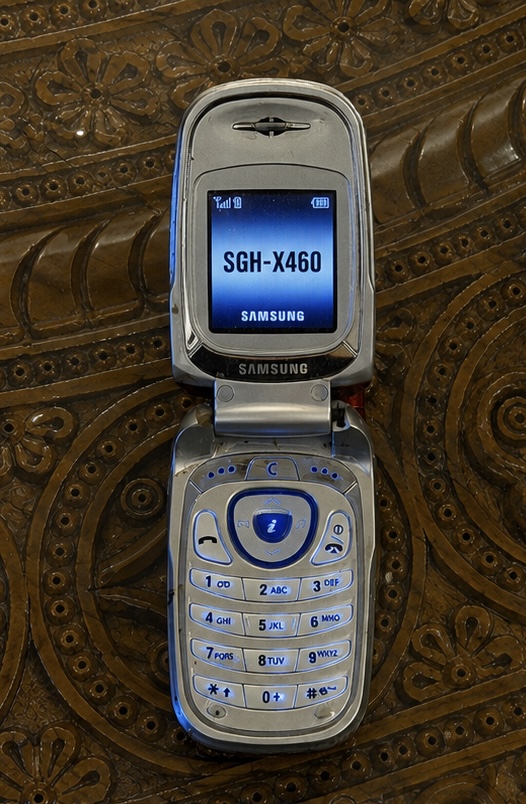
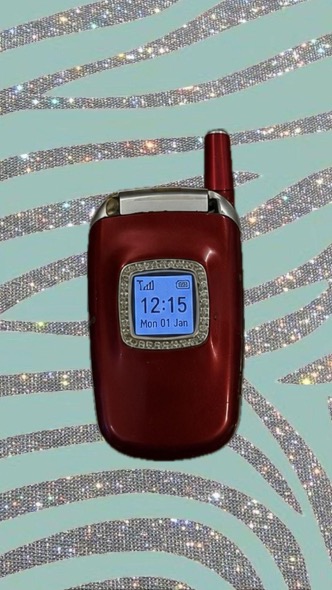
A few days later, I switched my iPhone for my mother’s 2004-born, old, pink Samsung SGH-X460.
The flip phone itself felt strangely symbolic. Not just because it was old, but because it belonged to a version of technology that still allowed for separation. Back then, phones were functional objects. You called people. You texted carefully because every message cost money. You snapped the phone shut after conversations with cinematic finality. There were limits. You logged onto the internet rather than living inside it.
Now, the idea of being unreachable for even an hour feels vaguely irresponsible.
The Razr could call people and send texts. That was mostly it. I still used WhatsApp and social media for work but only on my laptop. And that small distinction turned out to matter more than I expected.
The first few days were awkward in a way that’s difficult to romanticize. I kept reaching for my phone during all the usual in-between moments: lifts, queues, short pauses in conversations, walking from one room to another. Each time, there was nothing waiting for me. No feed to refresh. No notifications. No low-level stimulation to smooth over the discomfort of existing uninterrupted.
It made me realize how much of modern phone use has very little to do with communication and almost everything to do with avoidance. We reach for our phones not because something is happening, but because nothing is.
Without it, those empty spaces in the day didn’t disappear. They simply stayed there.
And slowly, they became easier to sit through.
Around the same time, the internet itself began to feel different. Scrolling on a laptop is entirely possible, but it lacks the seamless intimacy of a smartphone. You have to open the screen, sit down properly, and engage more deliberately. You don’t dissolve into it as easily. The friction changes the experience.
Which, increasingly, feels like the point.
So much of modern technology is built around eliminating friction altogether. Infinite scroll, autoplay, push notifications, algorithmic feeds—every platform is designed to remove the tiny pauses that might otherwise allow you to stop. The attention economy depends on continuity. It depends on making disengagement feel harder than staying.
Which is why inconvenience now feels almost radical.
This partly explains why analog culture has returned with such force in recent years. Gen Z has revived digital cameras, wired headphones, vinyl records, and flip phones with almost anthropological fascination. Entire aesthetics now revolve around slowness: underconsumption core, offline weekends, “dumb phones,” handwritten journaling, grainy flash photography. Even luxury has begun romanticizing disconnection. Quiet hotels market poor signal strength like an amenity. Restaurants encourage phone-free dining. Wellness culture increasingly sells what technology has eroded: attention, stillness, uninterrupted presence.
Somewhere in the middle of this experiment, I remembered a line I once came across online—ironically while scrolling—that whoever invents a real cure for doomscrolling will probably become a millionaire.
What this month made me realize is that the “cure” may be far less sophisticated than we imagine. It may simply require a little resistance. A little inconvenience. Just enough friction to interrupt the reflex.
Because the problem is not entirely individual. We often talk about excessive screen time as though it reflects a personal failure of discipline, but most platforms are engineered specifically to override self-regulation. The infinite feed is not a neutral design. It is architecture built around compulsion.
And yet, despite knowing this collectively, most of us continue participating anyway. We read essays about attention spans while half-watching TikToks. We send articles about digital burnout to each other through the very apps exhausting us. Awareness alone changes very little when the culture itself rewards constant accessibility.
By the end of the month, the experiment no longer felt like something I was actively doing. It felt more like I had briefly stepped outside the pace of contemporary life and returned.
Not dramatically. Quietly.
In the same way a good holiday changes you—not because your life transforms, but because your relationship to time briefly does. You begin noticing things you normally move past. You sit longer. You look up more. Silence stops feeling inefficient.
And then you come back.
Same routines, same city, same people. But something feels slightly misaligned in a way that’s difficult to unsee. The urgency softens. The impulse to fill every pause weakens. You notice how quickly everyone reaches for their phones the second a conversation dips below stimulation.
Including yourself.
I came back to my smartphone eventually, of course. That was always going to happen. The point was never permanent escape. Most of modern life now requires digital participation in some form, particularly if you work online. Stepping away completely is increasingly a privilege reserved for people whose jobs, finances, and social lives allow for disconnection.
But the month did leave me with one unsettling thought: perhaps what we describe as “presence” today is simply the absence of interruption.
And maybe that’s why the flip phone felt so unexpectedly emotional. Not because it transported me back to the 2000s, but because it briefly reminded me what attention used to feel like before it became our most contested resource.
The phone itself was never really the point. It was the silence around it.
PALAK GODARA is a fashion journalist and writer with a deep affection for magazines—especially glossy ones. A graduate of Parsons School of Design in New York City, she spent her student years writing opinion essays for Public Seminar, reviewing books in collaboration with Catapult Books, covering fashion trends for Photobook Magazine, and contributing to Parsons’ weekly digests. When she wasn’t relishing a Pret Pesto Caprese Baguette or walking 20,000 steps around the city, she was usually writing, rewriting, editing, or proofreading.
Today, Palak writes for British Vogue, Vogue India, and Vogue Australia, where she covers weddings and the worlds that orbit them—from beauty and fashion to culture, travel, and design.
Her Instagram is _palakgodara.
