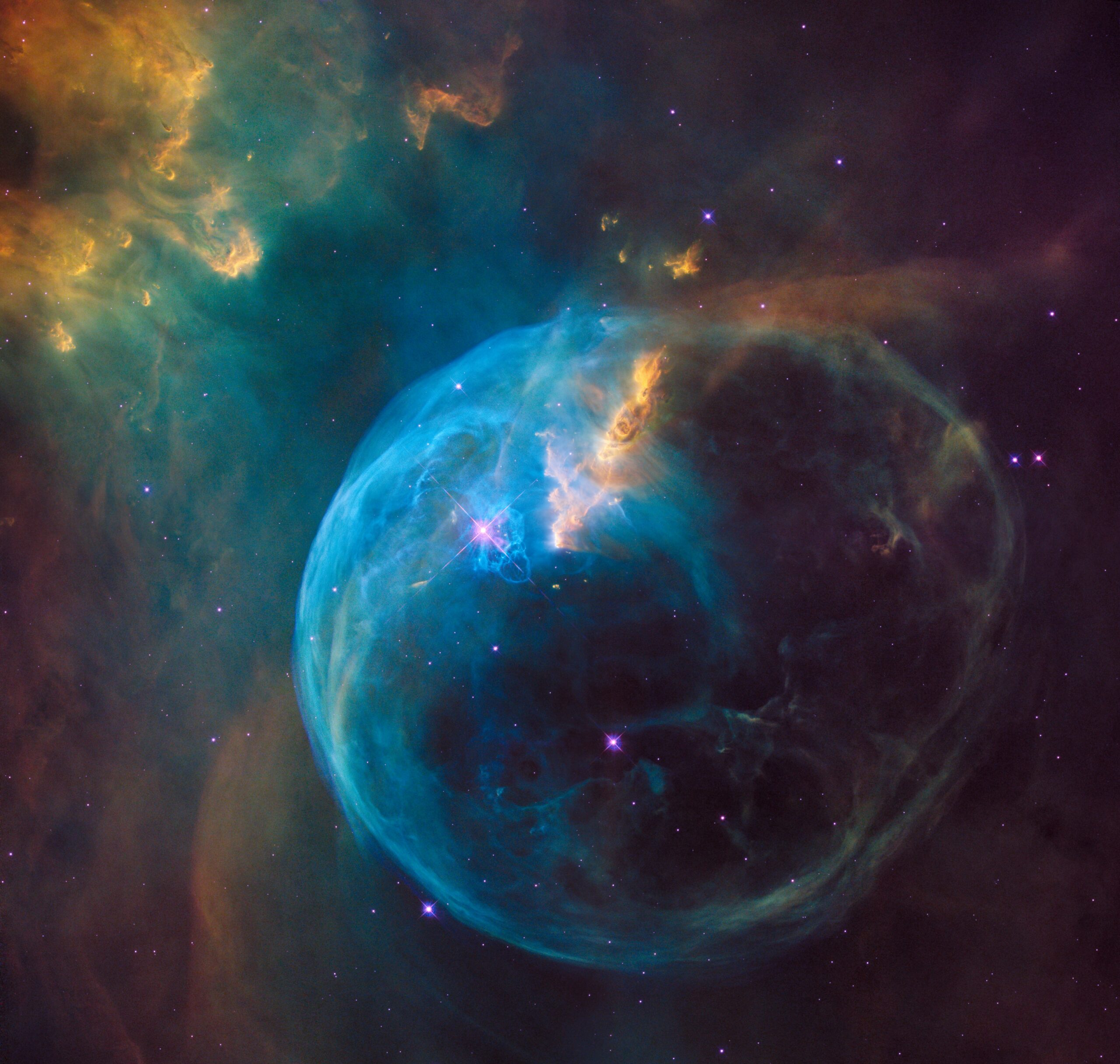
“Commander Mason, Commander Roland, you’re all clear. Welcome to the purple planet.”
Blaise Mason saw the first of the planet’s namesake as the purple dust began to settle. It was beyond her imagination.
The wormhole was functioning. Aliens were real. Valkisba was real. And she was one of the only human beings in history who would ever know this. Roland’s excitement wore off quicker than Mason’s. He seemed frustrated at their first steps on the sandy, purple terrain, their heavy boots sinking and dragging.
“You never get used to it,” Commander Roland said.
While this was Mason’s first trip to Valkisba, this was Roland’s eighth. She had tried asking him about what it was like traveling through a wormhole so many times while they were still back on Earth, and he had told her the same thing. You never get used to it.
They reached the facility as the sun just began to set. While Mason had heard countless times about the beauty of the sunsets here, nothing could have prepared her for the state of breathlessness it left her in. The sky was a dazzling lime green, and the planet had two moons, huge moons, the biggest she had ever seen. The stars were various shades of tangy orange and white, twinkling brighter than anything she’d seen from Earth.
“You haven’t seen anything yet,” Roland said, watching her take it all in.
The doors slid open with Roland’s fingerprints, and one of the Valkisban greeted them. Mason stood in awe for a moment at the sight of it. This creature was at least eight feet tall, its wingspan even larger. Its skin was iridescent, an impossible reflection of light, like the coating on a beetle shell. She looked at its face, with its large black eyes, and saw what she could only assume was a smile. It had at least three hundred black teeth.
“Welcome to the Propagation Center.”
The Valkisban’s voice was deep and had a natural echo. It reached out its long fingers to her in greeting, but Mason hesitated. Her caution was reflective, but she knew she was being impolite, so Mason swallowed back her shock and began shaking its cool, smooth hand. She tried hard not to show how bewildered she was at the length of its limbs, the feel of its claws in her hand.
“I am Altilnus. Do not be afraid of me,” it said. Mason would try her best. Carl Roland did not look the least bit fazed, and she wanted to make a strong impression.
“Al runs the place,” Roland said, breaking the silence before it got any more awkward. “Without him, we’d be nothing.”
“It’s nice to meet you, Altilnus. I’m Commander Mason. This is an impressive facility.”
The facility was massive, with endless doors and hallways. Each new section required clearance and Roland or Al’s fingerprints. It felt a bit excessive.
“Don’t worry,” Roland said. “After some work is done, we’ll put your prints in the system. You’ll be able to open these doors no problem.” Mason was delighted to hear this. It meant they would want her to come back.
Finally, after what felt like ten minutes of a maze, they reached the Containment Unit, where Mason’s first assignment was to take place. There were rows of hospital beds with at least a dozen unconscious Valkisbans. Their swollen bellies were being monitored with a large green scanner. Their limbs were hooked up to various tubes and IVs. The sight sent a chill down Mason’s spine.
“It will be a bountiful harvest,” Altilnus said. “The eclipse took place three days ago.”
Reproduction was asexual on Valkisba. And Valkisbans capable of breeding were rare, with only one in every ten females being fertile. On top of that, reproduction only happened during mutual occultation. This was when one of their moons blocked the other. Only four of these eclipses took place per year, and each marked the beginning of a new season. Valkisba was currently in winter, though the temperature was seventy-three degrees.
“You hungry for some eggs, Mason?” Roland said with a laugh. Mason thought she heard Altilnus join in, though she had never heard a laugh like his before.
Mason approached the Valkisban in the bed closest to the door. Her name, according to her file, was Xelulus. Beside her bed was a screen showing her vitals. And under that, the number eighty-two glowed on a screen, which was the number of viable embryos in her womb. Mason’s gloved hands holding a petri dish and needle had been shaking slightly.
“What are you worried about?” asked Roland.
“Are you sure they’re not gonna…wake up?” Mason asked sheepishly.
“They’ve got enough ketamine in them to kill about ten of us. And even if they did somehow, they evolved without any natural predators. They are genetically predisposed not to hurt us,” Roland said.
“The talons say otherwise,” Mason replied while gently touching Xelulus’s weightless hand.
“Claws for digging, Commander Mason,” Altilnus said with that big black smile again. “And for walking in the purple sand. Ten years Earthlings visit, and no one leaves hurt.”
Mason nodded her head, slightly disbelieving, but trusting Roland enough to steady her hands. Finally, she got her needle ready and, with total concentration, aligned and plunged it into the ovary of the beast. With her eyes on the ultrasound, she could see precisely where the eggs were located and, with great attention, suctioned one into the needle. The process took her five minutes. She sighed in relief as she looked at the purple embryo, bouncing around the petri dish.
The screen flickered, and the number changed.
Eighty-one viable embryos.
“Nice work,” Roland said, “eighty-one to go.”
Mason began to work faster as she got the hang of it. She finished up her second female while Roland was on his fourth, and Altilnus was on his sixth.
“Mason, check this out,” Roland called. She walked over to the last bed in the room, where he and Altilnus crowded around a display. “What’s that number say?”
Mason almost could not believe it. 208?
“That’s gotta be a record,” she breathed.
“This one,” Roland said, rubbing the limp arm of the Valkisban sprawled before him, “she’s our key supplier.”
“Commander Mason, this is Venarketa. She has provided over thirty percent of the Earth samples alone,” Altilnus said with pride.
“But…how is that possible?” Mason asked. “I thought the last one to have more than 175 eggs didn’t survive the eclipse. And that’s not even counting the viable ones.”
Roland gave her a toothy grin.
“We made it possible,” he said, motioning at the various IVs Venarketa was hooked up to.
For a moment, Mason felt immense pity for the creature. Its engorged belly looked painful and unnatural.
What if you weren’t supposed to?
They almost did not notice Venarketa behind them, rising from bed. And it seemed she did not stop rising. Mason’s face fell as she caught sight of the thing’s impossibly huge stature, its head nearly at the ceiling. Her face went pale, prompting Roland to turn around. He had never been around it while it was awake before; he had never seen it upright.
“Okay, Venarketa.” Roland approached slowly and had the same anxious edge in his voice as a zookeeper. “Just lie back down, we’ll get you some medicine and—”
Roland was cut off by a sharp sensation in his chest.
From where Mason stood, she could not tell what happened until Roland collapsed backward, and she saw what once was Venarketa’s IV plunged deep in his aorta. He was gone.
Enough ketamine to kill ten of us.
Mason gasped at the sight and rushed to the door. Access denied. She attempted to pry them open. It was no use; she needed clearance to exit the room.
“AL!” she yelled. “OPEN THE DOOR!”
Altilnus began frantically in her direction. He was quick, but Venarketa was quicker. Jumping, she landed directly behind Altilnus. With how she towered, Venarketa almost made him look short.
It happened in an instant—all four of her long claws were driven through Al’s head, entering at the back and bursting out through his face. His huge, bulging eyes dangled from their sockets. He crumpled to the floor. His blood pooled from his mangled face in a never-ending stream of violet. Venarketa grabbed him by his flaccid wrist and dragged him to the door where Mason stood, putrid purple trailing behind.
Mason, holding only her needle in her shaking, outstretched hand, began waving it around as if it were a weapon.
Venarketa disarmed her with one barely firm swat, and the needle flew across the room. Then she held Al’s thumb up to the scanner on the door.
Permission granted.
The massive doors retracted behind Mason, which knocked her backwards. Venarketa breathed over her; their faces were inches apart.
“Please, don’t kill me! I beg of you!” Mason pleaded.
“You work with Carl Roland?” She snarled. Mason could not tell if this was a question or an accusation. All she could do was beg for her life in broken, sputtering pleas.
This seemed to frustrate the beast even more. Venarketa’s long claws were threatening her throat. She was blinded with fear, blood vibrating in her skull. She could feel Venarketa’s hulking, protruding belly crushing into her ribs. Her voice was caught behind stiff vocal cords. She opened her mouth to speak, and for a moment, all that came out were hiccups.
“They’re… on…Earth!” Mason managed.
Venarketa, for a moment, seemed thrown off.
“Your children…” Mason clarified. “They’re on Earth. Don’t you want to see them?”
“Where is Earth?” the beast asked.
Mason was stunned that this was working.
“I can take you. I swear, I’ll take you to them. Just please don’t hurt me—”
And with that, Venarketa dragged Mason with one hand, and a long-gone Altilnus with the other through each hallway, using Al’s dead hand to unlock every door.
They somehow made it to the shuttle in one piece.
Venarketa lumbered through the shuttle interior, knocking things over, pressing buttons inadvertently, letting out crazed and awful cries. The creature was in pain.
“Please,” the commander shouted, desperation bubbling under words. “If you break anything, we will be trapped here for millennia.”
It felt dangerous to speak at all, but none of this would matter if they couldn’t make it to the wormhole.
“We will BOTH DIE! Please stop moving!”
Venarketa finally slumped to the ground, allowing Mason to power up the engine uninterrupted. When Capcom began speaking, she shut off the radio. It was no use plotting a discreet SOS; she could only hope that mission control would take her silence as a distress signal and have defense ready on the ground. And then she thought of all the unsuspecting people awaiting her return: her family, the press, her bosses, the infected…
What will Venarketa do to them? Will she kill them just as she killed Altilnus and Commander Roland?
Commander Roland.
How would she explain this to his family?
Her thoughts began to race, tears squeezed from her eyes, and that lump in her throat returned. Her hands were trembling now. Was she dooming all of humanity by bringing this beast back with her? What choice did she have?
Venarketa let out a horrible screech. When Mason looked over, she saw the beast doubled over, clutching her distended belly, spewing vomit, and heaving. Venarketa and Mason’s eyes met briefly.
“Fly,” it growled at her.
And they did, the G-force nailing both of them to the spot so hard it almost felt like they would fall straight through the floor.
Blaise Mason had never been in space by herself. The thought of it kept her up at night, even woke her up in a sweating panic. But she never wished to be alone more than in this moment.
Venarketa, in between clutching her stomach and roaring in pain, looked out the window at the view of Valkisba getting smaller and smaller. Something was happening inside her body, this much she knew. She could feel her stomach growing. She could feel everything alive in it getting stronger, moving faster. Twenty minutes of mutually terrified silence finally broke.
“How long?” Venarketa’s voice was not angry, not snarling. It was something different.
Commander Mason let out a shuddering breath.
“Thirty-six hours.”
Mason was no Valkisban expert, but she knew the look on Venarketa’s face because it matched her own—terror.
Of course, she thought to herself, Venarketa will not survive these thirty-six hours. She almost sighed in relief. Even if, under normal circumstances, the monster would somehow live, nothing in her condition will survive the wormhole. The wormhole.
Eight hours into the journey, the black hole was in sight. Venarketa was proving herself a less and less viable host to her 208 eggs, immobile and half dead, floating around the tin can. This was it. Time to suit up.
Lead vest first, then step into your radiation suit, then come the boots, then the coveralls, then the respirator, the mask, and the gloves. “Wormwear,” Roland had called it. It was not comfortable, but still preferable to imploding.
The wormhole entry point was marked on a map with precision, but Blaise had never pulled something like this off. She wished Roland were here; he knew this wormhole like the back of his hand.
No point thinking that way now. All Mason could do was steady her hands, align the shuttle the best she could, and say her prayers. The giant white vortex was in view. Either they made it together, Mason made it alone, or death came too quickly to process.
She looked at her watch. 8:07 pm. She closed her eyes, but behind her eyelids she could tell that the vortex was getting brighter, and brighter, and brighter, and then…
A tight, squeezing feeling wrapped around her head, her arms, her chest. Everything tingled, from the top of her head to the tip of her toes. The light subsided to pitch black. She stopped hearing the sound of the engines, the beeps of the consoles. She stopped hearing anything.
They were in.
Mason opened her eyes, with great effort. Through her heavy lead gloves, she touched herself for confirmation that she was real. Outside, she saw stars, bent and warped as if they’re frozen, as if everything was frozen except for her. Despite her weightlessness, something felt heavy on her. She could almost fall asleep.
And then the lights came back on. The hum of the engine returned, the beep of the consoles. Her limbs, though feeling slightly out of sync, stopped tingling. She checked her watch. It was the next day.
They were out.
The astronaut felt a mix of relief, peace, and stillness, all bottled up and shaken into a martini glass. But the harmony subsided as she heard the unmistakable sound of rasping, labored breath from behind her.
“Are you alive?” Mason asked, crestfallen.
“How long?” it replied weakly.
“Eight hours to Earth,” the commander replied, removing her wormwear.
Venarketa’s purple blood pooled from her mouth, nose, and genitalia, floating around her in the weightlessness of space. She almost looked like an angel, in a purple cloud of smoke.
“What have they done to me?” the alien asked.
“You’re dying, Venarketa. How many babies do you think you’re pregnant with?”
Venarketa thought for a moment.
“Twenty,” she said. “More is not possible.”
Guilt washed over Mason, extinguishing whatever peace she felt from the post-wormhole glow. She was no longer relieved to see this creature suffering.
“200. More, even.”
“Not possible.”
“They pumped you with hormones. Metabolic enhancers. Steroids that would push your reproductive system way past its limits. They transferred these embryos in bulk, knowing it would overload your system, and every single one was implanted. Not a single one was rejected. Because this is what they made you into. What they are making all of you into.”
There was a pause.
“Why?” Venarketa finally asked
“We needed a cure,” she stuttered. “Earth was sick. Atmospheric prions. Our brains were collapsing on themselves. 81% of us were infected, soon all of us would be, and there was no way to stop it. It takes years to kill you. And you never know when it’s going to take hold. It was an apocalypse. All hope was lost. And then we found you. Your embryos—they’re our cure. You gave us back hope. You gave us life. I need you to know that.”
“You take our life,” Venarketa said weakly.
Mason shook her head.
“I can save you,” she said. “Let me save you.” She placed a hand on Venarketa’s belly.
“Take them,” Venarketa relented, “but I will not sleep.”
Mason nodded.
She will only have a couple of hours to do this. Venarketa’s number glows “192.” A few have already been lost. Mason held the needle steady, aligned it.
“Breathe. This is going to sting.”
Venarketa took a deep, sharp breath and then let out a wild bellow of pain. The screen flickered.
191 viable embryos.
AMY YAISH: I am a writer based in New York. I am greatly influenced by the “normal people” interactions I encounter/come across in this city. My most influential writer would have to be Chekhov, who captures the tension and contradictions of human behavior in a way that continues to shape my writing. Most of the time, my work explores the depths and layers of womanhood, and all the plights and casual bloodshed that accompany it. And when I am not writing, I am reading, or working, or at home, spending time with my cats. This publication marks my first!
