Leaving the Cusp
In a grotto of debdaru trees, Father sits with novitiates, boys slightly older than us but still in their teens. These are the sprawling grounds of a seventeenth century church on the banks of the Hooghly River near Kolkata. Father, a stern Romanian in his thirties, speaks fluent Bengali and is perpetually in his cassock. Caught unawares by our approaching gaggle, the boys are bashful. They eye us warily but turn their attention immediately back to what the priest is telling them. We can’t really hear him from where we are, but he is discussing something religious, we imagine. We are provincial, impressionable, if not a bit cocky. We hang around, sitting on bench at a distance until Father departs. We dare the prettiest amongst us to go and address the group of boys. Stupendously, she does so, but the boys aren’t coy anymore. They consider her with what seems to be practiced detachment. The girl returns without a sense of having conquered anything.
It is the last day of Leadership camp and the last months before we leave school. We traveled here with our school’s Mother Superior and are staying inside the abbey for three nights. For several of us, this is the first time away from home, and Mother watches us with a hawk eye. We sleep in a dorm on the third floor, where the wild river breeze keeps us awake at night. In the morning, Mother admonishes us for whisper-chatting, but this togetherness is too delicious, and we can’t help ourselves.
The monks live in a nearby annex. Men and women do not mingle freely except at breakfast, when senior nuns and priests engage in a solemn ceremony of consuming fruit and porridge from a massive wooden turntable. Our days are filled with singing hymns and receiving lessons from the nuns, but Father is the driving force of the camp. He engages us in tasks that will teach us to become effective leaders. Unlike at home, we make our beds, do dishes, and help take turns serving food in the great dining hall. “Service unto others,” we mutter under our breath and stifle giggles.
On the last day, we are given some leeway. After the unsuccessful attempt at ensnaring novice priests, we seek the next best thing—permission to go for a walk along the riverside promenade. At sundown, two young nuns accompany us as chaperons. In the distance, a sailboat with square sails glints in the sun. One of the nuns, bespectacled and serious, asks us to imagine the ship that brought the Portuguese to these shores to set up this church at the turn of the seventeenth century. The enormous ship with its many sails perhaps arrived on an afternoon like this.
The promenade is deserted, and the church is cast in sharp relief against a mauve sky. A crescent moon begins to make an appearance over a neem tree. The wind carries towards us the faint smell of ghee and burning flesh, from which, strangely, we don’t recoil. Someone’s life has just ended. On the far side of the river, smoke wisps from a pyre at a cremation ground. Muezzin calls sound from a faraway mosque.
In the grotto, Father strums a guitar. No cassock. No students. His head is bowed, eyes closed. Tears well from unknown quarters of our hearts. The lumps in our throats we recognize as the passage out of girlhood.
SAYANTANI ROY grew up in small-town India and writes from the Seattle area. Her work appears or is forthcoming in Alan Squire Publishing Bulletin, Emerge Literary Journal, MacQueen’s Quinterly, TIMBER, West Trestle Review, and elsewhere. She was a 2024 fiction mentee in the AWP Writer to Writer Mentorship program. Say hello on Instagram @sayan_tani_r.
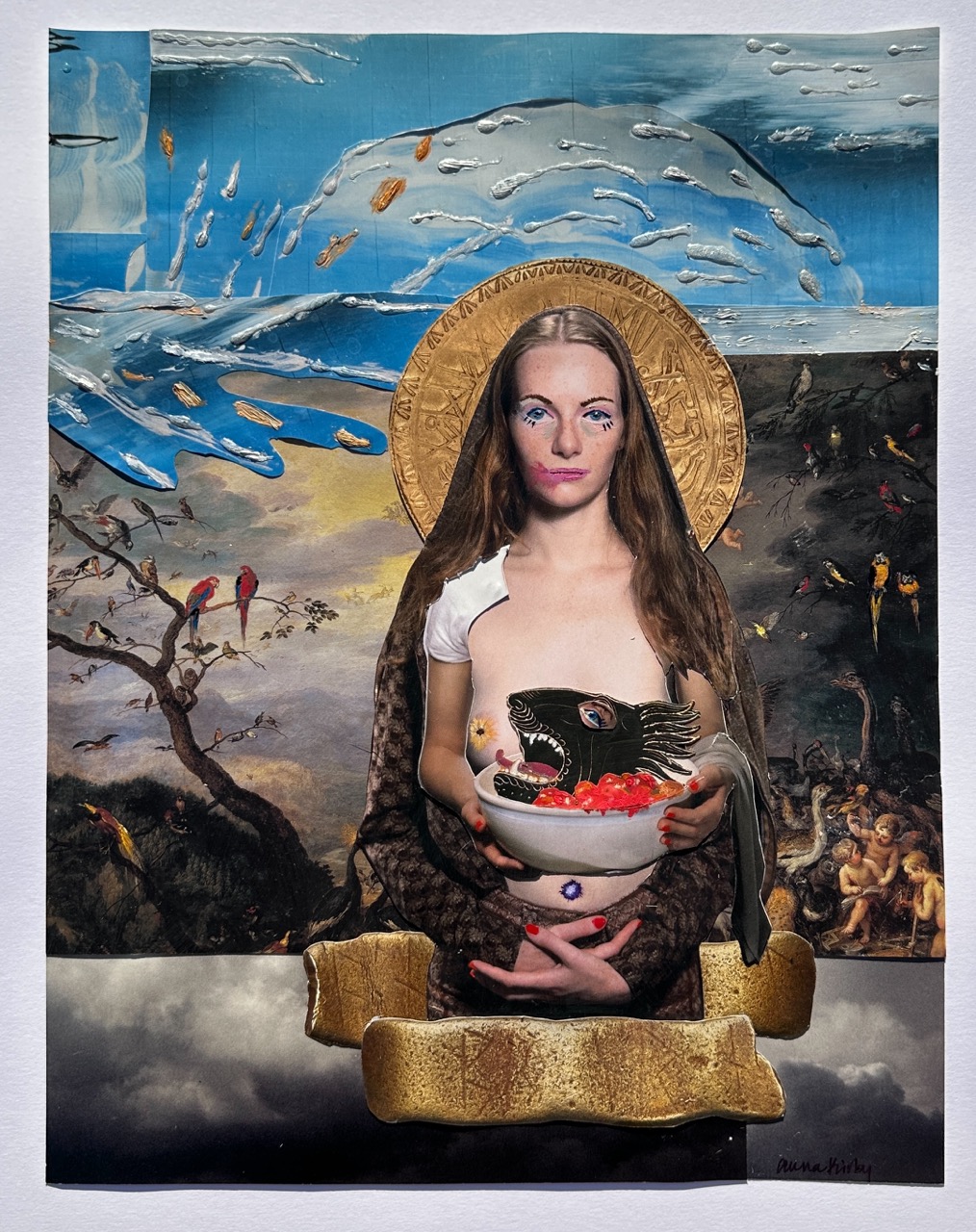
ANNA KIRBY is a community college English instructor living in North Carolina, USA. Her collages have been selected for juried exhibitions across the country.
