I’ve known too many disasters to trust the world like they do. The boys doing traditionally boy things.
In 1975, a girl on the stairwell in middle school stopped to say I act like a girl sometimes, a boy at other times. I never had the comfort of a closet. My masculine and femme get into these fights I don’t even know are going on, and she slips out in the fray. The girl was honestly confused. It was all over her face. I was embarrassed. Speechless. My femme has always had problems staying in the back.
I’ve seen queens for sale on midnight corners, feigning relief from the burden of gender in some stranger’s arms. Their gestures and makeup, caricatures of women. I saw no safety in that drag. I searched for peace in bisexual gods like the Ewu-Fon’s Mawu-Lisa, both male and female. Over time, I came to know this wasn’t enough. Either one or the other side of me would struggle for dominance. I needed both, side by side, working together. I didn’t know what that looked like so I suppressed femme to survive, or tried to suppress it.
Then, I stumbled upon the Yoruba trickster Eshu, or he found me. The trickster, sometimes carved as a pair, distinctly male and female, with umbilical cords of cowrie shells between them. Always seeking balance, he doesn’t like arrogance or extremes. Eshu is about balancing the masculine and feminine so that one does not overwhelm the other. Eshu teaches that one sex should not dominate the other, as in patriarchal culture, or the whole of society is thrown off balance. I’ve become his novitiate. I think of him balancing my two extremes so I don’t shatter into a wounded schizophrenia.
Eshu wears makeup, too. As the story goes, Eshu walks up a road between two competing farmers, wearing paint on his face—red on one side, black on the other. When farmers approach the road where he has just passed, one asks the other, “Who was that red man?” The other stares at him, thinking he’s a fool. “Red man? He was black!”
An argument becomes a fist fight then a village feud, with everyone choosing sides. A civil war ensues across the region as Eshu steals things from one house and leaves them in another, redistributing riches and resources, as he does when a nation tips away from its axis. Eshu is feared and called evil, but he’s only about harmony between people and gods.
I love the dastardliness of Eshu and makeup is powerful, but it’s never been my thing. I haven’t suffered gender confusion, and to me, wearing makeup seems like an effort to disentangle my manhood from the judgment of others.
I was stung by a bee once, leaving one eyelid a little darker than the other. I corrected a woman who thought I’d been sneaking into someone’s eye shadow. What a waste of a woman’s beauty, she must have thought, as we laughed away my embarrassment. I found it a divine compliment secreted in my head that always stuck with me, a boy with beautiful eyelids. I’ve always had flawless skin and long lashes, too. No mascara.
Oh, daughters of Jerusalem, do not hate me because the sun has looked down upon me.
At least the sun shone on my eyelids.
I got D’s in physical education. Basketball and football were a terror to me, being too physical and team sports. Coaches wanted me on the offensive line to protect the quarterback. Smaller boys wondered what was wrong with me. I had the size. That girl on the stairwell didn’t know from one day to another if I was a boy or girl. Even I didn’t know until years later. I went from a skinny kid in elementary school to a fat kid in middle school, trying to hide the femme behind my weight. Other boys stood in the mirror to exorcise their girl side with a ROTC uniform, stood gap-legged like gun slingers or grabbed their jock like the weight of their balls might spill out, played rough and tumble sports. They walked like boys with extra swag, in a hurry to manhood, anything to throw off sissiness.
I didn’t possess that same doubtless sense of masculinity. I could never be sure if I was boy enough or a girl in a boy’s body. It seems I’ve never been man enough.
My face was round as a girl’s and my voice was too soft for a boy’s, I was told. Because I easily sang the coloratura soprano range, I should be quiet until puberty ravaged my voice, I was told. I had too many femme ways. Once, a neighbor said I had loose hips, like a girl. “Somebody gon’ get ahold of him,” he said, implying rape.
Cousin Melissa used to look at me, her vision deteriorated by diabetes, and comment, “What’s he gonna be?” A quiet fell over the room every time. I ignored her. I held back a bitch of a cuss more times than I can count. Was it my fault my bacon drippings’ cornbread melted like butter in her mouth? Or that my pound cakes rose higher than my mother’s? I hated cousin Melissa, and when I think about her even now that she’s dead, I still hate her.
But I didn’t realize my power to reshape space, setting people to marvel at what I was. Eshu has struggled to get me to a place of comfort in balance — the war between male and female, all mine.
*****
Several years ago, in 2010, I adopted a son. We’ll call him Marcus. Some thought I should’ve adopted a girl, and said as much. I guess I would have ruined a boy’s stretch for manhood and was supposed to teach a girl how to be a woman with makeup tips and cooking lessons instead, the assumption being a gay man was somehow a default woman. I rejected that idea. I love women, but I’m not a woman, nor am I trying to imitate one.
Marcus’ high school was in the top 100 high schools in the country. My son hated my visits to the school, and I hated them as much as he did. He was in trouble often. From the time he entered middle school until he finished high school, every time I had to make a visit, masculine, femme, and Eshu tussled in me, and there was always a sense that I wasn’t stepping up to the plate as a Black father though nothing was ever said.
One time, walking into the school, femme threw a molly cocktail through the window of my mind. I was Aunt Jemima from the pancake box in a head wrap, ready for the brouhaha with a #10 skillet in hand to scrape a knot upside somebody’s head. I felt stout of breast and belly, like Gone with the Wind’s “Mammy” in a calico dress coming to kick ass if those white teachers gave me attitude.
I knew I embodied masculine and femme at war, but I tried to hide femme and butch up as much as I could. The trickster was too deeply embedded in me, and stubborn, to fake one way or the other, but I would wrestle with the point anyway. Jeans or khakis. Masculine t-shirts. Nothing with Minnie Mouse, no Wonder Woman’s “W” across my man breasts. Avoid tennis shoes, too relaxed. Button-downs and polos were more “professional.” And masculine. I didn’t want to embarrass him. But a same-gender loving dad? And femme? One puzzled little Asian girl who’d seen me there many times before commented to her friend, “He was more gay yesterday. What happened?”
So I’m sitting in a parent-teacher meeting in the proper uniform of masculinity, my legs gapped to give my big balls some breathing room … my calico draping the floor. The teacher was butch as hell and condescending, a white woman who beat my masculinity by a country mile. I wore locs to my shoulders. She had a graying buzz cut. I was the prettiest and the most handsome. It was hard being me—all of them, but only one man would be left standing.
Eshu coaxes you down off the arrogance of self-importance to get you to just be yourself. No roles set in concrete. No haughty titles. No comfort of indefinite pronouns, erased genders. Human (whatever that is) is a scratch recipe only Jemima or my mother could make on the fly. Eshu just wants me to be me, an exquisite balance of masculine and rogue femme, like a see-saw that never comes down on one side or the other. If I could only be the kid going “Weeeeeeee!” riding the gravity of its middle without a care.
*****
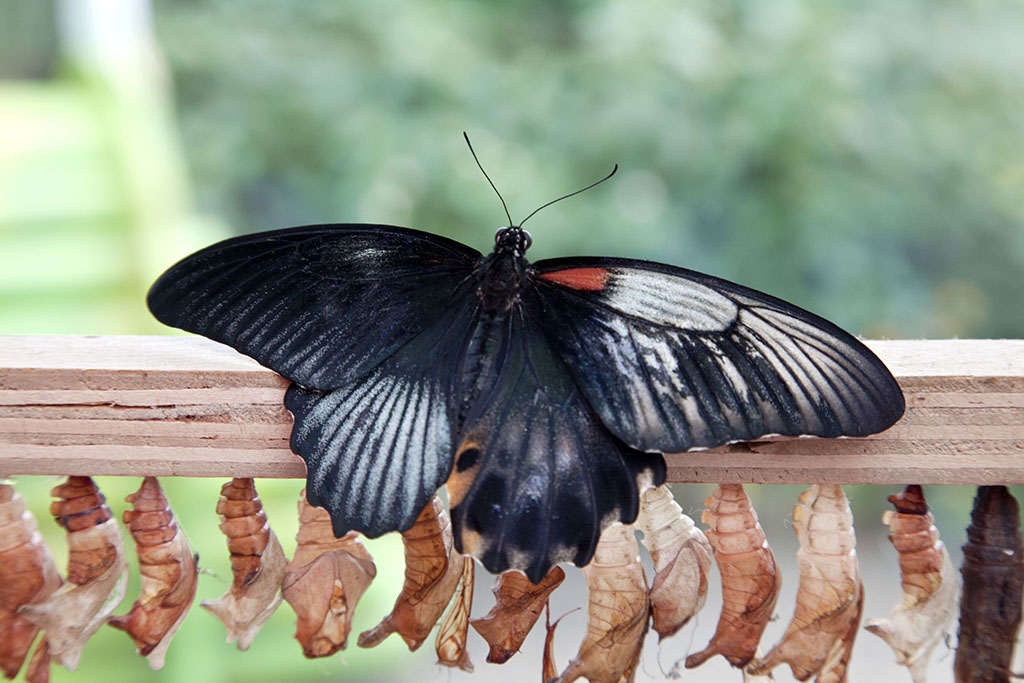
I keep a photo of a bilateral gynandromorph butterfly pinned to a collector’s board, a spectacle of an anomaly. Beautiful and dead, one side of wings male, the other female. I wonder, did other butterflies make fun of him … her … it … before we killed it? Many times, the world has tried to kill my spirit. Call me crazy, but I’m just too evil a committee of personalities to be pinned down without a fight.
Interacting with some in the Memphis City School system, often there was an overt disapproval for me and Marcus whose lingering behavioral issues had been assigned to me, and all the stereotypes of Black fatherhood. Some were bold enough to ask, “Where’s his mother?” I got no grace. I was somehow less than.
At home in Memphis, there had been questions within the family and outside about whether or not I, as a gay man, could raise a child. I was an experiment. There, I adopted a second son, Jonathan, the child of a white mother and Black father, thirteen years old. He brought issues around sexuality, influenced by others in his past, so I told him before the adoption that if my sexuality would be a problem for him, we could put an end to the process. He grappled with it but decided to accept who I am. I would be a Black daddy again, with a twist: Jonathan is biracial. Marcus, my first adopted son, is not. Jonathan had not been around Black people who had their own homes and cars, didn’t live in trailer parks with open sewage running outside the front door and didn’t go to sleep hearing gunfire at all hours of the night.
I may be different from the boy feeling there is a girl on the inside trying to get out, or the person transitioning from male to female. These are valid expressions, but often these are people who think there is some fortress against the pain of the world by eliminating certain words, and that puzzles me. I don’t believe there’s safety in juggling pronouns and there is no such thing as gender neutral. I’ve fought these wars and lost. Sticks and stones may break my bones but words will never hurt me is an old lie, but getting rid of words is a new hoodwink. The difference between me and this present generation, pushing pronouns and tossing gender out the back door, is Eshu. Who are their gods?
Now, years later, living away from home in Union City, Tennessee, I’ve arrived at my own ideas of manhood and fatherhood. There are still places that I try to avoid, like churches. There are too many queens and laity in church who hate themselves, and me for not buying into self-hatred. And barber shops. Their testosterone-driven conversations in rush mammy and the gunslinger to the microphone of my mouth to give a piece of our minds. The world is not a safe place. One person would kill another for stirring a war of desire and confusion around sexuality.
I’m parenting two sons the best I know how. I’ve lived my life with more authenticity than most. I never lied about my same-gender love. Of late, a new battle has been added to the femme-masculine war. My beard and hair are graying. I’ll only admit to being 21, a vanity agreed upon on both sides.
Over time, I’ve built a round table in my soul. There, Jemima, the gun slinger and his big balls, the trickster, a bilateral social butterfly who can’t be pinned down, the enunciating negro, and the femme and masculine of my personality can coexist peacefully. On occasion there are skirmishes, but fewer borders now between all the me’s. As long as I’ve known of his shenanigans, Eshu has been trying to teach me the end of this war. Finally, Mr. Pegues, one and all, is learning to be a content black and red child of Eshu.
CONRAD PEGUES is Assistant Professor, Public Services Librarian at the University of Tennessee at Martin. He has written to himself for more than 20 years, a practice in sanity, he says. Conrad holds an MFA from Lindenwood University. His collection of short stories, The Sweet’s Price for Edenville and Other Stories of Black Gay Males, is available at Amazon.
