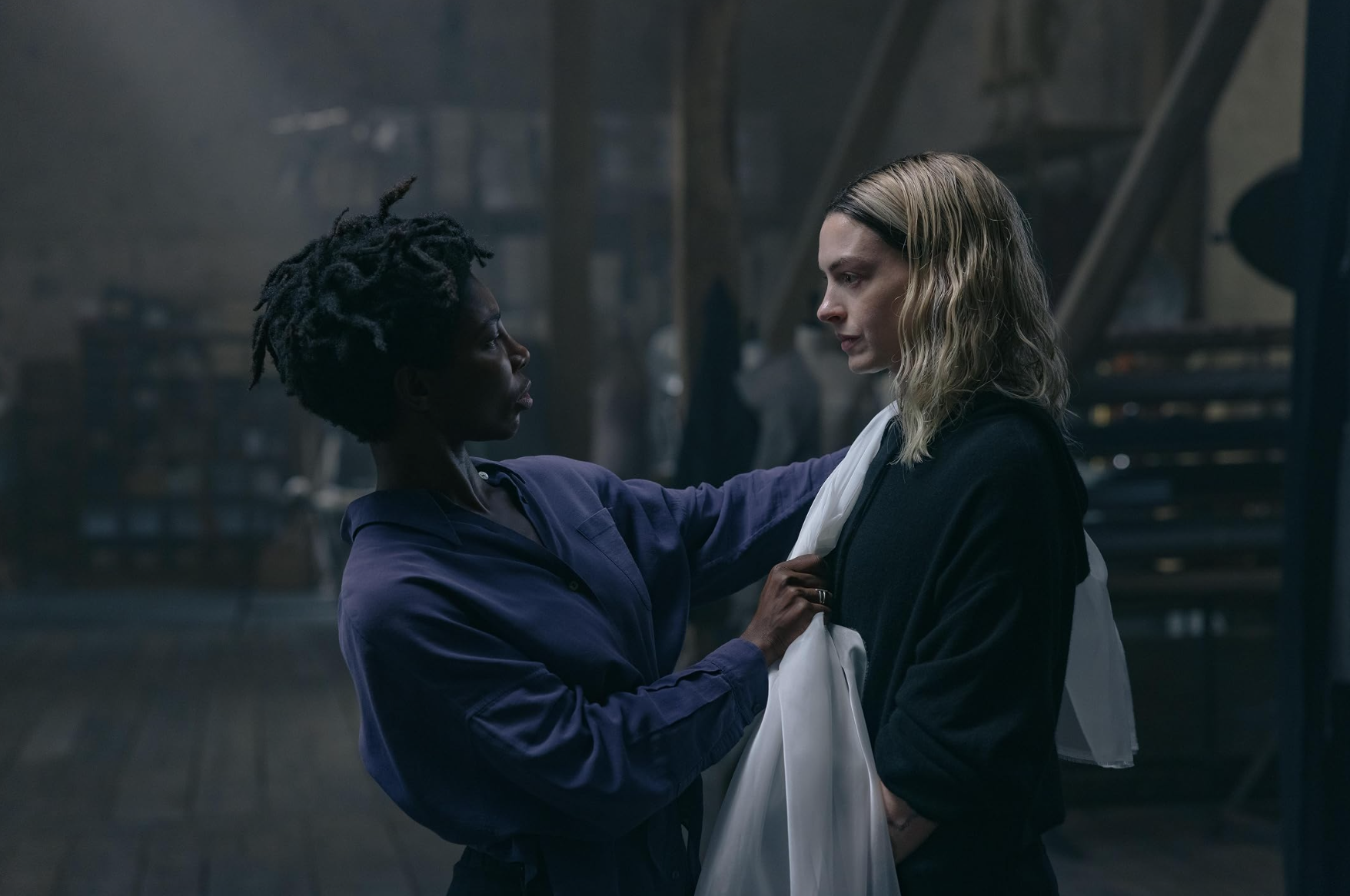
Few big movies this year have been as thought-provoking, haunting, and emotional for me as Mother Mary, a psychological drama and ghost story written and directed by the acclaimed David Lowery. In the film, Anne Hathaway plays a traumatized pop star, Mother Mary, who shows up on the doorstep of her old collaborator, costume designer Sam Anselm (Michaela Coel), to beg for a new look for her comeback show.
A quick glance at the film’s Letterboxd page shows how divisive Lowery’s latest film has proven. And while many of the critics and cinephiles who found fault with the film have perfectly cogent reasons for disliking it, some takes surrounding Mother Mary engage with the film in bad faith and demonstrate a stark misunderstanding of and lack of respect for the material. Many seem to actively resent the film they have been given, wish for it to be something else entirely, and then critique it for failing to fit that other mold. The deputy arts editor for The Guardian, Owen Myers, is one such critic.
Myers’ review for Mother Mary, published by The Guardian in April 2026, grossly mischaracterizes the film, gets some details flat-out wrong, and indulges in some casual sexism and homophobia for good measure. In my 12 years as a published film critic, I’ve rarely seen a major journalist interpret and analyze a film more poorly than Myers does Mother Mary. It’s an embarrassment to The Guardian and an embarrassment to the craft of criticism.
Before you continue—this essay requires knowledge of Mother Mary and Myers’ review in order to make sense. I highly encourage that you watch the film and read the review if you haven’t already, then come back.
* * * *
Myers begins by blatantly misquoting the film—about as bad a start as you can hope for in a review. He writes that “Anne Hathaway … declares that her new single ‘Spooky Action’ is about Einstein’s ‘transubstantiation of feelings,’” but not only is the “transubstantiation of feelings” not something that Einstein ever talked about in his life—the film does not mention him, either—but also, Hathaway does not say that line. That line belongs to Michaela Coel, the fashion designer who describes her process of creating clothing as a “transubstantiation of feeling.” Myers frames his entire opening salvo around that misunderstood, misattributed line, a problem that could have been solved by either paying more attention to the film or more diligently taking notes.
That’s merely Myers’ easiest assertion to disprove, rooted in a misunderstanding of the picture, a lack of outside research, and poor memory of the screenplay. But Myers, whether he realized it or not, also makes several broader arguments that could be characterized as sexist and homophobic, arguments that evidence the critic’s lack of respect for the film and its filmmakers.
Some critics and Letterboxd users have taken issue with the lack of a queer relationship in Mother Mary, a film that has two beautiful women on-screen for nearly the whole runtime, a clear attempt to objectify and sexualize two professional characters who are dealing with some real trauma and whose hypothetical sexual and romantic relationship is not supported by any evidence in the film itself. “At one point Anne Hathaway and Michaela Coel scissor each other but not in the hot way. What a waste,” says YouTuber Adam Olinger. On Letterboxd, these reactions—such as “could’ve been gayer should’ve been gayer”—commonly accompany four- and five-star reviews, clearly positioning those takes as joke reviews. But one must assume that Owen Myers, writing for a serious global publication, is not doing a bit when he suggests that Sam was “perhaps [Mother Mary’s] lover behind closed doors too.”
The fault probably lies with the film’s trailer and accompanying promotion, which hyped up Mother Mary as a “psychosexual pop thriller.” Rather than castigate Myers for a common misunderstanding of the film rooted in deliberately dishonest marketing, perhaps we can chalk this mistake up to good old-fashioned inaccurate promotion. Film trailers are designed to get butts in seats, not to honestly summarize a product and certainly not to inform criticism of said product—casual audiences cannot be blamed for mistaking one for the other, but critics ought to approach their work with more journalistic rigor. There is a reason most critics do not read promotional material before viewing a film, and if they do, such information rarely makes its way into the official review. Some make it a habit not to watch film trailers at all. Myers made the mistake of basing his judgments on the film’s marketing rather than analyzing the film on its own merits. Perhaps when he concluded that the film has “a strange coyness about its central queer relationship that reads as downright prudish in our age of sapphic pop,” he should instead have considered whether or not anything in the film supports his lesbian reading.
But why does that matter at all? Why should it make a difference whether one critic reads Mother Mary as queer when it clearly isn’t? It goes without saying that such queer-washing of the text, already so popular in online fandoms, is both reductive and gross when applied to criticism. Myers, when faced with two attractive female characters who harbor strong feelings toward each other, concludes that they must have sexual history. The perspective that two characters with an intense personal relationship must be sexually involved undermines the agency of these characters, their myriad traumas, and their issues, flattening everyone involved into players in a sexual charade wholly of the critic’s imagination. In the context of the rest of the review, this misreading proves disastrous, forming a cognitive berm that does not allow Myers to further access the psyches of Mother Mary or Sam beyond this perceived sexual relationship.
Myers’ criticism of the film also repeatedly discusses the film’s themes of fashion, identity, belonging, and costume in a pat and misogynistic manner. Already, fashion does not enjoy the lofty reputation of other art forms, such as sculpture or classical music. Textile arts, by virtue of a history of being seen as “women’s work,” are more often considered crafts than serious art, and as such they have been systematically devalued over time by the usually male elite of the art world. Pop music, too, often incurs the wrath of cultural purists who see that the majority of pop stars are women and believe that the majority of pop music fans are women and thus determine that pop music is a low, base, and vulgar craft that can never reach the status of “serious art.” Mother Mary, as a film that takes place at the intersection between fashion and pop music, seems as though it were made in a laboratory specifically to piss off misogynists and art snobs alike.
In his critique, Myers diminishes the protagonist’s existential crisis as a mere “fashion emergency.” She is, he writes, “unable to find anything to wear for her imminent return to the stage”—a crude misstatement of Lowery’s complex but easily understandable characterization. Mother Mary does not need a new dress because she has nothing to wear—to characterize her conflict as such is to demean the character, as though she’s a kid on the first day of school. No, Mother Mary has plenty of dresses. Instead, her problem is an intense personal and spiritual conflict—she has experienced something otherworldly and horrifying, something that has challenged her core ideas of who she is and what her music represents. This existential dread is writ large across Anne Hathaway’s entire delicately controlled and emotionally guarded performance. She goes to Sam not for a new dress but for a new identity, asking her to practically create a new Mother Mary persona for her like a phoenix reborn from the ashes. This is not exactly subtext, either—Lowery’s script and direction use religious imagery and the oppressive, ethereal atmosphere within the atelier to lead us naturally to these conclusions.
Myers is not the only writer to incorrectly view fashion as a lower art form, but note how the language Myers uses to describe Sam’s work reinforces this popular denigration of the art of fashion. “In a flurry of fabric and a few snips of scissors, Sam begins working on a look for Mary from the reams of chiffon that she has stashed in a dilapidated barn for such a purpose,” he writes. First of all, not all the fabric she has is chiffon. Second, the barn is not “dilapidated,” nor is the fabric “stashed” there—this is Sam’s workshop, a private and meditative space where she constructs garments, and as far as barn workshops go, it’s very clean and well-kept. Myers’ lack of understanding for these basic aspects of Sam’s character, the film’s setting, and Sam’s occupation effectively reinforce to the reader that the critic views these things as frivolous, that fashion is simply not a serious subject for a film.
Myers is not alone. Many critics share this perspective on fashion, whether they know it or not. How often do you read a review that specifically mentions the costume designer by name? For all he talks about fashion in his review, Myers never once names Bina Daigeler, who designed the film’s outfits, nor does he mention Iris van Herpen, the designer whose ghostly red dress becomes an important psychological component of the drama.
For critics such as Myers, fashion is just one component of a larger, more important work of art. It is something that can easily be denigrated with fallow prose like “ugly” or “experimental” or praised with pithy non-descriptors such as “stylish” or “extravagant.” They take fashion for granted, treating it as something ubiquitous and thus undeserving of our attention, much less our praise. Actors have to wear something, after all, but across the entirety of film criticism, little thought tends to be spared for the decisions that inform an actor’s wardrobe.
Film critics, like practitioners of many crafts, should be constantly learning and improving. For most of us, that means always seeking out new knowledge about film history and film production so that we can more accurately discuss art, situate it in its proper context, and more readily analyze how it’s made. Unfortunately, writing bad reviews is also one of the best ways to learn. A sort of trial by fire. While I understand why Myers made some of the mistakes he did in his review, I also hope that in the future, as the deputy arts editor for The Guardian, one of the most respected news outlets in the world, his editorial prudence and critical judgment become sharper over time. It should go without saying that not everyone needs to love Mother Mary as much as I do, but negative reviews of the film—like all reviews—need to be based in honest engagement with the material and rooted in a critic’s good-faith analysis of the text.
CLEMENT TYLER OBROPTA is a Culture editor at MAYDAY. He studied film and English at Ithaca College, has a master’s degree in film studies from the University of St Andrews, and his work can also be found with Film Inquiry and the Ithaca Times. He lives in Scotland with his wife and cat.
