This essay is written by MAYDAY magazine’s Critic in Residence
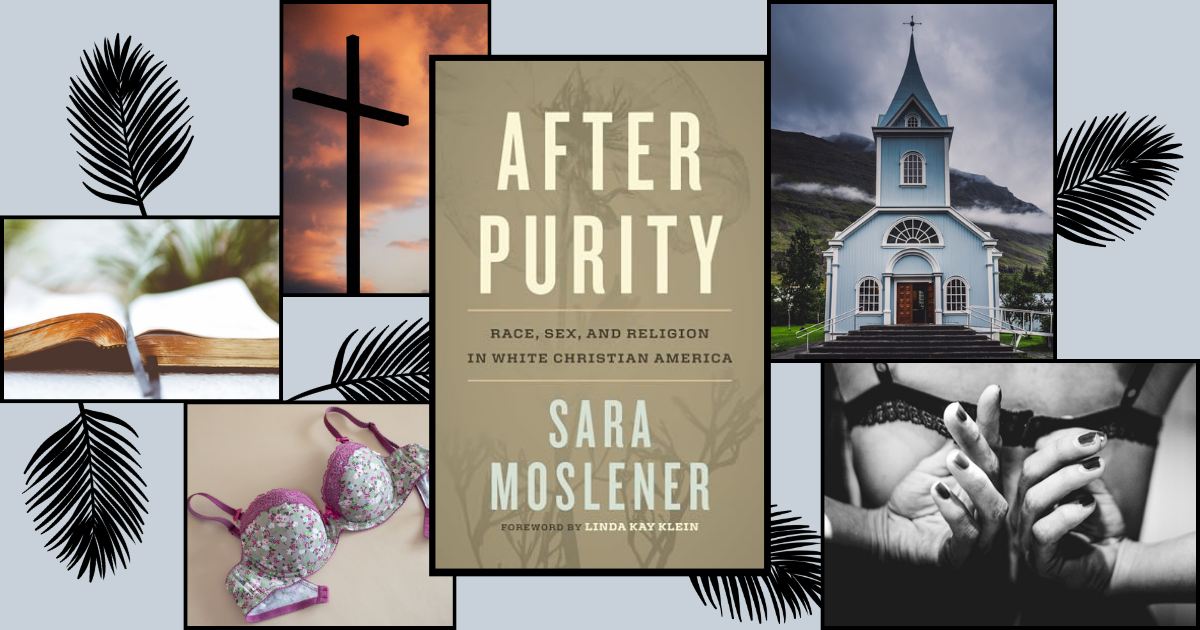
In her new book, After Purity: Race, Sex, and Religion in White Christian America (Beacon Press, 2025), scholar Sara Moslener explores how purity is a performance of the innocence myth, a kind of moral impunity attributed equally to the Virtuous White Woman and to Lady America herself, conflated as they are in the American imagination.
The term “purity culture” describes the wave of government-, church-, and NGO-sanctioned propaganda, merchandise, and messaging that proliferated in the 1980s, ’90s, and beyond to convince adolescents that premarital sex is morally egregious and to restrict access to comprehensive sexual education.[2] I remember learning the term when I was a freshman or sophomore at a private Christian college in New England, around 2012. “Purity culture” entered my lexicon only weeks after I first heard the phrase “rape culture,” which was described to me as “telling girls not to get raped instead of telling boys not to rape.” Many scholars and cultural commentators, including Moslener, have pointed out the parallelism between rape culture and purity culture—how both of them heap sexual agency on women and regard men as uncontrollable sexual creatures, emphasize sexual status as an indicator of personal worth, fetishize the female body, and more—to the point where the two could be considered reflections of one another, ultimately inextricable. In describing a pamphlet produced by the abstinence-advocacy group True Love Waits, Moslener enumerates how these teachings “[echo] the views that characterize rape culture. The pamphlet first argues that sex is always a danger that needs to be controlled, thereby placing the burden of responsibility on young people learning to navigate their own sexual desire. … Adolescents who have positive sexual experiences are encouraged to reframe them as harmful.”
As more and more people who were raised in the evangelical cultural frenzy of the ’90s and the ’00s leave evangelical spaces and go public with their stories of indoctrination, purity culture has become a familiar object of scrutiny and analysis. The seminal work of purity culture studies is Pure: Inside the Movement That Shamed a Generation of Young Women and How I Broke Free by Linda Kay Klein (Atria Press, 2018), who writes the foreword in After Purity—though nearly 10 years later, Klein’s book is no longer the lone wolf it once was. Moslener’s new work goes beyond the purview of purity culture analysis up to this point and demonstrates how purity culture operated on not just individuals but on American society as a whole to perpetuate racial stratification by reinforcing America’s longstanding innocence myth, the alleged impunity of the Virtuous White Woman. This was accomplished through the evangelical valorization of disembodiment, which severs its practitioners from their intuition, sensitivities, and physical experiences. Moslener examines how purity culture worked not just to inculcate certain kinds of behavior in its targets, but also to reinforce an implicit understanding of one’s position in the (stratified) world: White women were simultaneously revered for their moral authority and yet limited by their gender. White men were allotted authoritative patriarchal power but with moral failings that are regarded as natural and excusable. And Black people and people of color of all genders were seen as lesser because of their inability to embody the purity associated with Whiteness. After Purity is a vital work of scholarship that bridges the increasingly mainstream individual reclamations of self after purity culture with the broader social implications of purity culture’s racial ignorance. In short, Moslener shows that purity culture is just as much about racial ignorance as it about sexual abstinence.
Racial ignorance, a term developed by the sociologist Jennifer Mueller, “creates the illusion that racial identity is irrelevant to one’s lived experience,” Moslener writes. In a context of racial ignorance, blind spots (or entire fields) around race are regarded as a strength rather than a shortcoming. This is similar to White normativity, wherein Whiteness is the assumed standard and thereby rendered invisible, but folks participating in racial ignorance also ignore the racialized experiences of others, including people of color. “Ignorance is not the point, of course,” Moslener clarifies. “Innocence is: the desire to be free of guilt, released from responsibility, accountable only to one’s own unfettered path to social, spiritual, and economic fulfillment.” Racial ignorance both proceeds from and reiterates the innocence myth, creating a kind of vortex of untruth. In an extension of the idea that “God is perfect, so no evil can exist in his presence,” the innocence myth suggests that White folks, and White women in particular, possess an inherent moral high ground. Ideologies of White Women’s Virtue lead to unsubstantiated conclusions that White women cannot engage in acts that would subvert the status quo. For example, Moslener cites White women who were in consensual sexual relationships with Black men in the post-Civil War period but then sold out their lovers under pressure from the White community. Power brokers of the time like Frances Willard, president of the Women’s Christian Temperance Union (WCTU), “could neither imagine nor allow these relationships to be seen as consensual, as her political machine ran on the fuel of White women’s moral authority, an authority easily undercut by revelations of a ‘voluntary alliance’ between White women and Black men.” The indignant crowds then lynched those men in order to “protect the white women’s virtue.” This is how the myth of the Virtuous White Woman has long been used to justify racial division, from its most banal to its most extreme forms.
Moslener’s analysis is grounded in her familiarity with the 19th-century development of ideas of American womanhood on both sides of the color line. She writes with facility about Harriet Jacobs’ Incidents in the Life of a Slave Girl, in which Jacobs illuminates some of the exploitation inherent in slavery but, in doing so, confesses to what her Victorian-era readers interpreted as sexual impurity. “By portraying herself as a decision-maker and accepting responsibility for breaching one of the cardinal virtues of femininity,” Moslener writes, “she maintained her claim to truth-telling, even when it pushed her beyond the limits of respectability.” Another prominent Black female writer at the time was Ida B. Wells, who also valorized truth-telling over false corroboration of sexual stereotypes. “Nobody in this section of the country believes the old thread-bare lie that Negro men rape White women,” Wells reported. Moslener adds, “It was evident to Wells that White women’s purity was an ideological wedge used to pathologize miscegenation and to maintain the race line between Black and White.” Because the deconstruction of purity culture is so often far removed from the deconstruction of White supremacy, these unholy ideological alliances between White women’s alleged purity and Black men’s hypersexualization still persist. For many non-academic readers, these names may or may not prompt any latent associations, and some of Moslener’s passages of historical commentary and contextualization may read as dense and distant to a modern audience. The vitality of a book for our current social circumstances doesn’t always translate into accessibility, particularly in a time when reading is on the decline. In this way, After Purity reminded me of Rev. Kelly Brown Douglas’s Stand Your Ground: Black Bodies and the Justice of God (Orbis Books, 2015). These two books have both fundamentally altered and expanded my understanding of the racial landscape in America and the historical origin myths that lie like bedrock far underneath our contemporary assumptions, biases, and perceptions.
In her third chapter, “Evangelical Exodus,” Moslener provides an overview of the great de-churching, the widespread movement of former evangelicals leaving the church. The deconstruction movement has generated its own coverage, including dozens (if not hundreds) of podcasts, memoirs, support groups, and more. The material depicting and analyzing deconstruction continues to center White women and their experiences. This is partially a function of the demographics within evangelicalism, but the marginalization of people of color in the deconstruction space also replicates the marginalization of people of color within American evangelicalism at large. In the foreword of After Purity, Klein notes the predominant Whiteness of evangelical recovery spaces and adds, “Though some people of color find solidarity around issues of sex and gender, too many tell me that the silence around racism and colonialism leaves them feeling more invisible and alone than when they arrived.” For many White women, the trajectory out of evangelicalism is galvanized by an instance related to their personal sexual purity or gender identity, be that a consentual sexual experience, a sexual assault, or a crisis related to news of sexual misconduct or gender-based discrimination within the church. Klein summarizes what can happen after deconstruction: “In reconstruction, we connect to ourselves and develop the capacity to experience and assess the world on our own terms. For many, this includes wrestling with issues of gender, sexuality, race, racism, and colonialism. Unfortunately, most White folks come to the latter issues on this list later.” Reading After Purity spurred me to acknowledge the rarity of my experience, wherein my divestment from sexual purity and racial ignorance unfolded in tandem.
After my junior year of Christian college in New England, I moved to Houston for a two-month summer internship at an urban community center. Those two months served as a round-the-clock confrontation with my own racial ignorance, which was peeled off of me in real time. A romantic dalliance with a fellow intern prompted a minor confrontation with purity culture embedded within my broader reckoning with race. That summer awoke both my sexual body (which had been sleepwalking up to that point, neither completely prone nor conscious) and my racialized body. I recognized myself as a White person in a way I never had before. I already knew that my embrace of purity culture had left me stunted, but over the course of that summer, I recognized for the first time that my indoctrination into racial ignorance had also deprived me of something essential. The cost of my alleged innocence was my ability to relate to and acknowledge the humanity of anyone whom purity culture deemed less righteous than me—which, thanks to the innocence myth surrounding White women, included all people of color.
Allow me to summarize in different terms: I dated a Black guy.[3] We didn’t sleep together, but we got close. (So close, in fact, that when I returned to Christian college in the fall and my nosy roommate happened upon a picture I’d snapped of the guy’s bedroom, she asked me point-blank if we’d slept together. That’s Christian college for you—and note how this memory demonstrates that surveillance, which was and is marketed as a tool for maintaining morality, has always been a poorly disguised means of maintaining control.[4]) That summer was the first real course in my sexual and racial education.
I returned to Christian college in the fall, which meant I returned to a world defined by Whiteness. I was able to recognize how my racial ignorance was facilitated by near-total racial segregation. At the same time as I was questioning the sexual and exclusionary ethics of evangelicalism, I started craving spaces that were not steeped in Whiteness. After I graduated, I packed my bags and returned to Houston. Over the course of the following five years there, I began to dismantle both my evangelical adherence and my complicity in White supremacy and Christian nationalism.[5] My years in Houston were a case study in intersectionality. Still, I didn’t have language to see how the sexual aspects of purity culture are intertwined with the racial aspects. I could not yet identify that my experiences lay solidly in a historical tradition in which “White women’s sexual purity was a weapon of racial superiority refined by White, middle-class protestants who benefitted from assumptions about their own moral character.” Moslener’s book finally provides that language.
Purity culture requires disembodiment. Moslener argues that disembodiment is the fundamental praxis by which sexual purity and racial ignorance are inculcated and achieved: Only by separating from our bodies can we fully commit to refuting sexuality and race. She defines disembodiment as “a cognitive state that devalues or dismisses the lived experience of the body and how our bodies situate us within systems of privilege and oppression. … Denying the sexual prompts of one’s body has often been a sign of holiness in the Christian faith tradition. Likewise, claiming to ‘not see race’ is presumed to be a virtuous stance regarding racial difference. In both cases these disembodied practices perform significant violence, as erasure of bodies and their needs means developing cognitive habits that refuse to see harm if it conflicts with our established innocence myths” (emphasis mine). My experience validates Moslener’s thesis, and as I read, formerly discrete incidents began to cohere under this unified theory. I think of moments when my own experiences of gender-based marginalization have been denied because the people to whom I reported them were too invested in purity culture to acknowledge its harms. And I recall how long it took me to believe people of color about their experience of racism, because to believe them meant admitting to my own blind spots and complicity. In Houston, I strove to wake up to my body, to learn to feel and recognize my body’s cues and reactions. This involved noticing not only arousal but also my Whiteness. Embodiment unlocked both registers of forbidden knowledge. In the context of the historically Black neighborhood in which I lived and worked, I found there was no way to welcome one frame of knowing and not the other. At times, I resented these new layers of knowledge because of what they required of me: to confront ugly histories of American White supremacy, Christian supremacy, and the ways my own body had been a pawn in a political scheme I hadn’t understood. I didn’t realize yet how many of the privileges of my White life worked to keep me ignorant, and comfortable in my ignorance. “The habits of being in a nation whose greatness is predicated on historical illiteracy and psychological defensiveness are formed through practices of ignorance,” Moslener writes. “Historical illiteracy isn’t just a passive stance toward learning but an active resistance toward the truth and the cultivation of non-knowledge.” Those of us who carry privilege are actively disincentivized from curiosity and empathy that would fracture this racial ignorance. Re-integration costs us everything that we gained from staying disembodied. Before one of his miracles, in John 5:6, Jesus asks the man lying beside the pool of Bethesda, “Do you want to get well?”
When I moved out of Houston and back to Boulder, Colorado, the lily-white landscape of my youth, I struggled not to relapse into the racially ignorant way of thinking that my experience of racial consciousness-raising had nothing to do with the other aspects of my evangelical deconstruction process. Moslener calls out the post-evangelical influencers who peddle race-blind purity recovery tools and groups on the internet. As long as we continue to deconstruct the sexual aspects of purity culture but not the racial ones, we will continue to perpetuate systems devised to endorse inequality and maintain social stratification. This is the lesson that intersectionality exists to teach us: You cannot dismantle one system of oppression without addressing the others. All systems—racism, patriarchy, capitalism—influence one another in a complex matrix of privilege and disadvantage. How, I found myself wondering, does disability factor into purity culture, especially given that many disabled folks do not have the costly privilege of disembodiment? This question about the intersection of purity and disability is just one example of the many frontiers to which I hope post–purity culture scholarship will extend. After Purity lays the groundwork for a deconstruction movement as robust in its commitment to anti-racism as in its commitment to dismantling the patriarchy.
Back to Stockholm, back to the ninth floor hotel room with the two twin beds where Hannah and I were listening to two podcast hosts dismember American Canto. In clips of Olivia Nuzzi speaking about her book, I immediately recognized her distinctive, breathy way of speaking as what Tia Levings and others have identified as “fundie baby voice”[6]—a vocal affectation that extends the myth of the Virtuous White Woman as a person with the innocence, sweetness, and submissiveness of a child. Nuzzi is signaling victimhood and vulnerability. In the final clip from The Rampart, Tim Miller confronts Nuzzi about her complicity in RFK Jr.’s rise to power.
“Couldn’t you have tried to stop it?” Miller asks.
“What are you asking me exactly?” Nuzzi says.
“He’d been nominated to be HHS secretary… you had information that you could’ve shared,” Miller says. “And you didn’t share anything. Why?”
“You’re making this—I don’t know how to responsibly, uh, handle this on camera with you here,” Nuzzi responds: an implication that Miller is in the wrong for posing the question. When Miller presses her, she replies—her tone turning defensive, but never losing the breathy baby quality—“I lost my job.” She tells him his question is making a lot of assumptions, she deflects over and over. “I lost my job!” she repeats. “I was fired, I was in hiding, I was afraid, I was terrified.”
“Of what?” Miller asks.
She mentions her former fiance, and then her voice tightens, raises in pitch. “I was very worried about people knowing where I was, and, um—” She bursts into tears. White woman’s tears. Nuzzi is performing the White female victim, using allegations of male aggression to mask her own missteps. I recalled Moslener’s citation of scholar Ruby Hamad, who, in her book, White Tears/Brown Scars: How White Feminism Betrays Women of Color, writes, “As the chosen symbol of the innocent perfection of whiteness, the white damsel with her tears of distress functions as both denial of and absolution for this violence.” Nuzzi proffers her tears in lieu of responsibility: a saltwater sigil to reinforce the innocence myth.
When the podcast reached its end, Hannah and I looked at each other, rolled our eyes, and went to bed.
[1] While this clip was included in the American Canto episode of If Books Could Kill (which can be found here: https://podcasts.apple.com/us/podcast/olivia-nuzzis-american-canto/id1651876897?i=1000747114532), I have fact-checked these excerpts in the source material itself, the Olivia Nuzzi episode of The Bulwark Daily (found here: https://podcasts.apple.com/ca/podcast/olivia-nuzzi-breaks-her-silence/id1447684472?i=1000739422190). The quoted dialogue starts at 47:51.
[2] Moslener credits the term’s coining to Donna Freitas, in her book Sex and the Soul: Juggling Spirituality, Sexuality, Romance and Religion on America’s College Campuses (Oxford University Press, 2008).
[3] I’d like to call out here the fallacy of affiliation: this idea that we can only truly appreciate a group of people after developing personal affection for someone from that group—similar to how men will frame rape or sexual assault in terms of their (sometimes hypothetical) daughter. Do you really need an imaginary offspring to understand the harms of gender-based violence? But at the same time, it took me until I spent a summer working with and alongside a group of Black folks to think seriously about racism. You don’t know until you know, and I was seriously and intentionally insulated in a White and privileged world before I accidentally made my way to South Union, Houston. This is one of the functions of segregation: to keep us from developing bonds with the other.
See also: Jess Row’s White Flights, Jeff Chang’s We Gon’ Be Alright, and Richard Rothstein’s The Color of Law.
[4] Someday I hope to write a full essay about dynamics of surveillance (1) within religious spaces: accountability partners, the visitation hours we kept in the Christian college dorms, Covenant Eyes; (2) in the technological sense, how we have embraced surveillance as a form of intimacy: see Zoe Hitzig’s essay, “On the Grid: How Surveillance Became a Love Language” in the Drift: https://www.thedriftmag.com/on-the-grid/; and (3) in the carceral sense, police surveillance as a means of protecting property rather than facilitating community care; Ring cameras; “safety” as preservation of the status quo. But since I’m writing this essay today and not that one, I’ll include this quote of Moslener’s: “As a system of control, patriarchal Christianity thrives on monitoring behaviors and relationships and teaches young people that self-monitoring is a form of obedience to God.”
[5] “Began” because this work is ever ongoing, and I am far from finished unearthing my internalized biases, my prejudices, and more.
[6] See Tia Levings, “Fundie Baby Voice Isn’t What We Called It,” via Levings’ substack; https://tialevings.substack.com/p/fundie-baby-voice-isnt-what-we-called
MCKENZIE WATSON-FORE is a writer, artist, and critic currently based in her hometown of Boulder, Colorado. She holds an MFA in Writing from Pacific University and a BA in Biblical Studies from Gordon College. She serves as the executive editor of sneaker wave magazine, and her work has been published or is forthcoming in Full Stop, Christian Century, the Offing, CALYX, and elsewhere. When she’s not writing, she dances Argentine tango, knits baby cardigans, and watercolors her feelings. McKenzie can be found at MWatsonFore.com.
