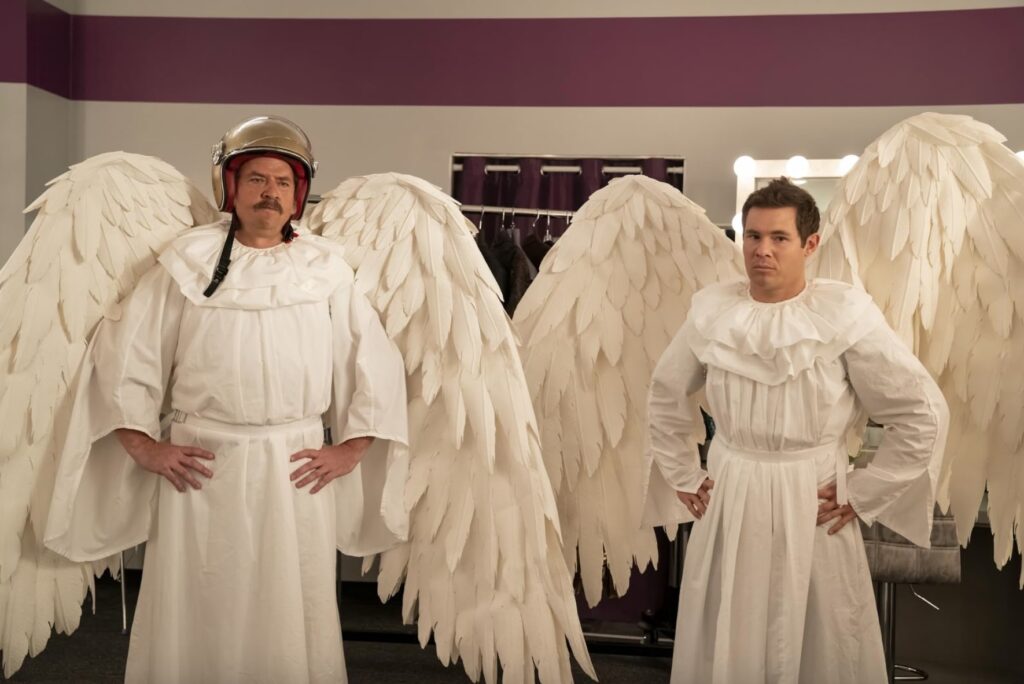
(Photo by Jake Giles Netter © HBO)
This essay is written by MAYDAY magazine’s Critic in Residence
This past summer, my partner Michael and I attended the wedding of two of our friends. One of them grew up in a Y2K prepper cult in Eastern Oregon. Her now-wife is a Dutch gynecologist. The four of us will often laugh about the mirrored dynamics in our relationships: one partner is all-too-familiar with the intricacies of high-control religion; the other, lacking any religious upbringing, is consistently bewildered by the experiences their partner recounts about church.
Shortly after their wedding, the cult survivor and the gynecologist texted me separately to ask if Michael and I had watched HBO’s The Righteous Gemstones: a bawdy satire about an intergenerational family of megachurch pastors. “I just want to know,” the gynecologist texted, “how realistic it is.”
The show’s premise made me both excited and nervous. Humor involving religion is not always welcome, particularly among the religious. My mom was not thrilled when I started writing about my religious upbringing, and she was even less thrilled when I started making jokes about my imperfect religious adherence. “Just make sure,” she said, “that you don’t make fun of God.”
Maybe I’ll get struck by lightning for writing this—if I do, let it confirm your faith, consider me a martyr for comedy, and you’re welcome—but is it really even possible to make fun of God? If the best kind of humor comes from “punching up,” is there any further up one can punch than all the way to heaven? Would an omnipotent, omnipresent, ever-loving Being really take offense at whatever jabs I might make? Shalom Auslander asks similar questions in his memoir, Foreskin’s Lament, where he writes, “Wouldn’t part of being All-Mighty include being All-Self-Examining? All-Open-to-Criticism? All-Honestly-Self-Evaluating?”(1)
Then again, according to a certain reading of the Old Testament—where God does things like split open the earth to swallow Korah and his family(2), strike down Uzzah for touching the Ark of the Covenant(3), or turn Lot’s wife into a pillar of salt(4)—God doesn’t seem to have much of a sense of humor. (“Are you kidding?” a rabbi friend recently said to me, after I explained the early premise of this essay. “The Bible is hilarious! All those empty rhetorical questions, those impossible commands?”)
I used to spend hours in prayer asking God if it was okay to want to be funny. Jesus sure didn’t seem to be funny—and my straightlaced evangelical context made me feel like a libertine for wanting him to be. While certain strains of Christianity are more free with emotional expression (see: snake handlers, charismatics who speak in tongues, those slain in the Spirit), my Swedish Lutheran-influenced congregation numbered among “the chosen frozen.” Plus, none of the gospels mention Jesus laughing, or staying up late telling ridiculous stories, or teasing the disciples until goat milk spurted out of Saint Peter’s nose (it would definitely have been Saint Peter who was the butt of the joke, though).
I stayed afraid of comedy throughout college. My alma mater ran an annual, student-led comedy variety show, and women weren’t featured until 2013, my sophomore year. I remember walking past black-and-white posters in the student center that asked (sincerely), “ARE WOMEN FUNNY?”
Sometimes, the resistance to humor is actually fear of exposure—what if the jokes strike too close to home? This was the case for me, as a middle schooler, when my best friend Hannah got a copy of Joel Kilpatrick’s A Field Guide to Evangelicals and Their Habitat. I remember sitting on the carpeted floor of my yellow-painted bedroom, flipping through the satirical guidebook until I encountered a fake newspaper article headlined, “Christian Couple Maintains Abstinence Throughout First Two Years of Marriage.”(5) At the time, I was too enmeshed within purity culture to identify how Kilpatrick’s wry satire lampooned the idolatry of virginity. Similarly, I remember being uncertain if I should be amused or offended by the 2004 film Saved, starring Mandy Moore as an evangelical mean girl, which perfectly captures the way teenage Christian girls learned to be bitchy, judgmental, and condescending in the name of Christ.
The aversion to comedy about religion in my upbringing implicitly taught me that the two should be kept far apart, like orange juice and toothpaste. But not all Christians are equally alarmed about humor regarding the particularities of religious practice.
Harrison Scott Key, winner of the Thurber Prize for American Humor, clarifies his Christian affiliation (and its relevance to his memoir, How to Stay Married) in this manner: “It will be important to understand this bewildering fact about me because my weirdo religious faith shapes everything about this story…For some of you, I know this is weird stuff. And it is. It is very weird to subject yourself to an ancient religion that dares you live to according to a collection of primitive writings featuring more murder and foreskin content than is perhaps advisable for young children, the central theme of its stories being that everyone should imitate the strange behaviors of a divine hayseed born in a Palestinian cowshed to an eighth grader who just woke up one day pregnant.”(6) Key’s disclaimer demonstrates something spectacular: it’s possible to acknowledge the preposterousness of something without disrespecting it.
So I started wondering, what if there’s a different approach—where humor is not antagonistic or orthogonal to religion but a tool for exploring its idiosyncrasies? Thankfully, I’m no longer uncertain about whether or not women are funny. Now, I want to know: what is the role of humor in narratives of religious experience?
G.K. Chesterton was a notable advocate that humor exists within Christianity. I recently re-encountered Chesterton’s arguments for Jesus’ sense of humor in Brandon Ambrosino’s “Notes on (Christian) Camp,” a riff on Sontag’s famous essay, “Notes on Camp.” “Jesus is funny, but everyone misses it,” Ambrosino asserts.(7) According to Ambrosino—and my rabbi friend—Jesus is campy, melodramatic, prone to exaggeration.
Ambrosino references an early definition of camp, from novelist Christian Isherwood, who writes, “True High Camp has an underlying seriousness. You can’t camp about something you don’t take seriously. You’re not making fun of it; you’re making fun out of it. You’re expressing what’s basically serious to you in terms of fun and artifice and elegance.”(8) (“Can you tell my mom that?” I’d like to ask Isherwood.)
If we take God seriously, are we then permitted—or, perhaps, even obligated—to investigate the absurdities of religious culture that have propagated from our structures of worship and religious instruction? There’s a huge difference between making fun of God and making comedy about the shortcomings of human attempts at religion.
That brings me back to the Righteous Gemstones. The show, an HBO comedy that ran from 2019 to 2025, follows the Gemstone family, led by patriarch Pastor Eli (John Goodman), after the death of his beloved wife, Aimee-Leigh (Jennifer Nettles). The Gemstones are a South Carolinian iteration of Jim and Tammy Faye Bakker-cum-Joel Osteen, at the helm of a contemporary, multimedia Salvation Center, with a brood of spoiled, immature adult children, who are raring to take over the family business of soul saving. The newly widowed Pastor Eli is reluctantly preparing his succession plan, but his would-be successors—Jesse James (Danny McBride), Judy (Edi Patterson), and Kelvin (Adam DeVine)—are all total fuck-ups.
The story arc of season one revolves around a blackmail plot that features a video of Jesse leading some fellow church elders in a night of debauchery, complete with drugs and sex workers. That scandal is laid to rest after the initial nine episodes, but the family continues their hijinks for another three seasons.
The show, created by Danny McBride, and directed by McBride, Jody Hill, and David Gordon Green (plus three episodes toward the end directed by Jonathan Watson), features graphic violence and nudity. Car chases end in dramatic accidents; naked penises appear in more episodes than not (regarding the high cock count, McBride has said, “I feel like frontal male nudity is a very Old Testament thing to do”[9]); and human beings are burned alive. The Gemstones are a reckless clan, self-absorbed and ignorant. Their violence and humor alike are slapstick and gratuitous. And, like Ambrosino and Isherwood have articulated, the show takes these people, in all their absurdity, seriously.
The humor in The Righteous Gemstones interrogates the dissonance within an appearance-obsessed religious context that preaches authenticity and integrity. It’s funny because it’s so spot-on. The plotline skewers the Gemstones for their hypocrisy while practically pleading with them to grow up and do better. In the midst of all of it, the sermonic voice-overs and clips of church services are not slapdash stereotypes but real injunctions to a transformed way of life.
The show never asserts that religion itself is bad, or that God is evil, uncaring, or wants bad things for our lives. It doesn’t portray the Gemstones as malicious but human. They’re totally incompetent people saturated with excess wealth, but they are still just people, failing to live up to their ideals.
Something I was delighted to discover while researching for this piece is The Righteous Gemstones’ popularity amongst people who identify as having religious trauma. In my experience, people from far outside of religion often assume that religion itself is the problem. But so often, it’s the execution that causes harm, not the core beliefs: a nuance that’s easy to portray, but a dichotomy that is successfully reflected in the writing of The Righteous Gemstones.
I watched much of The Righteous Gemstones absolutely rigid, frozen in my body, paralyzed with discomfort. (Let me be clear: Please do not read this essay as a wholesale endorsement of the show.) Two days into my binge-watch, I texted the Dutch friend who had told me about it.
“I hate to inform you that this is upsettingly realistic,” I said. But I couldn’t tear myself away.
Michael and I watched at night on the hottest days of July. We’d recently acquired a giant monitor that was being discarded by some office space downtown, so we set it up on our back porch and watched outside, after the sun had gone down. I was self-conscious about the soundscape, and I frequently leapt from the cushions to minimize the volume during sudden explosions and frequent vulgarities. But more than any of the profanity or nudity or violence, what affected me most about the show was how much I recognized from my own religious upbringing.
Adam DeVine plays Kelvin, the youngest of Eli’s children, as the emblematic youth leader, convinced of his golden boy potential, vaguely metrosexual (or just totally repressed), sporting thick-framed glasses and a gelled-up duck-tail of a hairdo. You do not manufacture a portrait so accurate without knowing—and on some level, loving—your subject.
In season two, Kelvin assembles himself a team of bodybuilders called the God Squad. The God Squad is based off of a real-life troupe of Christian bodybuilders, the Power Team, founded in the 1970s by John Jacobs—a troupe that I remember visiting my private Christian elementary school in the early 2000s. On stage in the darkened auditorium, the musclebound performers ripped phone books in half, split concrete blocks with their foreheads, and then preached about the power of God.
The Righteous Gemstones is the kind of satire designed for an audience intimately familiar with the original subject material. Early in our relationship, Michael attempted to expose me to the satirical anime One Punch Man, but without any background in the tropes and routines of other animes, the show’s jokes fell on deaf ears, as it were. The way Ambrosino puts it: “Camp is laughter for those with ears to hear.”
The Righteous Gemstones is deadly serious about religious instruction; the pitfalls of fame, wealth, and power; and the ever-present risk of hypocrisy around religious performance and human action. I cannot think of another artifact of visual media that is so serious about the limited roles available to women in the church, and Edi Patterson dramatizes the pinched constraints of Judy Gemstone’s life with equal parts hilarity and tenderness. I mean, the characters endure a literal plague of locusts. This also illustrates why comedy is such an effective opening for tragedy: laughter primes the reader for feeling without plunging into the sentimental.
By contrast, the so-called reverence that my mom enjoins me to (please don’t make fun of God) actually denies the seriousness of the subject matter. The only way to talk about something you can’t joke about is to admonish, to wield the topic like a weapon or a measuring stick.
Humor, similar to wonder, paves a path into self-expansion, because part of the delight of a joke lies in its surprise. Know-it-alls can’t permit themselves the humility of laughter, because appreciating humor requires that one be on the receiving end of insight.
As long as certain American evangelicals remain convinced of their narratives of persecution, their defensiveness will demand that they never let their guard down enough to be humored. Laughter is vulnerability—and many evangelicals consider vulnerability a risk they can’t afford.
The key to humor that involves religion is noting the absurdities of belief—not to mock them, but to reflect belief’s expansiveness and humor’s refutation of a minimized reality. Humor is bombastic and hyperbolic, and what’s more hyperbolic than an invisible, omnipotent being who oversees the universe? What if humor could be seen, not as inherently disrespectful, but as one more means of rigorous engagement with the full, bewildering scope of human experience?
1 Shalom Auslander, Foreskin’s Lament (Riverhead Books, 2007), 160.
2 Numbers 16:32
3 2 Samuel 6:7
4 Genesis 19:26
5 Joel Kilpatrich, A Field Guide to Evangelicals and Their Habitat (HarperCollins, 2006), 123.
6 Harrison Scott Key, How to Stay Married: the Most Insane Love Story Ever Told (Simon & Schuster, 2023), 9.
7 Brandon Ambrosino, “Notes on (Christian) Camp,” The Christian Century, https://www.christiancentury.org/features/notes-christian-camp.
8 Christopher Isherwood, The World in the Evening (Farrar, Straus, and Giroux, 1954).
9 Interview with Danny McBride from Polygon, https://www.polygon.com/interviews/2019/8/16/20805976/righteous-gemstones-hbo-danny-mcbride-halloween-sequels-vice-principals-eastbound-down.
MCKENZIE WATSON-FORE is a writer, artist, and critic currently based in her hometown of Boulder, Colorado. She holds an MFA in Writing from Pacific University and a BA in Biblical Studies from Gordon College. She serves as the executive editor of sneaker wave magazine, and her work has been published or is forthcoming in Full Stop, Christian Century, the Offing, CALYX, and elsewhere. When she’s not writing, she dances Argentine tango, knits baby cardigans, and watercolors her feelings. McKenzie can be found at MWatsonFore.com.
