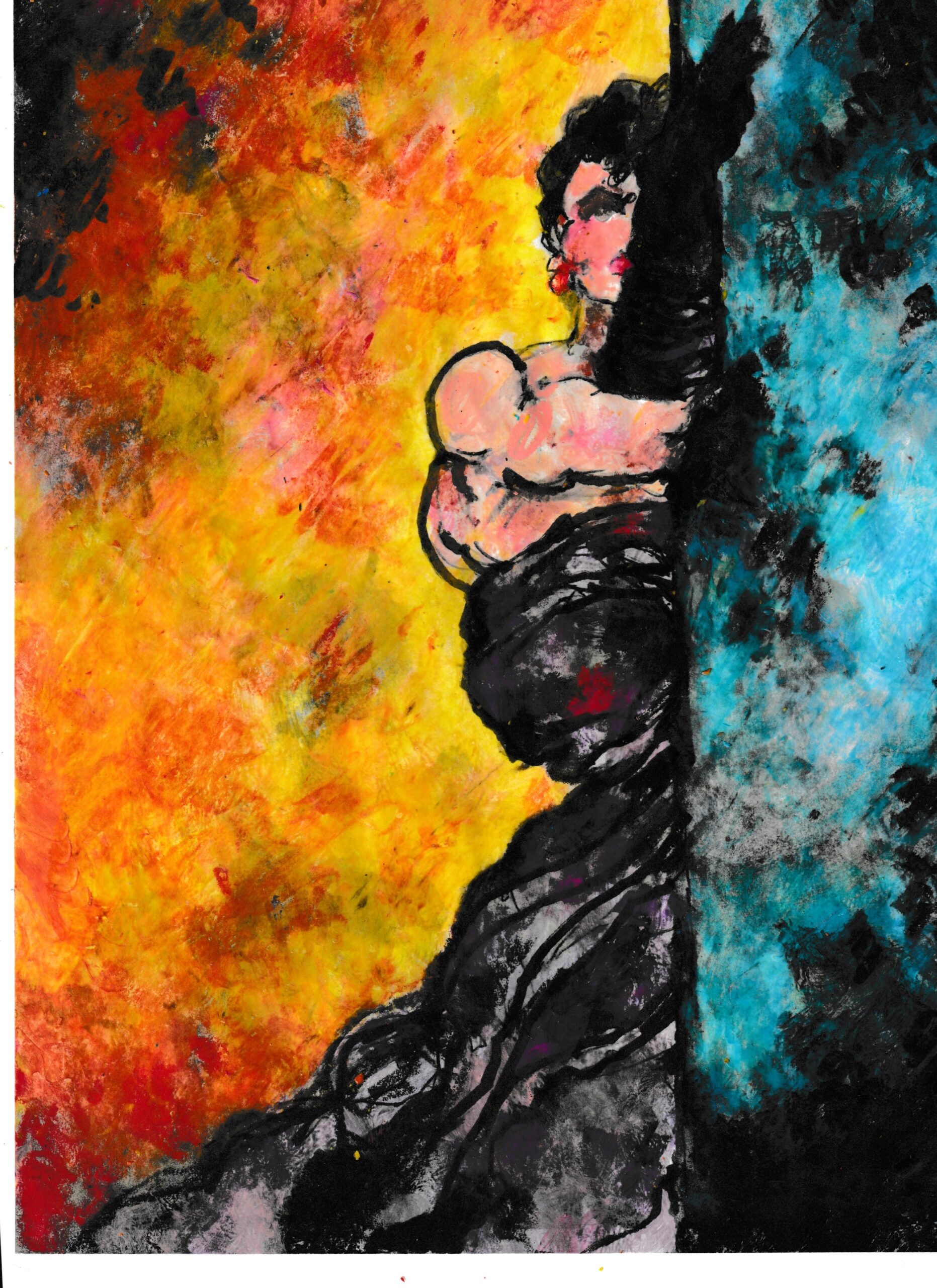
Purple Rain
We’re learning the past tense in Yiddish
class – ikh bin geven amol a yingling –
when my Tante leaves a voicemail.
She always appears as No Caller
ID. I have something
important to tell you. I worry
about Savta’s health, or my brother,
or my own forgotten failures.
I just want you to be careful,
and safe, she says, about dressing
up in the clothes she’d given
me, two weeks before in her Harlem
apartment. A pipe had burst, water
warped irreparably the floorboards.
I balanced one leg on the waving
wood and hopped into my Tante’s
floor-length dress, and her floral
dress, her red dress with the sequins
and even a black leather skirt Savta
must have worn sixty years prior.
It all fit. Ooh we delighted
at each twirling piece until her closet
emptied. We filled her old duffel and, hungry
now, from the trying-on and taking-off, the kvelling,
lugged it twenty blocks downtown, past the Bertha,
her old, perpetually hot apartment, which she hated
to leave for she loved the heat, the extra
bedroom, the pull-out couch, space for nieces
and nephews to dress up in tank-tops and boxers
in winter, eat ice cream for breakfast.
We walked past the Westside
Market she often
calls me from, halfway
home from the clinic
on days she walks the sixty
or so blocks, and I hear her, stopping
in for gum or Advil, to refill the pockets
of her depthless shoulder bag, and over
the checkout sounds she offers
me advice on love or healing
a stye, to press it with freshly
steeped black tea, Lipton’s,
she advises, how to cradle
the phone in one hand and the dripping
tea bag in the other,
how to brush away the dangling
string, that, for a moment,
I confuse for my own hair, and now I’m tucking
the string behind my ear, like her sister,
my mother, who collected her famously
long hair in a braid, so the story
goes, and cut it clean before her parents,
a braid on the table
between them. I reassure my Tante
how safe this place is for a cross-dresser,
relative to any other place with people.
After all, the man screams at me from his pick-up
only because I’m biking.
Once, I was a boy.
Tonight, there is a sunset.
Someone has written Purple
Rain in purple
on the rain-soaked
sidewalk. The bike chain rattles,
and I’m thinking,
that’s something
I should look into fixing.
Queerspawn Creation Myth
A stork dies. An aspiring wood-worker cares for its egg,
playing one scratchy Patty Loveless CD on repeat
until rivulets of light begin to break through. The song
of a television set wreathed in maple. The hologram
of Humphrey Bogart buttering a toaster waffle
in her nightie. A butch leading lady buries a basket of unused makeup
from a desperate trip to the department store and marvels
at what grows. Cobalt blue mascara. Worm-red blush. A potion
that tastes like a Caeser salad dressing packet
from an airplane dinner between California
and the second night of Passover. Lingering smoke from the chametz incinerated
in the backyard. The potential energy of one empty place setting,
one door open to the mountain. And on the peak a payphone,
a tea house, a clotted cream, a gust of muffin calling
to its blueberries. On the coldest morning of the year,
13 eels in the coils of a bedroom radiator kiss.
Based in Columbus, Ohio, ISAIAH YONAH BACK-GAAL is a queer poet, climate justice organizer, and drag performer. They are currently an MFA candidate in creative writing at The Ohio State University and Managing Editor of The Journal. Their work can be found in or is forthcoming in Seventh Wave Magazine, Ghost City Review, and Copper Nickel and has received support from the Greater Columbus Arts Council. Their poetry has been nominated for Best of the Net.
ANTHONY ACRI is a cartoonist, illustrator and a social critic, in the terms of Croce or Vidal, who lives in the suburbia of Pittsburgh Pa, with his sister and brother and are all that is left of a family of Italians who had coddled and both warned him of the quagmire that he was going to be dealing in and with as a boy.
