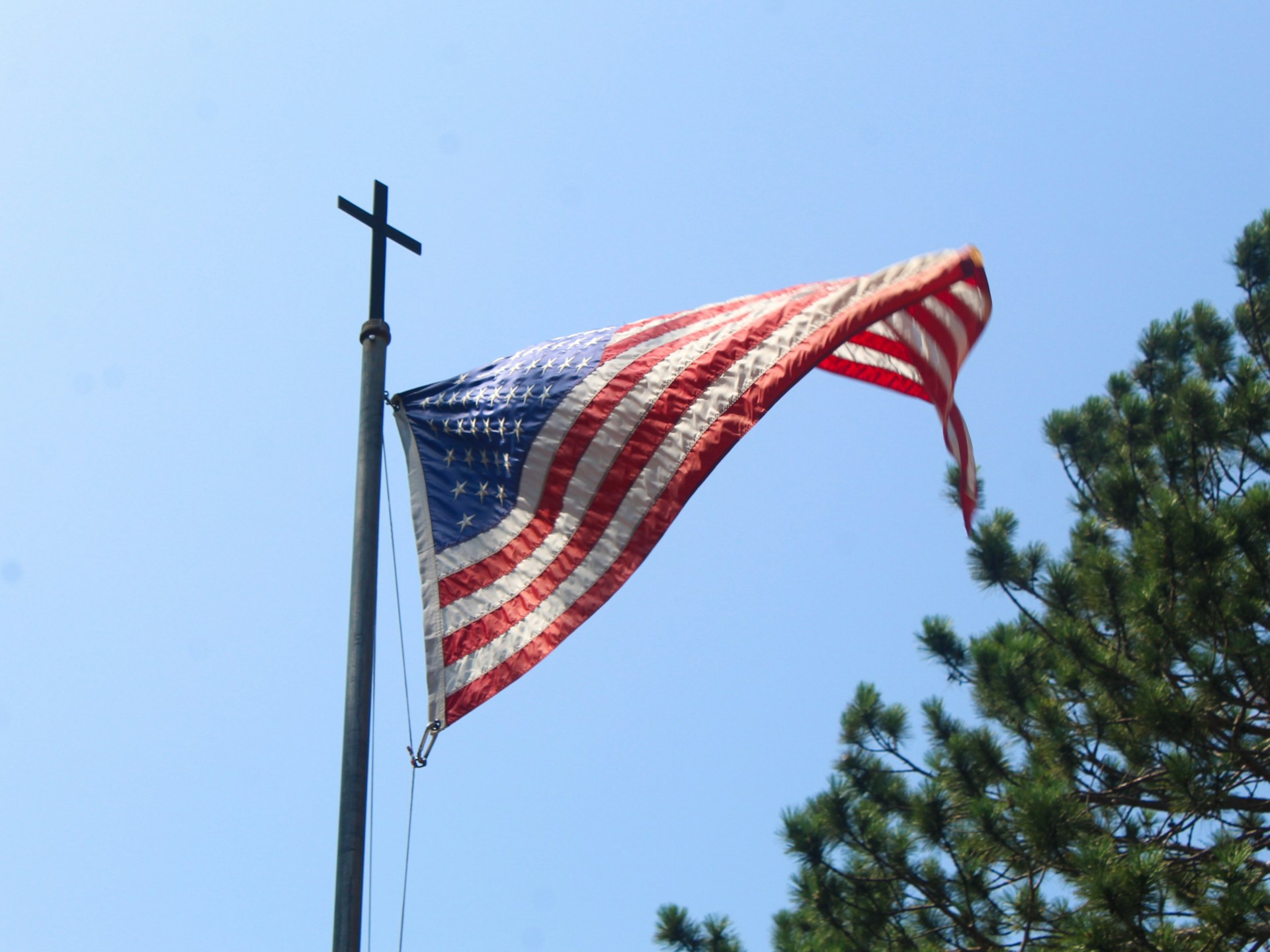
This essay is written by MAYDAY magazine’s Critic in Residence
For the previous three pieces in this critical residency, I’ve focused on evangelicalism, the intersections of Christian and mainstream literature, and the collision of pop culture and evangelical subculture. For my fourth piece, I want to turn the lens toward an expression of evangelicalism more influential and more urgent than what I’ve previously addressed: Christian Nationalism.
Christian Nationalism means exactly what you think it means: using Christianity—faith in Jesus Christ—as a justification for extreme patriotism and to underwrite nationalistic power. American exceptionalism by virtue of divine preference. Tia Levings, author of A Well-Trained Wife and the forthcoming I Belong to Me, carefully delineates the distinction between a Christian identity—which “claims belief and behavior in line with Jesus Christ” —and the Christian Nationalism ideology, which, Levings asserts, “promotes Christian identities and viewpoints as a means to an end: political dominance.”(1) Christian Nationalism has reshaped American evangelicalism in its image, to the point where many people cannot tell them apart. April Ajoy, author of Star-Spangled Jesus: Leaving Christian Nationalism and Finding a True Faith, points out that “the two have become so intertwined that it can be really hard to spot the differences. It’s one of the more difficult things about stopping Christian Nationalism—it hides in plain sight as regular old American Christianity.” The edges are intentionally blurred by Christian Nationalists in hopes that they might win more to their cause by oversimplification: “If you love Jesus, you’ll join us.” That has proven an effective strategy. “One day,” Ajoy writes, “you are just a Bible-believing Christian in a sanctuary and the next you are at a political rally with a Jesus flag. It happens quite slowly and under the surface. That is by design.”
Like me, Ajoy grew up evangelical: a little white girl taught to be proud of her faith and country, and proud of the ways they reflected each other. I remember learning that God guided our founding fathers to this land and helped them set up our democracy. When I still attended a private Christian school, I remember praying in class that George W. Bush would be re-elected president, because he was a Christian and that was God’s will. This same ideological foundation—belief in the United States of America as divinely appointed, belief in Republicans as the correct and moral party—fuels Christian Nationalism today as the force behind some of the most oppressive and alarming political moves in this not-so-great nation’s profoundly checkered history.
Throughout the month of October, I watched clips on my phone of a backhoe clawing into the East Wing of the White House, listened to reports about the failure of the latest ceasefire in the Middle East, scrolled past news updates about the suspension of SNAP benefits during the government shutdown, and I realized that it was far past time for me to become more conversant about Christian Nationalism.
I am a literary critic; I approach topics by reading about them. I’d seen April Ajoy’s satirical videos of MAGA moms,(2) and when I realized that her book, Star-Spangled Jesus: Leaving Christian Nationalism and Finding a True Faith, was released in paperback just a few months ago, I left my house to get a copy.
Reading Star-Spangled Jesus was more activating than I expected—by which I mean, I still haven’t fully metabolized my own religious trauma and Ajoy’s book presses on it. I woke up early the day of Daylight Savings and read her chapter about how Christian Nationalists manipulate the evangelical fear of hell in order to justify certain kinds of political actions—demonizing the U.N., dismissing legislation meant to address climate change, and unequivocal support for the state of Israel. Earlier that week, I’d written my own essay about my childhood fears of hell,(3) and Ajoy’s chapter left me dysregulated and irritable for the rest of the day. Only a few months ago, TikTok was full of videos of people preparing for the Rapture, or mocking those who were. The Rapture, despite its mainstream adoption thanks to media like The Late Great Planet Earth and the Left Behind franchise, is a theologically shoddy end-times fantasy developed in the mid-1800s with practically no biblical backing. Even so, Ajoy documents that “it is a real and widely held belief that affects both our country and our international relations. See, one of the core tenets of the premillennial rapture belief is that Israel must occupy all of God’s promised land before Jesus can come back.” (Ajoy 106) This hypothesis-turned-belief is a major reason for American support of Israel, which has intensified its occupation of Gaza and the West Bank into a genocide that the U.S. has supported and funded. “And it’s being championed and cheered on by Christians in an effort to accelerate the end of the world.”
One dynamic Ajoy captures is how comprehensively we evangelicals ensconced ourselves in ideological echo chambers, because even superficial exposure to differing opinions could threaten our convictions. In explaining the content she was allowed to consume, Ajoy writes, “I knew there were two types of media in the world: good, inspiring, Christian media that would lead you along the right path, and those that would lead you straight to the devil. […] All of it was filtered through a simple black-and-white ideology that directed followers to listen only to voices that align with their worldview.” This is one of the features of evangelicalism that my parents wanted for me and my brothers, because they saw it as protective—but they also didn’t understand its true power and how the consequences of this self-siloing might extend beyond what they could see. This ability to write off outside voices directly correlates to Christian suspicion of secular media, which has escalated to support for conspiracy theories and “alternative facts.” “If you censure every voice except your own,” Ajoy notes, “you become the ultimate source of truth for your followers.”
Ajoy’s book captures her youthful fervor, her early convictions and how they eroded in the face of the harm that they promoted. In a scene that made me physically cringe and push the book away, Ajoy recounts how, while employed as a summer intern at a local NBC affiliate, she was sent to interview a gay couple who had appeared in a JC Penney ad. “In my notebook, sprinkled among my ‘regular questions,’” Ajoy writes, “were ones like, ‘Don’t you think it’s better for a child to have a mom and a dad, though?’ ‘How will your kids learn right from wrong?’ and ‘Are you not also being intolerant of those with a different opinion than you?’” I turned the page and held my breath, too anxious to inhale until I saw how the interview turned out. To my relief, Ajoy was so disarmed by the dads’ kindness that she couldn’t muster the brashness to ask any of her tactless “gotcha” questions. Ajoy’s interaction with the couple brought her face-to-face with cognitive dissonance that would continue to crackle in her psyche for years, until she could definitively break from the theology that asked her to deny the humanity of people who had nothing against her.
Star-Spangled Jesus is excellent: humorous, readable, highly accessible, equal parts empathy and depth. Ajoy treats her former self with grace and levity. She maps out the tenets of Christian Nationalism, the tactics, and the frontlines of its ground war (gun control, abortion, education, queer and trans rights). Ajoy’s book focuses on the internal ideological commitment to Christian Nationalism and how that manifests for an individual. She mentions protests—the ones she and her mother attended in Tennessee the summer of 2020—and of course Trump, but for the most part, her book is about the individual’s relationship to Christian Nationalism and how its mantle—however unknowingly put on—can be cast off.
But what about the groups promoting these ideologies?
Christian Nationalism may not credit a centralized organization, but it certainly claims to combat one. Antifa (short for Antifascism) and the deep state are Christian Nationalism’s avowed enemies, most clearly targeted by QAnon, the conspiratorial ring that claims to protect children from predators. Ajoy touches on conspiracy theories, with a specific emphasis on COVID-19 denialism, but doesn’t spend too much time linking them to Trump.
To my surprise, Ajoy largely neglects the inner workings of evangelical and Christian Nationalist politicking, never once mentioning Project 2025 or the Heritage Foundation. She does, however, include the Seven Mountain Mandate, “a global strategy that seeks to spread Christianity to all corners of the world and often focuses on America as the vessel to do this.” She lists the seven “mountains” which Christians should seek to control: “education, religion, family, business, government/military, entertainment, and media (though there’s slight variation on this list depending on who you ask).” I had never heard of the Seven Mountain Mandate before a few years ago, but that doesn’t mean it wasn’t subtly at play in the ideologies I grew up with. The Seven Mountain Mandate is an expression of dominionism, the belief that Christians have already been granted dominion over the world by God and that they are fulfilling God’s will by bringing every living creature under their power. This is an inherently patriarchal ideology, and Tia Levings links it to “theonomy,” a theoretical form of government rooted in a punitive and extremist application of Old Testament law.(4) Russel Vought, former VP of the Heritage Foundation and co-author of Project 2025, is a theonomist. Doug Wilson, patriarchal pastor and co-founder of the Community of Reformed Evangelical Churches (CREC), to which Defense Secretary Pete Hegseth belongs, is a theonomist, as is Bill Gothard, who founded the Institute for Biblical Life Principles (IBLP).
There is no shortage of scholarship on these groups and their influences. Earlier this year, professor and political expert Matthew Boedy released The Seven Mountains Mandate: Exposing the Dangerous Plan to Christianize America and Destroy Democracy. Journalist Jeff Sharlet has written The Family: The Secret Fundamentalism at the Heart of American Power, about the niche but influential Christian group that’s been responsible for organizing the White House’s National Prayer Breakfast since the 1950s. The far-right is polka-dotted with secretive cabals and front-facing propaganda machines; we are all overwhelmed with rabbit holes and conspiracy theories and big-money coalitions and the despairing sense on both sides of the political divide that choices are being made by forces much larger and more sinister than we regular people can see.
It’s these larger forces—the Heritage Foundation, the New Apostolic Reformation, hate groups and militias—that worry me, that make me wonder if a light-hearted book about personal responsibility is the political equivalent of attending to the plastic straws of my own politico-moral leanings while ignoring the Big Oil of ChristoFascism. So once I finished Star-Spangled Jesus, I turned to Jeff Sharlet’s The Undertow: Scenes from a Slow Civil War.
Sharlet’s book is certainly stranger than Ajoy’s. Its register is more literary, which makes the content feel simultaneously more alarming but more remote. Ajoy’s book could ostensibly be used as a deradicalization tool for well-meaning Christians who haven’t recognized their own slide into Christian Nationalism. However, I can only imagine that someone in that position would be repelled by Sharlet’s grave tone, his lyrical meanderings, his distance from his subjects.
Sharlet is an immersion journalist who specializes in the role of religion in American politics. He has written essays similar to those in The Undertow for years, but Sharlet himself acknowledges the shifts that have accompanied our turn into what he terms “the Trumpocene.” In an essay about a reality-show church in Miami, Sharlet notes, “I’ve been writing about American religion for years…but never before Vous had I encountered a church that seemed so simply and completely empty.” Later, in an essay about a 2020 Trump rally in Bossier City, Louisiana, Sharlet writes about his recorded conversation with one attendee, “I found myself thinking, I can’t use any of this. It’s too much. This doesn’t represent anything but one woman’s delusions. Then I googled [what she had told me]. And—Diane was far from alone.” Sharlet’s subjects—those he speaks to in order to understand the American movement toward Trump—are both more and less credible than the educated elites one is used to encountering in several-hundred-page books of meticulously reported political journalism.
Sharlet’s book is a work of anthropological curiosity, and he targets as his subjects the willing soldiers—“boots on the ground”(5) —of what he comes to see as a slow civil war. Sharlet’s research centers experiences and exchanges with his subjects in their spaces. In the essay “Whole Bottle of Red Pills,” Sharlet goes to a conference on the Manosphere and then sticks around for a private after-party in Paul Elam’s hotel suite. He profiles Vous Church, a Miami reality-TV congregation pastored by Pastor Rich Wilkerson Jr., famous for officiating Kanye and Kim Kardashian’s wedding. Sharlet drives across the country, documenting and conversing. When he stops for drinks, the bar he bellies up to is often that of an American Legion or VFW hall.
I have long loved Sharlet’s style of writing: voice-driven, first-person reporting that originally bore the mantle of the New Journalism, a school of reporting that dropped the impossible pretense of an objective observer. Sharlet writes with humor and insight, supported by a career’s worth of contextual knowledge about the role of American religion in politics. His essays often take place in scene, present-tense narration: “the tense is shifting again,” Sharlet writes, hurtling, sleepless, from Nebraska to Ohio, one hot church parking lot to another, one fever dream of revolution to another, one more day taking his limited heart pills far from home. He brings in secondary source material to corroborate and contextualize what he sees and hears. For example, in his early essay about a 2016 Trump rally, he introduces Trump (of course, the man needs no introduction) and then presents his ideological backdrop, Norman Vincent Peale’s The Power of Positive Thinking.
In one sense, Sharlet is an exemplar at his style of writing. He has done his research. He can swap Bible verses and references with the best of them. He has fraternized with the enemy and reflects them back to us in their own words. He references repeatedly the delicate balance of journalism: getting close enough to the subject to see them as they are and then leveraging that access, that trust, to expose them to us. Sharlet records the instances in which this balancing act cannot be achieved—when his “handler” at Vous Church tracks him down and scolds him for not sticking to his pre-approved agenda, or when an armed security officer intervenes in Sharlet’s conversation with a group of women in a parking lot after another strip mall church service. Sharlet, a member of the media, is persona non grata in many of these settings—”Goddamned media,” is how Ashli Babbitt’s mother refers to him from the podium at Ashli’s memorial service, “naming the enemy she held most responsible for her daughter’s death”—and that designation is sometimes followed with intimidation or threats. “‘We welcome you!’” boasts Pastor Hank at LORD OF HOSTS in Omaha. “‘Report on! Write on! I hope you enjoy yourself!’ The truth is, I have been,” Sharlet admits. “The music, the fantasia. Great material.” It is to Sharlet’s credit that he never pretends an identity or affiliation other than his own. But that’s also the fundamental flaw—identities and affiliations in this book stay static, fixed. There is an enemy. There is an “us”—the reader—and there is a “them”—Sharlet’s subjects. In his efforts to study them, Sharlet cannot help but exoticise his subjects. His fascination with those on the fringe necessarily keeps them there. This alienation is part of what fuels their anger, their indignation. The Undertow offers no vision for reconciliation.
But what am I looking for, I ask myself—a conversion story? Ironically, I can find one in Ajoy’s book. But this isn’t the intent of Sharlet’s writing. His book is a document, an archive, a reference. As a journalist, he seeks not to alter outcomes but to record events. Acknowledgement of our political polarization is perhaps the most widely agreed-upon point in contemporary American politics. There is an us, and there is a them, and what they want is threatening our way of life.
By contrast, Ajoy humanizes the Christian Nationalist; after all, she was one. “Now, I wouldn’t have called myself a Christian Nationalist back then,” she notes. “I thought I was just doing what every good Christian was supposed to do: love God, love people, and vote red.” She charts what she believed and advocated for then and how she moved away from it. Sharlet can offer no corollary tale of personal transformation, but it would also be wrong of the reader to want him to—that’s not what The Undertow is trying to do.
Ajoy’s book feels nearly frivolous compared to Sharlet’s—his cover shows a grayscale evidence photograph of the switchblade that was in the pocket of Ashli Babbitt; whereas Ajoy’s title is spelled in red, white, and blue sequins—but her tonal levity is intentional, disarming, and deployed to great effect. Sharlet is a documentarian. Ajoy has exchanged orthodoxies—she no longer believes that “Republican-ness was close to godliness”—but she remains an evangelist, explaining her position in hopes of winning converts.
“If I can change,” Ajoy promises, “anyone can.” Sharlet offers no such promise. He’s not interested in hypotheticals; he wants to know what we do with the reality fomenting in our palms. I want to strike some kind of middle path between the two: complicating Ajoy’s levity and diluting Sharlet’s severity. Is his seriousness something I would fully embrace if I had the courage to look closely, to see clearly? I do believe that Christian Nationalists have a clear vision for the United States that involves subjugating nearly every population besides white patriarchs, and this is incredibly alarming.
Around the same time I was immersing myself in these texts, my social media feeds filled with clips of Steve Bannon’s interview with The Economist, in which he asserts that Trump is pursuing a third term as president.(6) Current reporting suggests that Bannon’s “Trump ‘28” assertion is more indicative of in-group feuding than any discrete plan to keep Trump in the White House, while online commentators note that Bannon’s projections align with what Trump has been threatening all along.(7) Do you remember during his 2024 campaign, when Trump promised Christian voters that if he was elected, they wouldn’t have to vote again?(8)
I divested from white American Christianity—or I thought I had—before the canonical conflation of “evangelicalism” and “Trumper.” I want to wave my hands and say, “Not my circus, not my monkeys.” Pilate, washing his hands of the situation. “He’s not my king.” I want to pretend like the situation has nothing to do with me—but there’s no way to pull that off that doesn’t include a willful blindness towards the ways I was indoctrinated into narrow thinking and suspicion of outsiders, towards conspiratorial thinking and strict binaries. Every day, I am working to deconstruct the legacies of such frameworks in my life.
Is that enough? Is a civil war looming, or already underway? And what do we make of the way Christian Nationalism has infiltrated the American psyche going forward?
Of the January 6 investigations, Sharlet writes, “I do not believe they will ever, in a true sense, be ‘resolved.’ This isn’t that kind of story. The crisis kind. The kind in which the outcome is yet to be determined.” At no point reading his book did I consider the ending a matter of suspense. No plot twists were lying in wait in the final hundred pages. Was my response the comfort that arises from predictability, or despair in the face of the predetermined? Sharlet gives his final diagnosis: “It isn’t a ‘crisis,’ January 6, any more than the fire and heat I’d been driving through all these miles. It’s a condition. Our condition. The one we share.” If it is, indeed, the one we share, then I hope I will be able to encounter the Other there, and perhaps we can find a way to grow beyond our present condition.
1 Tia Levings, “Why a Christian Identity Differs from a Christian Nationalist Ideology,” published via Substack on October 10, 2025, accessed November 03, 2025; https://substack.com/home/post/p-175818844
2 April Ajoy, see: https://www.tiktok.com/@aprilajoy/video/7563425790658874654?lang=en, https://www.tiktok.com/@aprilajoy/video/7567126567382469918?lang=en
3 McKenzie Watson-Fore, “What Up, Skidmarks,” published on Substack on November 04, 2025, accessed November 04, 2025; https://open.substack.com/pub/mwatsonfore/p/what-up-skidmarks-its-bad-janet?utm_campaign=post-expanded-share&utm_medium=web
4 Tia Levings, “Breaking America for God: What Russ Vought Believes Will Hurt Us,” via Substack, published October 03, 2025, accessed November 06, 2025; https://substack.com/home/post/p-175232482
5 This phrase is sourced from the tweets of Ashli Babbitt, the woman who was killed during the January 6th insurrection at the Capitol. The titular essay of Sharlet’s book chronicles the cross-country road trip he makes after attending her memorial service in California; he interviews Americans about her legacy while driving back to Vermont.
6 See “Could Donald Trump Become President Again in 2028?” by The Economist, published October 30, 2025, accessed November 06, 2025; https://www.economist.com/united-states/2025/10/30/could-donald-trump-become-president-again-in-2028
7 “Steve Bannon Responds to Report of MAGA Rift over Trump 2028 Plans,” by Kahleda Rahman, for Newsweek, published Nov 03 2025, accessed Nov 03 2025; https://www.newsweek.com/steve-bannon-responds-report-maga-rift-trump-2028-10981809
8 Anna Betts, “Donald Trump Repeats Controversial “You Won’t Have to Vote Anymore” Claim,” via The Guardian, published July 30, 2024, accessed November 06, 2025; https://www.theguardian.com/us-news/article/2024/jul/30/donald-trump-wont-have-to-vote-anymore-fox-interview
MCKENZIE WATSON-FORE is a writer, artist, and critic currently based in her hometown of Boulder, Colorado. She holds an MFA in Writing from Pacific University and a BA in Biblical Studies from Gordon College. She serves as the executive editor of sneaker wave magazine, and her work has been published or is forthcoming in Full Stop, Christian Century, the Offing, CALYX, and elsewhere. When she’s not writing, she dances Argentine tango, knits baby cardigans, and watercolors her feelings. McKenzie can be found at MWatsonFore.com.
