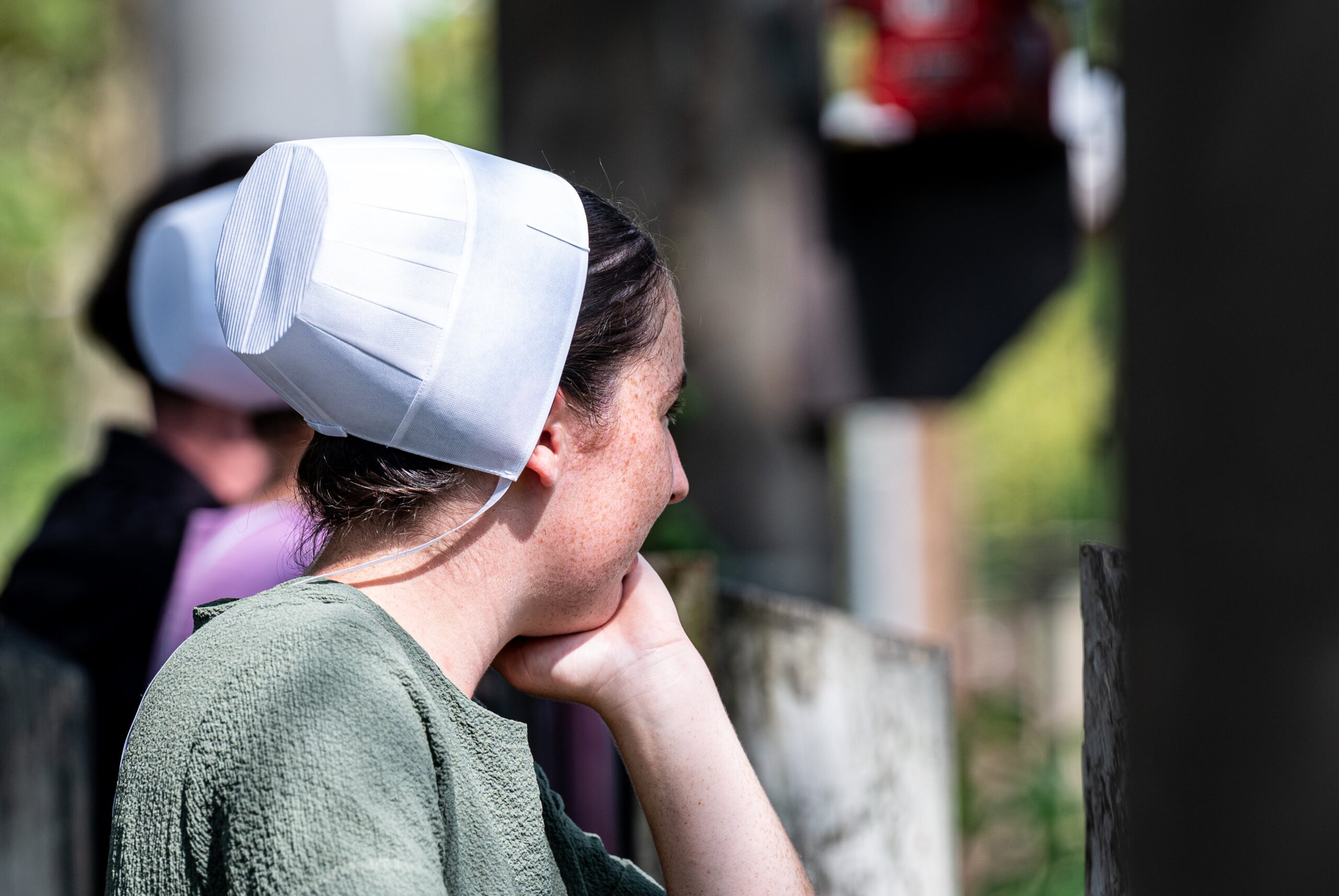
I notice them first during boarding. I don’t see her there, she’s camouflaged, just one of the flock. There is a cluster of them, too many women and girls together, all dressed in wine-colored gowns down to tennis-shoed ankles, with gray fleece jackets over their shoulders, tall black hats pinned to their heads. The man who is with them is gray-bearded, gray-haired, wearing suspenders that look homemade.
When we board, they disperse throughout the plane. I am rude, my eyes follow them. I’m curious, or sorry, or angry, or all three, I can’t tell.
Of course, there is one in my row. She sits in the middle; my seat is the aisle. I wonder if she’ll speak to me or if I’ll speak first. I remember I spoke first to the young woman in the pleated white cap who sat next to me on a delayed flight from Chicago to Virginia. Eventually, sitting in the darkness awaiting departure, I asked if she had studied CLE, the Mennonite homeschooling program made in Harrisonburg, Virginia. She had, all her life. I admitted I’d studied it too, all my life until college. She was taking classes at a Mennonite college, she wanted to be a nurse’s aide. I learned later that the Mennonites run many elder care homes in Harrisonburg.
The girl with the black hat on this flight speaks to me first. She asks, “Do you like this?” and it takes me a moment to understand she means take off. Or maybe I speak to her first. I offer her a stick of gum once I’ve taken a long time stripping the plastic off the box, so she’ll see it was sealed. Maybe that’s why she talks to me, maybe not. Either way, I’m impressed. She’s so friendly. And then I wonder if that’s what people thought about me. So friendly, so social, what a complete pity.
She asks me how many times I have flown. “I don’t know,” I tell her.
She asks, “A lot?”
I tell her truthfully, “More times than I can count.”
I ask her how many times she has flown, and she tells me this is her second time. Her first was to DC from Columbus and I realize she means today. “So just now?” I say, “Today was your first ever flight?” She tells me yes.
I hear another of them, just a couple rows back. She is asking her seatmates if they speak English. They don’t, only Spanish, and she smiles sweet but resigned. The girl next to me looks younger than her.
I hope she won’t proselytize to me.
“Where are you headed?”
“Bolivia,” she says.
“Is it your first trip abroad?” Then I remember, as she nods, “Oh of course, it must be.”
“How old are you?” I ask then.
“Seventeen.”
I find this hard to believe, I would have guessed twelve, maybe thirteen. Did I look that young when I was seventeen? But then I wore makeup and tight dresses, tops and jeans that showed off my body. I was expected to sell—posters, CDs, salvation through Jesus. Maybe she isn’t.
“You’re younger than I was on my first flight,” I tell her. “I was nineteen when I first went on a plane—on a trip like yours, from a big city to a bigger city, then to a foreign country. Only I was going north.” I think of my itinerary from cities familiar—Curitiba, São Paulo—to those I’d never seen—Orlando, Detroit. I don’t tell her my ticket was one way.
“I still love to fly,” I say, “but the first flights are always the best.” I smile at her. She grins and nods in agreement.
I don’t tell her that nowadays at takeoff, I mostly feel a roll that starts in my head and ends in my stomach. I don’t confess that while I like to stare out the window, sometimes I just lay back with my head against the seat and forget to look at all, till we’re high in the air and there’s nothing but darkness.
Her parents, if that’s who they are, sit in the row in front of us. I wish, almost, that she would try to convert me, though I don’t know how I would act if she did. It might make me angry; it always makes me angry when I see children preaching. Once, when I was in graduate school, someone knocked at my door. I lived over an orthodontist, at the end of a large parking lot that during the day was crammed with cars. The doors to the second-story apartments were in the back of the building, up narrow steps that overlooked a leaf-covered alley where us tenants squeezed in our vehicles. No one ever knocked on my door.
When I answered, I found a woman and a child, maybe six years old, maybe ten, I’ve become bad at estimating children’s ages. The child, after a prompting of the woman’s hand on her back, held out a tract, asked if I knew Jesus. To the child, I leaned down and smiled, but over her head I glared at the woman I assumed was her mother. I hated her. I wanted to ask her why the girl wasn’t in school, why she thought this was a good idea, forcing the weight of strangers’ souls on a child. I wanted to ask if she believed that truly good news, truly good ideas, would be evidenced by their bearers being children coerced by adults. I wanted to strangle her. To snatch her daughter away and clutch her to my chest. I did none of these things.
Instead, I made up an excuse to end the conversation and waited at my window for the woman and child, watched them traverse the parking lot of cars. Imagined what the mother might be saying to her daughter to make her believe they had changed my life for the better. For hours after, and again now, thinking of this on the plane, my body is tight with fury. That girl with her hand outstretched with a tract, this girl with her wine-dress and black cap, make me wonder how I looked, all those years I spent handing out colorful posters, begging at stoplights and strangers’ doors for donations in exchange for a magazine I promised would transform their life.
I want this girl on the plane to ask, like the Mennonite woman on the ORD-DCA flight, whether I still believe. I guess I want a reason to tell her that I am now an atheist. I want her to know that there are nonbelievers who can still be kind. More than that, I want to tell her that I was raised something like her and that I got out. I want her to know that she can leave. I want to say that it will be hard, that it will hurt but that her life will broaden, and she will realize that the outside world is a joyful, messy, gorgeous place.
I want to save her. I want to go back and save myself.
I wonder if this girl feels justified in her belief. Does she feel special, sanctimonious, holy, the way I once did? Does she feel trapped like I also once did?
“What are you doing in Bolivia?” I ask, “How long will you stay?”
“Two weeks,” she answers, “we’re visiting some of our church family who live down there.”
“Which church is that?”
She mumbles half under her breath, “New Order Amish.”
I remember reading about Mennonite and Amish communities moving to South America. I think of my own parents, their flight from North to South, an escape from the norms and the looks and the judgment down to countries where their leaders thought no one would care.
I know I can’t save her. What can I say here, behind her elders? What could I say anyway that would cause an impression? That would pierce through the bubble of her whole life? I try to remember people who might have wanted to save me. I try to recall strangers who told me they were atheists, who said it wasn’t right, to raise kids that way, who lashed out at my parents. I can’t remember faces, only feelings. Feelings of horror, of fear, of hiding.
I learn that she’s from southeast Ohio. Just outside Athens, the college town where the girl came to my door. I tell her I went to school in Athens, I lived there four years. I sometimes drove slow behind black, Amish buggies that took up the road, though I don’t tell her that. I don’t ask but I wonder if she goes to school, or if she ever will. I want to tell her she can. That nothing is ever truly out of reach.
The flight attendant hands out earphones and she doesn’t take one. I wonder if she isn’t allowed. I watch a movie and see her eyes stick to the screen when she thinks I’m not looking. I search the menu for subtitles so she can follow along but there are none. I want to hand her the earphones, to say, here, take them, watch a movie about the world that you’re kept from. But I know she won’t take them. I wonder if she watches TV in secret, the way that I used to. If she’s scared of being in trouble, if she’s punished for bad acts or bad thoughts that are perfectly normal. If she’s worried deep down that she’ll go the wrong way or if she’s longing to find a new way to go.
I think of ways to help her, this girl I don’t know who hasn’t said she needs help. What if I slipped her my number? Whispered, “I don’t know you, but if you ever need help, don’t hesitate to call.” I imagine her calling, a move to DC. ACT prep, college. A life on the outside.
I have a bad savior complex. Maybe it comes from an early adulthood spent in poverty. My husband and I have had four different people live with us in as many years: siblings, friends, people we were trying to save. Again and again, we fail. I fail. Troubled relatives and acquaintances step into my house and leave months later, with the same troubles or worse: twisted marriages that should die but don’t; drug addictions that lapse only to return; anxieties that morph into diagnoses, suicide plans, hospital stays.
When I chose to enter the world, there were people who wanted to help me, and did. But the first move to leave, the saving at that moment and every moment since, I’ve had to do myself. I don’t know that I’ve succeeded. Perhaps this is why I feel others cannot save themselves, that I must save them, the way that I wish someone would have saved me. Maybe it comes from a childhood belief in a savior. Or a childhood responsibility to save the whole world. I need to get over it. I keep thinking I should see someone.
What can I offer anyway? The world is hard. If I could have kept on believing, maybe it would have been better. I have thought this many times. When I have been broke, when I have been depressed, when I watched loved ones succumb to addiction, when I watched friends hurt themselves, get committed, be broken again and again by this world that we all fought so hard to break out to. Maybe we would be better off where we came from, all locked inside. Still, despite all the shit, and despite how okay this girl next to me looks, her clear, trouble-free face, I feel she is lost, and I want to save her.
We don’t say much more through the rest of the flight. She watches my screen and the window-seat screen. She falls asleep at one point. She wakes up and watches the end of my movie.
As we begin to descend, the girl presses her ears and I offer her gum. She takes it and thanks me. I ask if she’d like the pack.
“Please take it,” I say, “I have another.”
I wonder if she’s allowed to chew gum like I was, on rare occasions. I wonder if there’s money for luxuries like gum. She takes another stick and again I offer the pack.
“Oh no, this is enough,” she tells me, and I say,
“Then take one more, one for the take off and one for the landing.”
She unwraps one and puts it in her mouth, slips two silver-wrapped pieces into her backpack.
I wonder what she carries, besides the blanket she pulled out earlier that was identical to the one the girl a few rows behind us covered herself with. I wonder if she has anything that’s private, any room, any bag, any word of her own in the world where she lives.
I put the gum pack in my own bag and swallow the stupid questions that rush to my throat, what about the flight back and the flight to DC, and back to Columbus? Will they give you gum for your ears? The church family in Bolivia?
I tell myself that she will be fine, that we all are fine, in our own way. That no one can save her except for herself, like no one could save me except for myself, if that’s what I am now, saved.
The plane drops further out of the sky. I tap the girl’s arm, point out the opposite window. She smiles at me and we both stare. The window nearest us is all black ocean below, but the square of glass just across the aisle is a glow of orange and yellow. Lights that look alive, reaching for the sky.
KRISTI FERGUSON is a researcher and writer. Originally from Brazil, she currently lives in Arlington, Virginia with her husband. Her fiction and creative nonfiction has appeared or is forthcoming in The Daily Drunk, Litro Magazine, BULL, and elsewhere. Connect with her on Twitter @KFergusonWrites.
