This story won first place at the MAYDAY 2024 Short Fiction Contest.
I don’t know why I was chewing on my uncle’s arm, but I was. As a child I don’t know why I did a lot of things, so must find meaning from a memory handed down to my not-child-self: being small, and chewing on an uncle’s arm, because it was covered in hair, a dense forest on a muscularly dense arm, not chewing (even a child would have found that weird), gumming really, that’s less weird, pulling at the strands to see if like a puppet I could control that beast of an arm. Guests were appalled and commanded me desist, but I resisted and gnawed, or hummed, the hair between my lips, and he told them to desist and let me be, his voice was booming, hint of growl, hint of wolf. I knew then he would always protect me. I let go of his arm. He had passed the test.
The vending machine lied. Perhaps all machines lied, at least this is how it seemed to a child’s eye, sad at what it saw, or what it didn’t see: Christmas boxers, snowy night skies, humid pools lit with blue, red exit signs, panic and the fumbled steps of confused adults; none of these remained in the vended book, that tiny diary, the means to record what I saw on that trip, the cheap, yet red, binding held none of this, so in anger I wanted that quarter back, so in anger I kicked the machine. A chime went off, a tame version of the fire alarm that went off the night before, the event I tried to record in that child-sized-book using child-sized-words.
The fire alarm rang in the middle of the night, in the middle of the hotel, in a middle floor, somewhere in the middle of Colorado, it was a loud screeching that brought everyone outside, dazed, wearing whatever adults wore to bed, which to a child was very little, yet very amusing. Compared to that night, the vending chime was smaller, almost apologetic. As it should be. The machine, after all, a touristy-hotel-souvenir-novelty-dispensing-bandit, the one for which I begged a quarter, and hated myself for doing so, promised the one thing, out of a sea of silliness, that I needed: a way to be taken seriously.
It was a road trip, SUV up front, popup camping trailer in back, stopping for the night, for the sake of the parents, kids having napped most of the way, now dense engines of energy, screaming down hotel hallways while all else sought rest. And in this manic exploration I found the machine. The novelties, all for a quarter. I looked up at it, then looked down in child-disgust. Novel meant to not take seriously, and I, after all, was a serious-child. Serious-children do serious-things, like write down their thoughts, read before bed, and floss after meals.
This vended non-serious things, 8-ball keychains, temporary tattoos the size of a pinky nail, tiny sticky rubber-hands, miniature bicycle cards, pens with six colors that looked like the barrel of a revolver, spectacles that let you see bones, and a cellophane fish that would tell your future. But one thing out of all those rows caught my eye, and so the machine had won: I needed that tiny-big vinyl-bound journal with a sleeping Snoopy on its red cover and a tiny-big red pencil in its tiny-vinyl side-loop, sitting chunkily on the bottom row. But Snoopy got stuck, I sighed, barely heard above the hum of the ice machine nearby, but enough to draw my uncle near, so I pointed to the book. He liked books. He took them seriously. This is why I needed it. I asked him for another quarter. His large arms smiled for him, and he shook the machine like a box of crackers. Snoopy fell. Other things fell too, the other kids got their novelties, their silliness. The chime was too dazed to chime.
I forgot to floss that night, perhaps I wasn’t a serious-child after all. Still, I clutched the journal tightly and took it everywhere, it was not novelty because I could use it to document the journey, make from it a book, thick, dense, recording in words the scene of hotel guests holding their hands over the middle of their ears to muffle the sharp sound of a fire alarm, the one which had recently been pulled in the middle of the night, in the middle of that hotel, by someone who was definitely not me, followed by confusion, shouts, the sight of grown men running into walls like misguided toys, displays of shocking illiteracy as entire troves of sleepy adults failed to read signs on the walls, pointed arrows of egress, glowing red exits, paths to a fireless freedom, crowds forming at elevator doors trying to pry them open, fingers slippery with cold cream, pushing the call button hard enough for it to dislodge and fall surrenderingly on the floor, giving-up, inert near the unused door marked stairs. The tiny-big red pencil moved with fury like flickering flames as it burned all these words onto paper, smokeless inferno.
But I knew there was no fire, only words. But he didn’t know. So from the crowd emerged my uncle, just from sleep, shirtless, pantless, a giant of a man, having dense forests of hair in places, as a child, I had not seen before and didn’t even know existed, with a slight pair of jingle-bells boxers for modesty, pinching the fur around his waist, the landscaping of his body acting like Velcro, adhering to those he brushed up against, dragging them along too, but he still lumbered forward somehow, calling out to through the chaos, his booming wolf-voice a beacon, me frozen mid-sentence, him a guardian again, hero of his own story, scooping me up in his mighty arms, he pressed me tightly to the quilting of his chest and flew through the panicked crowds like a fighter pilot, which he was, or at least used to be, but now was just an uncle, an uncle who I knew would bring me to safety, to the outside of night, so I could catch the last of the winter snow storm as it passed, catch the last falling snowflake on my cool tongue.
What I did know was that my uncle passed the test. I had the written account to prove it. Only I didn’t. Serious-children do not know that you cannot fit a real journal in a vending machine for only a quarter. Only pretend ones. The red cover that covered the pages held true, the snoozing Snoopy, its hairless protector, ensured that, and the pencil did contain at least a few cents worth of lead, so the words were indeed written, but between trademark royalties, the ever increasing cost of premium vinyl, and the expense of overly-applied red paint, there were no cents left for glue, the meagerest of daubs miserly applied, enough to keep the pages inside when on display, but not enough to keep them from melting away if carried everywhere, held with clammy hands, read by the steam of an indoor pool, jostled by a jet-pilot, dampened with midnight-snow, with the cold that came from being in the middle of Colorado in the middle of winter, Snoopy pulling the cushioned vinyl cover over his long ears to hide, but pulled too hard, tugged the binding, loosed the glue, loosed the pages, the words, the memories of that night, loosed so they all fell out. Bad dog.
Maybe that’s why the following year my uncle died. He was stronger than a bull, could take on any matador, lived a life that was above reproach, noble, pure, ate supreme, every vitamin in the alphabet, conquered every sport, took care of his mind, loved books, a monster of a man holding in his hulking hands a tiny paperback, all books to him looked like novelties from a vending machine, but from these books he grew smart, and from life itself he grew strong, but what good did the pills, the pushups, the pop-up trailers do him, the brawn, the books, the brains, as he lay there dead on the operating table, a routine surgery (no reason to have assumed otherwise), why then, after saving me from the threat of fire, after navigating snowy roads back home, after giving me an arm to cling on to, why did he so easily give up? Why did he refuse not to wake? Why did the plug have to be pulled? Why could he not pass this, the simplest of tests?
Was this revenge for me pulling his hair, using my gums to move him like a puppet when now he lies motionless, a million wires thicker than the hair sprouting from his body, no longer seeming massive, but smaller somehow, reduced? He sank further into the two-ply hospital bed, sank further into unconsciousness, never again to open his eyes, never again to silence the alarm of a vending machine, the only machines now were small, made small noises, made him small. Soon the smallness stopped its chime. Stopped, like the fire alarm stopped that January night. But that was a call to safety, this was a wailing at its loss.
My last road trip was me in the front, him in the back, in a jar. Even ashes get buried at national cemeteries which is where we were going. It was near the state capital, not-far, but not-near enough so that by the time the ceremony was over, no one wanted to drive home, so we sought a hotel, for shelter, for sleep, for comfort, or perhaps just out of habit. Thoughtlessly I asked my mom to find one that had novelties. Also, a habit. I needed one more vending machine, to look one last time for answers or wisdom or some charm to ensure that I would be ok, something I could put on a keychain, hide in my pajama pocket, tuck under my pillow, something to be a protector in a protector less world. I only found vending machines of Coke, Snickers, a dusty sleeve of peanuts, and a pack of chewing gum that had wilted for lack of being chewed. Maybe hotels lied. Maybe those vending machine never existed, those metal boxes of coins and promises, flashing lights and fantastic fantasies, giant wiry coils that pushed cellophane treasures to lemming-like falls behind an iron gate, a one-way trapdoor, an escape to freedom only to be left behind in the snow. Perhaps that was the test, one which I failed.
The hallways were empty and quiet. The middle of the week is not peak time, hotels profit between weekends by giving shelter to the grieving. There was plenty of room at this inn, but I sought sleep in a stable instead, some hay to lie in, in the hopes I’d wake wise. Instead, I found the parking garage, underground, two levels of concrete and green fluorescence. There were no cars save one. Parked in a striped zone was a fire Marshall’s truck, dormant. In a scene that would have been called ironic, had I known the word at the time, a lone fire alarm was mounted to the concrete pillar near the truck. I reached out my hand. I looked both ways, hoping to see the ghost of my uncle telling me not to do it. There was no ghost that day. There was also no alarm that day either. But I did pull it. For some reason it didn’t go off. I took a quarter from my pocket and wedged it into the casing of the open alarm. I wanted it to stay ringing. I lay in bed that night straining to hear, but never did, and still don’t to this day.
Now I am older, not a child. Now I am an uncle, and must test myself, must try to rescue my nephew, a child himself, but I lack the strength of my uncle and call out for his help but hear nothing in return, look down empty hallways, but see nothing, see only the bookshelf at the end, and the books he left. My nephew climbed up to pull one down. It had a blue cover, an illustration of a shadowy figure saving someone from a burning building, the light from the blaze, stylized, obscuring them both, it was not even clear who was saving whom. He put the book in my hands and begged me to read. The cover opened, the binding crackled, but held fast, held onto its pages, and I began to read, the child peering over one arm. Beside me a ghost appeared. A wolf. I felt his fur, as it brushed up against me, like Velcro, holding fast, always be, paws heavy, like anchors, to keep me from blowing away with the world, and eyes which can see in the dark, to lead through uncertainty, calling with a voice that communes with the moon. I feel him as we read. The fur from his neck tickles, the weight of his head settles into the crook of my arm. The child falls asleep on one side, the wolf on the other. I can feel their dreams. Can feel a hum, a gumming, a tug, along one side, either side, or both sides of my arms. I smile to myself, or perhaps I smile out loud. A bit of bone briefly glistens as I smile. Something to chew.
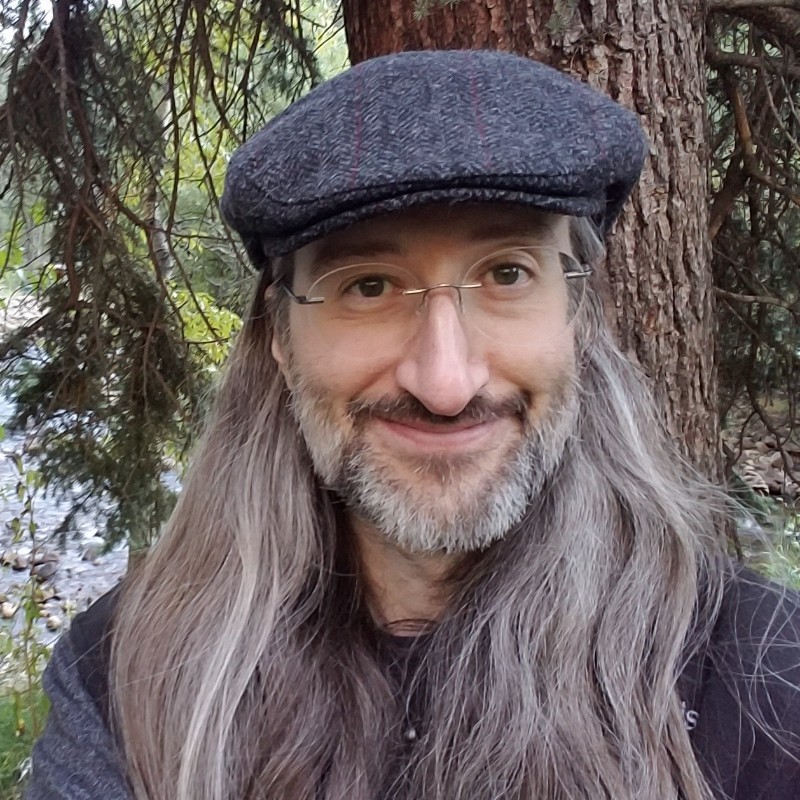
AARON BARRERAS is an unlikely writer who started life as a small-town boy from New Mexico and somehow stumbled into an award winning career in film, animation and VFX. After making pixels all day, writing is a chance to escape the screen, which he stares at far too often, and to make words instead, which he doesn’t do often enough. He’s no longer a boy, but still lives in a small town.
