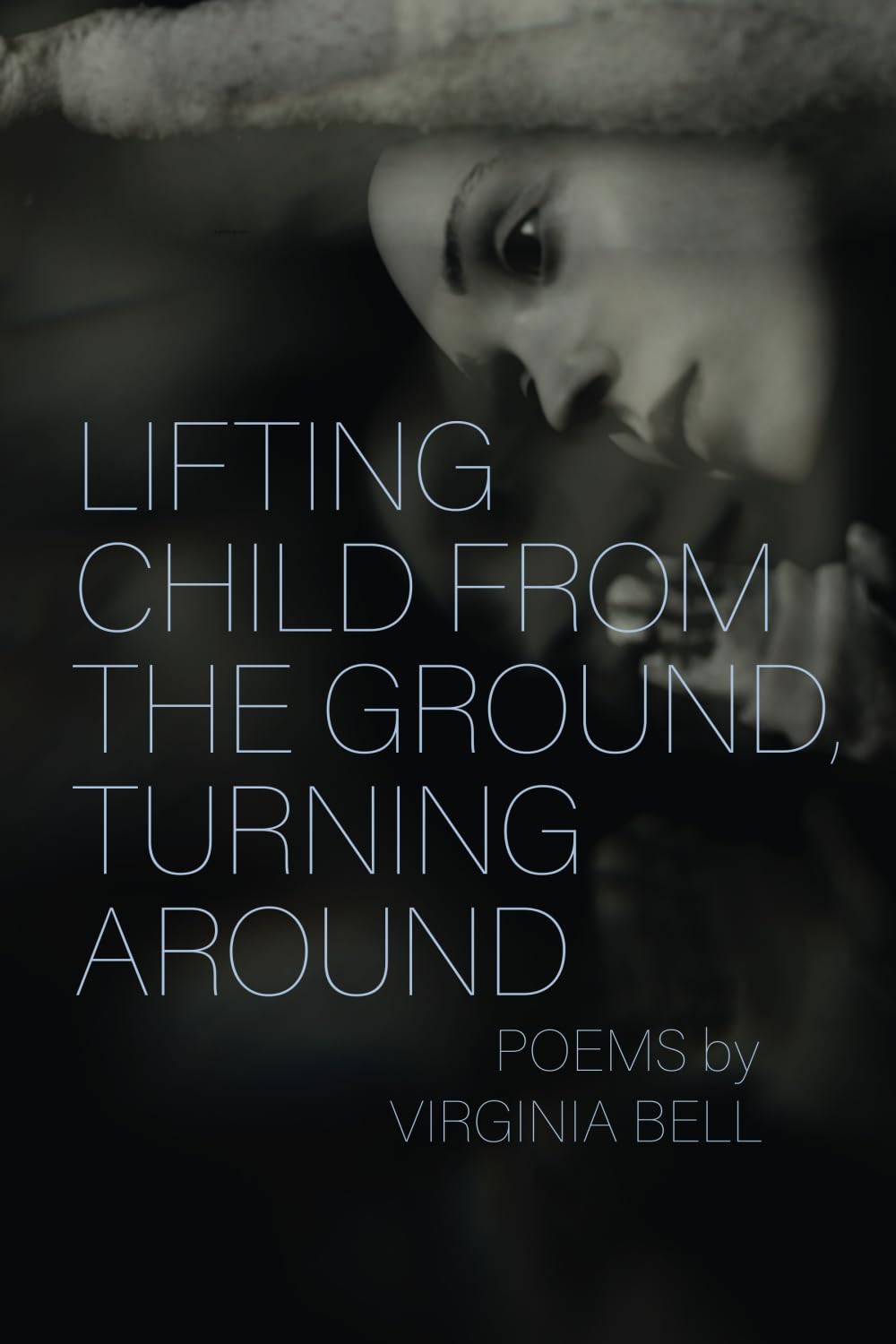
There’s a moment in Virginia Bell’s poem “The Invention of Walking” where the speaker’s son shares with her his observations of how humans walk: “…some like windows opening out // or in, some like puppets dangling— / he imitates to show me, then he imitates // me, my Neanderthal arms swinging” (p. 39). It’s an intimate moment between the two on the one hand—a chance to laugh together—but also captures an ambivalence the author feels about motherhood. She realizes that “It almost kills to be seen / as a mother,” the word “kills” meant in both senses of the word, humorous and deadly.
Motherhood in all its complexity is a central theme running through Bell’s new collection Lifting Child from the Ground, Turning Around, both being a mother and the experience of being a daughter to an aging mother with dementia. But the book’s fascination with Eadweard Muybridge’s late nineteenth century exploration, through photography, of the nature of motion adds to the collection an additional imagistic, linguistic, and emotional depth, and raises the question of what it means to be seen and by whom.
Bell (Co-Editor of RHINO and author of the poetry collection From the Belly) is as fascinated with those on the other end of the lens—those being studied—as she is with the process of discovery of what it is to be human. She writes later in “The Invention of Walking” that the Inventor (as the fictional character representing Muybridge is referred to) “commanded / his subjects to walk so that he could // see their invisible selves” (p. 39). These lines call out a male power dynamic and reductive process to discovering the grace and meaning that those being studied already have.
Bell takes on the voice of a number of those subjects being photographed, including that of the race horse Sallie Gardner in the poem “The Invention of Suspension,” writing “I could have / told them there // is a moment / when my four // hooves are / all in the air at once” (p. 50).
And while it’s clear the reason someone who is inventing the precursor to motion picture might be referred to as the Inventor, the way Bell uses the term and her suggestive poem titles like “The Invention of Marriage” or “The Invention of Motherhood” raise for us the questions of why or in what ways the discovery of something that already exists is invention.
Many of Bell’s poems are in conversation with those who’ve passed away—not just a grieving for her still-living mother who is no longer the same person, but also for her brother who died. And the title poem is a conversation with a friend who’s passed away, about time spent after the friend’s death with the friend’s daughter: “We talked / about the invisibility of grief” (p. 96) the speaker reports to her friend. And it is the attempt to untangle and uncover those invisible things that make this book compelling. Ultimately, the poetic undertaking is not only one of discovery—the way the Inventor is trying to discover the invisible mechanics of motion—but one of reclamation in the midst of grief, and as such is a true work of poetic imagination.
BRIAN SATROM’s poetry collection Starting Again was released by Finishing Line Press in 2020. His reviews have appeared previously in MAYDAY and at the Center for Literary Publishing. You can find more about him at briansatrom.com.
