Six Ziegfeld girls in their teens were in the theater dressing room that night in 1916: Olive Thomas, Lilyan Tashman, Fifi Alsop, Bessie Poole, Kathryn Lambert, and Martha Mansfield. An old woman walked into the girls’ dressing room to sell them cosmetics. As they talked, she told them she used to be exquisite too, one of the original Florodora Girls, a double sextet that performed in the Edwardian musical comedy Florodora. That made an impression on those six beautiful girls, who had always taken their youth and beauty for granted. Olive Thomas then said that she imagined what her life would be like in 20 years, and for the first time, the girls thought of how flimsy their fame could be. They agreed to meet in that time, to reunite and see what the future had held for them.
Olive Thomas died in 1920, at 26, of mercury bichloride poisoning, after ingesting a medicine that was supposed to be for her husband—some suspected suicide or even fowl play. Bessie Poole committed suicide that same year. Effie “Fifi” Aslop suffered from alcoholism after leaving the Ziegfeld Follies, and lived in poverty until she died in 1932, at 38. Lilyan Tashman died of cancer in 1934, at 37. There’s no record of what happened to Kathryn Lambert, but if she lived, she would be the only group member able to attend the reunion—so it wouldn’t be much of a reunion, would it?
All of them suffered tragic fates, but none compared to that of Martha Mansfield, whose tragic death cast a shadow over her brilliant career. One can only imagine the classics she would have done and the heights her career would have reached if it wasn’t for the fire that killed her. All signs indicate she would have adapted well to talking movies, and become as famous as Greta Garbo or Pola Negri.
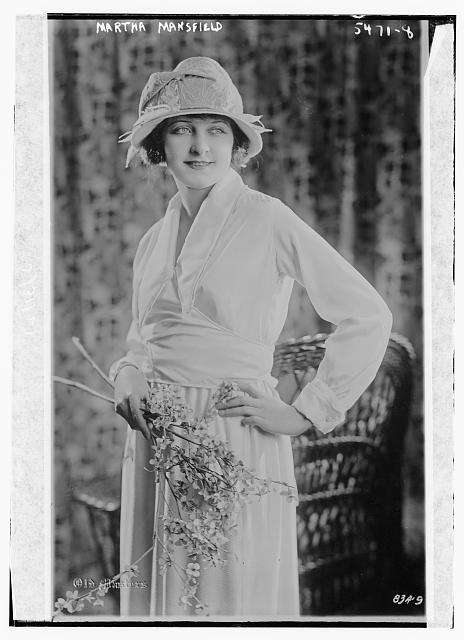
At the time Martha Mansfield lived and worked, the concept of a film star wasn’t well-defined. She was born on July 14, 1899, in New York City. She was born as Martha Erlich, from an Irish mother whose family had emigrated in the latter part of the 19th century and achieved significant influence in the town of Mansfield, Ohio. It was there that Martha’s mother married Maurice Erlich, a New York newspaperman of Hebraic origin. He deserted the family in 1912, leaving Harriet to take care of her daughters Martha (then 12) and Edith “Toby” (then 7). Toby was sent to live with relatives of the Gibson family in Mansfield, while Martha and her mom stayed in Manhattan.
At 14 (around 1913 or 1914), Martha became a model for Howard Christy, an artist who specialized in illustrating pictures for burgeoning magazines. Christy was one of the most popular artists in America. Always surrounded by tons of the most gorgeous girls in the business, he was mesmerized by Martha’s looks. Under his tutelage, she became a famous Christy Girl, and appeared on the covers of many magazines.
Martha worked for two years as a model and also posed for Stanislaw and Fisher while pursuing her goal of becoming a serious actress. Her theatrical debut was with William A. Brady’s spectacle Hop O’ My Thumb at the Manhattan Opera in 1914. She was cast because of her ability to mimic a British accent, which she learned from her father.
Her gorgeous looks and offbeat personality led Martha to secure several roles in New York theater. Martha could sing, dance, and act, and she made a good name in vaudeville. That’s how she got into the Ziegfeld Follies, the most celebrated and extravagant company at the time. She had to be beautiful, also charming, talented, and willing to work hard. Having a portfolio as impressive as hers was of great help too. Martha became a successful Ziegfeld Follies Girl, one of over 3,000 who passed through that stage.
Mr. Ziegfeld was known for taking good care of his girls, for they were the Follies’ greatest asset. Being on the Ziegfeld stage opened many doors and helped Martha get dramatic roles in Broadway plays. She was a workaholic, something that would be reflected in her future film career. A social girl, she was loved by her fellow gorgeous Broadway stars working under Florenz Ziegfeld Jr., known collectively as the Ziegfeld girls, the most prestigious group of dancers in America under the tutelage of Florenz Ziegfeld, Jr.. There she developed a special rapport with Marilyn Miller, her best friend for life.
The Ziegfeld Follies were a great talent showcase, and many illustrious people would attend the performance in search of fresh blood for their own shows. Max Linder, the famous French comedian, caught an act where Martha was featured. Linder was visiting America to expand his career and was looking for a co-star in a new series of films. But he needed more than beauty: He needed talent, something Martha had in spades.
A contract with Linder meant a lot to Martha. She was now becoming something bigger than a vaudeville dancer: a movie star! The papers said that Martha was to Linder what Edna Purviance was for Chaplin. Just like his British competitor had done with Purviance, Linder intended to make Martha Erlich a household name under his tutelage.
However, things went sour pretty fast. Martha appeared in three of Linder’s pictures before he was forced to go back to Paris because of sickness. As he remained there, their contract expired. Martha had tasted the world of cinema, and though she still loved the theater, she also wanted to become a film star. The contract might be over, but she still had three Linder films on her resume. Something didn’t seem right, though: her name. “Erlich” didn’t sound like a star, and her mother’s maiden name, Gibson, didn’t fit her well either.
The solution came from the newspapers, which, during her brief partnership with Linder, would call her “our Mansfield actress” and “our Mansfield girl.” She even became a celebrity in Mansfield, Ohio, and many people started believing she had been born and raised there. Mansfield newspapers praised her for being clever, beautiful, and a great promise for the future. Martha was very fond of the town and used to travel there from time to time to pay visits to her grandmother. With all that love, why not use the town’s name? Martha was back at the Ziegfeld Follies when she got her second opportunity to make it big in the world of cinema. At this point, she starred in Al H. Woods’ production On with the Dance and appeared at the Ziegfeld Midnight Frolic. Her admirers were all there to see their favorite actress, but this time, the name Martha Erlich wasn’t in the credits. She was Martha Mansfield now.
Once more, Martha was noticed by a film star, Harry Lockwood, who was looking for a co-star in his new movies. Like Linder before him, Lockwood wanted a gorgeous girl to share the screen with him and was impressed by Martha’s beauty and charisma. She signed a contract with MGM to appear as a leading lady in forthcoming productions starring Lockwood. In Broadway Bill, their first movie together, Martha got second billing. She played Muriel Latham, whose love for the title character helps him to abandon a life of drinking and hard parties. Her performance got decent reviews and was the beginning of an enduring partnership.
The Hand Invisible was Martha’s first movie in 1919. A family tragedy, the film was a vehicle for Montagu Love, and she played a minor role. That same year, Martha was cast alongside Eugene O’Brien in his first David O. Selznick picture, adapted from Lelia Burton Wells’ novel The Naked Truth. Its four main actresses were all selected from the Ziegfeld girls, as they all had to be exceptionally beautiful to accompany O’Brien, the most handsome star in the business.
The film was released on Sept. 7 of that year. O’Brien played a young artist who becomes the protégé of a society woman, only to find out that she doesn’t want him for his artistic skills, but because he’s a great lover. Another minor role for Martha, it served as the start of her partnership with O’Brien, which continued for three more movies.
Though still very young, Martha was already enjoying the success and glamor of being a film star, appearing in social columns and posing for photographers. Having been featured on the covers of several magazines, Martha was making good money and spent a large portion of it to improve her image. The journalist praised her good taste and extravagance, reporting her appearances at parties and receptions, where people rushed to shake her hand and to have a word with her. Martha often had to be escorted to her car by security guards, always with a bright smile on her face.
At the peak of her success, she starred in 1920 in the play Dr. Jekyll and Mr. Hyde, with famous star John Barrymore. She played Millicent Carew, Dr. Jekyll’s fiancée. In the role, created especially for the play, Martha displayed her dramatic abilities, showing the fear and fragility of a character who sees her world falling apart. It was a big deal to act by Barrymore’s side — at the time, he was one of the most praised actors in the world — but Martha excelled and proved herself as more than just a pretty face.
Newspapers presented an image of Martha as a quirky and coquettish young woman, someone who loved her fans but was also very demanding with male company. She even claimed once that she would never marry a man who wore bow ties — a statement that shouldn’t be taken seriously but proves her exacting attitude. Though she continued to dedicate herself to her family and remained as nice as possible to her many fans, fame always takes its toll on a young person’s mindset. After a small supporting role in Mothers of Men, starring Claire Whitney, Martha got her hands on a juicy part in the film Civilian Clothes, with Thomas Meighan. She played an American society girl living in France who falls in love and marries an American soldier, mainly because he looks great in a uniform. After he returns to his country and is believed to be dead, she falls for another admirer. Her husband is still alive, though, and comes back to claim her dressed in his civilian clothes, which makes him lose his charm. A fitting role for an actress who took her sense of fashion so seriously.
Eugene O’Brien cast Martha again that same year in The Wonderful Chance. It was O’Brien’s seventh movie in little less than a year, the first of which had been with Martha. The newspapers were just as excited about her as they were about O’Brien describing the delightful leading lady deemed to become a star, having signed a long-term contract to work on Selznick pictures. Movie exhibitors were eager for more Martha Mansfield movies, for they were guaranteed to fill the seats.

Martha, who had never stopped her work as a photography model, was recognized as America’s prettiest magazine cover girl. She stamped the cover of the July 1920 Photoplay Magazine, her face sideways, a baffling colorful hat on her head. Having started her modeling career so young made her comfortable in front of the lens. She was said to have appeared on more magazine covers than any other actress of her time and knew how to work the camera to her advantage.
In September 1920, the film version of Dr. Jekyll and Mr. Hyde was released. Martha reprised her role as Millicent Carew and had excellent reviews. She almost lost the role to Tallulah Bankhead, but the producers went with the cast from the play. This is one of the few movies with her that are still available today. Barrymore gives a chilling performance as both Dr. Jekyll and Mr. Hyde, aided by a strong supporting cast. Martha is the protagonist of the most horrifying scene in the picture, in which she’s trapped inside a laboratory with the awful Mr. Hyde and screams in despair for help.
Having worked on eight films in a row allowed her to travel a lot and get to know the country. One story in the Charlotte News on Dec. 6, 1920, tells of how Martha, together with Lillian Walker and Eugene O’Brien, were greeted by a crowd as they stepped out of a train in the town of Charlotte. They were heading to Warrenton, Virginia, to work on their new film for Select Pictures and didn’t expect such a grand reception.
On the stage, Martha was revered by the local audiences, but her movies brought her talent to places had she never visited. There was an adventurous quality to filmmaking, which put her in curious situations. During the shooting of Gilded Lies, again with Eugene O’Brien, one of the most important locations was Bats’ Cave in North Carolina. As there were no hotels in the vicinity, the cast and crew had to spend the night in the cave, which, as its name suggests, was full of bats. The female members of the cast were terrified of the situation, except for Martha, who calmed them down and persuaded them that the bats would not attack anyone during the night.
That same year, she did The Last Door with Eugene O’Brien, an adventure movie in which she was second-billed. Martha was now officially O’Brien’s favorite leading lady, a partnership that did just as much good to his career as it did to hers. In fact, many people by this time went to the theater to see Martha, rather than O’Brien.
Martha’s rise to stardom was outstanding. Sometimes, she was featured in several films playing in different theaters at the same time, and she was adored by the crowds. At the time of her ascension, cinema was a young medium, still less appreciated than theater. It only felt natural for a young actress to exploit this new media to gain fame. It was one thing to rehearse and act in a play inside a safe movie theater, and a whole different one to travel through the country just to shoot a scene on location. Having acted in the Ziegfeld Follies for years, Martha was used to big productions, but this was a whole new deal, and she became deeply involved in the art of filmmaking.
Martha, however, wasn’t just an opportunist vaudeville girl who made films for prestige. She had strong thoughts about cinema and believed that the great day of pictures was about to dawn and that it would become of critical importance to develop people’s souls. Film aesthetics were still in early development, and to Martha, the masses were expecting film to become more sophisticated. She believed that cinema was here to stay and that it would only be a matter of time before talented filmmakers came to revolutionize this art form.
Martha’s transition from theater to pictures had been smooth, and unlike others, she seemed to be completely comfortable acting in front of the cameras. Just as many film directors tried to break the mold and use cinema at its full potential, a handful of actors also wanted to do more than just play their roles the same way they did in theater. In a time when many movies were simply filmed plays, Martha understood the medium could go much further than that.
In August 1922, Martha was elected Queen of the Coney Island Carnival, with 2,776 votes. Her looks were being compared with those of Mary Pickford, Hollywood’s greatest star at the time, with a beauty so intense it distracted the viewers from the plots of her films. As a Ziegfeld girl, Martha knew she couldn’t afford to neglect her looks, which also meant always dressing in the best of fashion, and she continued to appear as much in the social columns as she did in the film and theater review sections. Her powerful presence and exquisite beauty, with a classical oval face surrounded by semi-brunette locks, were among the best parts of her movies, even when the reviews weren’t as kind to the movies themselves. In 1922, she took the leading role in the vaudeville play Wright or Wrong, which was considered below her brilliant talent. To compensate for that, Martha got one of her best movie roles, one that seemed to be tailor-made for her. In Queen of the Moulin Rouge, she played Rosalie Anjou, a young dancer who falls in love with a music student. His music teacher creates a scheme for her to dance in the Moulin Rouge in order to break the heart of the young musician.
Several Broadway girls were cast in the picture, but Martha, playing the title role, outshone them all. She was in her element here, playing a role that required her to be funny, dramatic, charming and adorable while also dancing in front of a crowd. Martha used her skills as a dancer and actress to bring the role to life. It was the role she was born to play, one that combined everything she cared and stood for on both the stage and in front of the camera.
Martha followed Queen of the Moulin Rouge with a minor role in Till We Meet Again, a vehicle for Mae Marsh. Right after that, she appeared in Is Money Everything?, a moralist tale of a man who climbs the social ladder from farmer to Wall Street broker but loses his soul in the process. Martha played the role of a society woman who tries to seduce him. Her performance gave a special flavor to the part, which could have easily become a caricature.
As she continued to make movies, Martha still found time and energy to appear on the stage at the New York theater every afternoon and evening, playing roles in Century Girl for Ziegfeld, and in A.H. Woods played in On with the Dance, a performance she concluded by reciting “The Other One” by Robert W. Service, on the Lyric theater. Martha was known for being friendly with her audience, and she would talk with them backstage after the play was finished as if they were longtime friends.
Her next movie was The Little Red Schoolhouse, based on a successful play by Hal Reid. The movie is a whodunit mystery about a murder committed inside the walls of a school. She also starred in Fog Bound, where she plays a girl who gets involved with a young, rich man, and Youthful Cheaters with Glenn Hunter, who was a meteoric star at that point.
The Silent Command, done that same year, is one of the few Martha Mansfield pictures that are still available these days. This spy thriller, where Martha plays a vamp femme fatale, is also a curiosity for horror movie fans since it stars Bela Lugosi before his fame as Dracula. Her other films that year were The Leavenworth Case and Potash and Perlmutter. Both were released after her death.
In a famous photograph of that period, Martha posed smoking a cigarette with a very long holder in a gracious fashion. Taken just a few weeks before her death, the picture would exist just for commercial purposes, since Martha’s mother would later state that she wasn’t fond of smoking. Surely Harriet Mansfield (who had taken her daughter’s stage name) could have been mistaken about her daughter’s habits, especially since they didn’t see as much of each other as before. However, when a young girl with a brilliant future ahead of her burns to death, it’s only natural that her loved ones get confused about what they were really like.
It was Nov. 29, 1923, on the set of the movie The Warrens of Virginia, located in Brackenridge Park in San Antonio, Texas, and Martha was taking a break from shooting. This was her biggest film to date, a Civil War epic in which she played a young girl from the South who falls in love with a Northern soldier. There wasn’t any sign that the stream of work was going to stop. In the past two years, she had made 10 pictures, including a couple that hadn’t premiered yet. Audiences loved her and would follow her everywhere she went.

As she sat there in full costume and watched her fellow cast members shooting a scene of battle, Martha must have felt prouder of herself than ever. They had just wrapped up the big battle of the movie, and most of her scenes were now shot. At this point, Martha’s life was extremely busy and her schedule filled, which hindered her from paying regular visits to her family as she did before. Her love for her art seemed to be greater, though, and the young girl whom her father had rejected had now a whole new set of admirers who wouldn’t abandon her for nothing. She was loved by people who never met her in person and was doing what she loved to do at her full potential.
And then people heard her scream.
Martha’s limousine was parked on a long line of cars, and she was sitting there by herself when her dress caught fire. Martha was waiting for her turn to shoot a scene when flames engulfed her. She ran around the set, yelling in pain while everyone else watched, not knowing what to do. Martha’s dress was a crinoline piece in a Civil War style, with frills and hops and covered by laces. The laces were the reason she burned so fast. Two members of the company ran to her and extinguished the flames by wrapping their overcoats around her. Martha’s co-star Wilfred Lytell was the first one to aid her and the one to put out the fire. Her driver also burned his hands badly while trying to help Martha.
As for what ignited the fire, there’s never been a good explanation. She could have done it herself while smoking a cigarette, or maybe some careless person was passing by and, after lighting their cigarette, threw the match aside and hit Martha accidentally. There were rumors of suicide and even murder, neither of which which have never been proven.
On her way to the hospital, Martha tried to calm everyone down and kept asking if her face hadn’t been damaged, wishing perhaps to return to the shootings soon. She was taken to the Physicians and Surgeons Hospitals to treat her burns. Doctors were optimistic, believing that the wounds were not fatal and that Martha would survive the ordeal. Her situation, however, became worse during the night. Martha died of shock the following day, shortly before noon, leaving behind only a small fraction of what should’ve been a huge career.
The body was removed from the hospital to the undertaking establishment of Porter Loring to be prepared for shipment to New York, where her family lived. Everyone was perplexed, from her fans who never expected something like that to happen to the newspapers that, less than a week before, were publishing notes about the lovely film star. No one was more shocked than her mother, though, who was still in New York waiting for the body.
Martha’s funeral was held one week after her death, at the Campbell Funeral Church in New York. Over a thousand people appeared at her departure. On Broadway, a crowd of 5,000 people, many of them theater workers, waited motionless for two hours until her coffin was brought down the street. Several Ziegfeld Girls came to see the body and walked away in tears. Stars such as John Barrymore, Gloria Swanson and Betty Compson came to the funeral.
Florence Leeds, who grew up with Martha Mansfield, came in after the services. She hurried over to the coffin, leaned above her dead friend for a second and vanished in the passing crowd. Martha’s best friend, Marilyn Miller, who had been by her side on and off the stage, was there by Martha’s mother’s side. Always welcomed into Harriet Mansfield’s home in New York, Marilyn continued to go there after her friend’s death to talk about her times of glory in the Ziegfeld Follies.
The Industrial Accident Board of Texas later paid a sum of $1,500 to Harriet Mansfield as compensation for her daughter’s death. The state commission has made the award under the laws of Texas to be paid in 360 installments of $20 to Martha’s mother. The actress would probably be happy to know that The Warrens of Virginia, the movie she was so proud of, was released the following year. Her role as a lovely and aristocratic heroine remained as prominent as it had been before her death.
Among the pallbearers who carried her to the hearse were famous film producers Samuel Goldwyn and David O. Selznick as well as Martha’s scenario writer, Edward Goulding. She was quietly buried in the Woodlawn Cemetery in the Bronx, under a tombstone that carried the name she had chosen for herself. There were no services at the grave.
Image credits:
- Repository: Library of Congress Prints and Photographs Division Washington, D.C.
20540 USA:
http://hdl.loc.gov/loc.pnp/pp.print
http://hdl.loc.gov/loc.pnp/ggbain.32432 - Source: https://www.vintag.es/2017/11/64-glamorous-portrait-photos-of.html
Photographer: Alfred Cheney Johnston - Repository: Library of Congress Prints and Photographs Division Washington, D.C.
20540 USA
http://hdl.loc.gov/loc.pnp/pp.print
http://hdl.loc.gov/loc.pnp/ggbain.32951

MATT FERRAZ is a Brazilian author whose works have been released in English, Portuguese, Italian, and Spanish. With a master’s in Biography from the University of Buckingham, in the UK, Matt has published short and long pieces in traditional and self-publishing. The Grandma Bertha Solving Murders series was Matt’s first hit, but he has also found success writing YA novels for Bolivian publisher Editorial 3600. His most proud accomplishment is Sawara: A Jaguar’s Memoir, a book told from the point of view of a jaguar living in the Amazonian jungle. The book was written in the Costa Rica Cloud Forest, as part of a literary residence for which Matt was awarded a fellowship.
