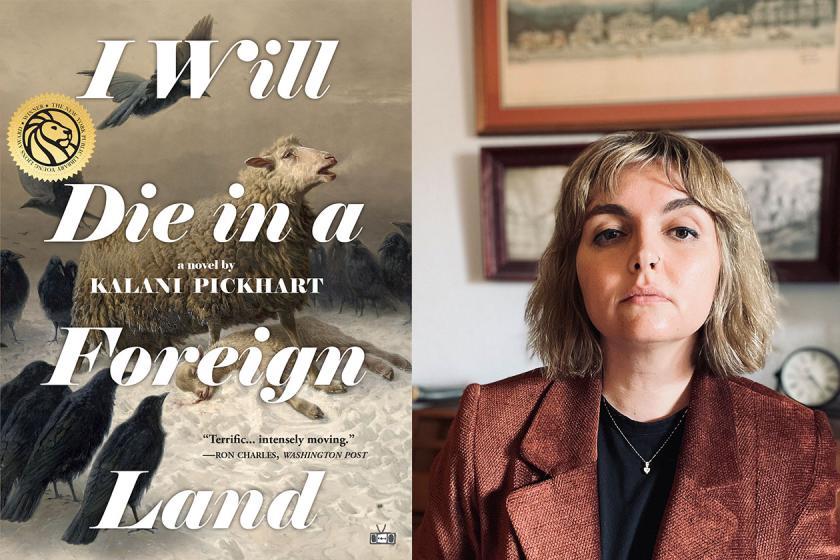
I recently had the pleasure of speaking with novelist Kalani Pickhart about her debut novel I Will Die in a Foreign Land. The book provides a vivid portrait of the 2013-2014 Euromaidan protests in Ukraine through the interconnected stories of four characters whose lives are forever changed by the events. In our wide-ranging conversation, Pickhart reflected on the responsibilities of writing fiction set amidst real-life crises, the extensive research process that went into recreating the specific time and place of her novel, and the winding road the book took from first draft to final publication. Throughout our conversation, I was struck by Pickhart’s thoughtfulness and empathy, and after discussing where her interests have been taking her writing in recent days, I’m incredibly eager to see what she’ll decide to do next. —Nathan Winer
Nathan Winer: I have to say, I’m somewhat embarrassed to admit this but I really was very unfamiliar with most of the events your novel covers, the 2013 and 2014 Euromaidan protests in Ukraine. And unfortunately, I don’t think this is that rare, for an American audience at least. When you were writing I Will Die in a Foreign Land, were you thinking about the fact that its publication would make you not just a novelist but, for many people, an educator as well?
Kalani Pickhart: That’s a good question, and yes, I did. I actually was very new to the material when I started writing the book, so I didn’t really have any prior knowledge about it other than one documentary from Netflix, called Winter on Fire. I knew I was writing for an American audience mostly, and that definitely played into some of the work itself, and having to maybe subtly explain certain things. I was trying to look at it from the perspective of: if I didn’t know anything, what would I need to know? So it hasn’t been uncommon for people to say to me that this book has really helped them to understand what’s going on currently in the area, that the book helps to contextualize some of the aspects they might not know about.
But when Russia invaded Ukraine two years ago, I wasn’t necessarily prepared to talk about those events. And that was probably the weirdest part about the book coming out, people reaching out to me looking for me to comment on the war. And I always try to be clear that I am not an analyst, I’m not actually an expert in any of this, and nor am I Ukrainian. So we should probably be talking to any of those people instead. It’s been an interesting experience learning how to express my own boundaries, just because I don’t ever want to say the wrong thing, or disrespect the other voices, that kind of thing.
NW: Of course. That being said, it does seem like the response you’ve gotten from Ukrainian people, or people of Ukrainian descent, has been for the most part positive, yes?
KP: Oh, yes. I’ve especially had support from some Ukrainian authors, or authors who grew up in a Soviet or post-Soviet environment, and that’s all been very encouraging. It was very meaningful to have that perspective, too, because it is very scary to….You know, I don’t necessarily recommend writing something that’s not like your own personal story, I guess. But at the same time, I think that if you can go to those places, imagine what it could be like, or hear so many accounts and really do the research, I do think there’s something to be said about using writing to practice that empathy. Even if it’s just as an exercise, something never published or anything like that.
NW: You were talking about some of the responsibilities you felt you had, especially with people coming to you and asking you to weigh in on the war. As I was reading the novel, I found myself thinking a lot about the various responsibilities that artists or creators all bring to moments of crisis. I’m curious what you make of both the power, and the responsibility, of art in a time of crisis. And I realize that’s a big question, I apologize.
KP: No, it’s a really good question—it’s probably, like, the question, you know? I feel like we’re living in an age that is perpetually crisis. Whether or not it might feel like that day to day, it’s something that’s existentially all around. You see it in memes on the internet, your friends talk about it—people are, I think, perpetually in this state of fear, of uncertainty. We live in this post-truth era where it’s just like…certainly there is a truth, you know?
NW: One would hope.
KP: Yeah, exactly! But it’s not always that anymore. Truth is turning out to be this very subjective thing which…you know, it is and it isn’t. But to answer your question first on a personal level. When I wrote this book, I was going through a personal crisis. A very emotional, social and relational crisis that was very painful. And there are parts of me that think I would not have survived if I’d not had this book to lean on. I think that doing the work saves you, more even than you realize it does in the moment.
Sometimes we go to news articles, but we don’t find solace, we don’t feel peace, until we’re reading something like poetry, or a story we can get lost in. Or until we see representative art of what’s going on, which can be equally important. I think that art is just such a good way to process things, experiencing it or making it.
And so I think living in a time of crisis often gives people a sense of purpose, which can then give people a sense of control. And I feel like you need that when something terrifying is happening. Asking “What can I control?” It just grounds you in a different way. And in the novel, for Katya, that was taking care of people; for Misha, it was taking care of Katya. When everything just feels like a mess, I think that purpose can help to ground you.
I think that’s true for the characters in the book—like Aleksander, his piano work became very grounding for him. And I think for the photojournalist that appears in the book, Dascha, getting the truth out there is so important for her. And even the doctors, you know—everyone has that artistic lean, everyone has that expression to give, whether or not they even know it’s art. Everybody has gifts.
NW: You’ve touched a bit on your introduction to the topic, with “Winter on Fire,” but I’m also curious about the research that goes into any creative work set in such a specific time and place as your novel is. Would you mind talking a bit about how you gathered the knowledge that went into this book?
KP: I was fortunate in that I started writing the novel during the first semester of my MFA at Arizona State University, and our first workshop class was a novel writing workshop. We were basically given a clock, and an ideal number of words. I feel like this was sort of a unique circumstance in that I didn’t have a lot of time, really. I did a lot of research, but I also did a lot of intuitive work on the first draft. Sort of saying, “I don’t really know what this is like, but I’m going to guess it’s like this,” just from things I’d seen in documentaries. It was just a lot of surface level research for the first draft, honestly a lot of Wikipedia, some timelines I found. A fortunate thing about this project also was that, because it was so recent, it was easier to dig up information on the internet, rather than having to go to a particular destination to do such specific research.
NW: You didn’t have to go to an archive, say.
KP: Yeah—though, actually, they were just sort of building an archive for all of this at the same time I was writing it. So all of that was still relatively new. My biggest struggle honestly was finding sources in English. Now, of course, we have a lot more resources, and more reporting happening. But in 2016, I was always just trying to stay current, without losing sight of my own specific narrative.
But I got an inkling that there was a lot more to this story than just the Euromaidan. Because, for example, just ten years before there was the Orange Revolution, which was very similar to Maidan. And then just before that you have the breakdown of the Soviet Union. So there’s just all these things, one after the other, and as I’m researching this I’m suddenly almost spiraling, because I realized it was all a much bigger story than I had first thought. But I felt like I couldn’t tell this story without telling, at least in part, some of those other stories.
Eventually, I was able to go to Ukraine; I studied Ukrainian in an intensive language course. All of that helped to flesh out subsequent drafts. Like you said, it’s such a specific place and such a specific time. When I went to Ukraine, a lot of it became real, in a very different way. For lack of a better term, I kind of had a “come to Jesus” moment when I was in the Saint Michael’s monastery for the first time. And I was staying in an Airbnb that was right on Shovkovychna, which is where my character Slava’s apartment is. I got a sense of how long it takes to walk to the Maidan, walk to the church. And at that point it was only about four years after the protests, so there were still all these remnants of it. Lots of posters were still up in Independence Square.
That really affected my research. It all just made me feel I needed to honor this moment and these people without making it kitschy, it needed to feel authentic. I really needed to get in there, to understand.
NW: Once you were into those further drafts, was that when you started throwing in those details of, for example, people that grew up very near the aftermath of Chernobyl, and Aleksander being in the KGB, or were those things you knew you wanted to include from the start?
KP: Those were the surface level things that I kind of found in my research. I wasn’t initially going to do anything with Chernobyl, but I’m glad that people responded well to it. Chernobyl’s very close to Kyiv, and it’s something you can’t really ignore if you’re writing a book like this. So yeah, I had an inkling that I wanted to do something with that.
Aleksander’s story, all of the KGB stuff, that actually started out as something just for fun. I knew that I wanted to write a love story, and the love stories that I’ve really enjoyed—The English Patient, Atonement—they all happen in times of war. I was interested in finding that intimacy and joy in these terrifying moments, so I knew that was kind of where the center of the book was. But Aleksander’s background came up because I needed an alternative perspective—I wasn’t fully comfortable writing about Ukraine only from a Ukrainian perspective. Misha and Slava were probably the hardest characters to write, for that reason. But Aleksander and Katya were both outsiders. So it was a way to sort of access the story distantly, at first, until I felt more comfortable delving into these other lives, with Misha and Slava. I felt I couldn’t tell the story without that outside perspective.
NW: You’ve kind of answered this in a few different ways, but I’m really curious how the writing process compares to the final version of the book. Because it has these different perspectives, and it…I don’t want to say jumps around, because I feel like people sometimes use that as a criticism—
KP: No, it jumps around. [laughs]
NW: It moves from one person to another very quickly, but they all do ultimately come together in a way that’s very meaningful. When you were working on this, did you know it was going to be divvied up between people in this way, or was it initially more linear before you decided to change it up?
KP: Well, I will say that this book was getting reorganized up until…basically the print day! We were constantly reorganizing it. One of my favorite memories was just being on back-and-forth emails with Eliza [Wood-Obenauf] at Two Dollar Radio, just like, “Oh, oh, should this go here, should that go there? What makes the most sense—I don’t know! We have to get this to the printer tomorrow!” It was really exhilarating and exciting, but also I wanted to die a little bit, you know?
I’ve learned that I like to write in bursts, basically. Mostly just like, if I can get through a scene, that’s good. It doesn’t matter where the scene is in the book, I do not care. And that’s how the first draft was written, initially; I was just playing with voice, and trying to figure out these people. They didn’t even talk to each other, necessarily. I didn’t worry, in the first draft, how they all fit together. I wrote all of Katya’s narrative, I wrote all of Aleksander’s, and then Misha, and then Slava. Then I tried to put them all together, figure out what worked, figure out what was missing.
And having that MFA timeline, the due dates and the accountability, made it a lot easier, for me at least, to be more playful in how I was figuring things out. But I decided after the MFA semester ended to just finish it. I told myself, “I’m going to just stick with this nasty first draft, because then, I’ll have it.” It would be something to work with. The act of actually generating work is really painful for me! It’s just not my favorite thing. But revision, editing, researching—I love that stuff. It just makes me feel like there’s more to work with; like I have this glob of text, and I can now figure out how all these things work. Now, outside of the MFA, time is just so much more constrained, so I have to get something out of those shorter bursts of writing, if I can.
NW: I saw an Instagram post of yours, actually, where you mentioned that for a while you’ve been feeling a lot of struggle with writing, but recently you’ve been finding motivation to throw yourself back into it. I’m wondering what are some of the things you find inspiring or motivating? What makes you choose to spend your, as you’ve said, somewhat limited time and creative energy on this or that topic?
KP: You know, recently I’ve been really interested in exploring the things you’re not supposed to think, or the things that everyone is thinking but you’re still not supposed to say, you know? I feel like there’s something taboo in I Will Die in a Foreign Land, but not to the extent of what I want to continue writing about. You know, there’s an affair, and there’s gay relationships in a country which is still very much in the process of becoming more open minded. The secret world of the KGB and then breaking free of that. So there were some of these things that were a little bit more illicit in context, but I feel like it’s something I really want to write more about. I think, ideally, my work will start to more actively challenge the status quo, in ways that might make someone uncomfortable. I think that’s really what I want.
I grew up in a more Christian-type environment, and I’m the only agnostic-slash-maybe-atheist in my family. So it’s interesting to have conversations with family members about, you know, inconsistencies in the Bible, things like that. And I think that there’s something that sort of dwells beneath the surface that I’m always very drawn to and interested in. Not even as a writer, just as a person. And I think that’s true for a lot of people, I think we’re all naturally interested in hidden darkness. But it’s always a question of, are you going to really look at it, or are you going to look away?
And this has sort of been a journey for me, but I’m coming to terms with the idea that I may not ever be mass-market. And that’s okay with me. I just want to be the best storyteller that I can be. So right now, that idea of the taboo is what I’m most interested in exploring. And it’s very uncomfortable as a writer to go there. You have to confront your own biases, the things that make you uncomfortable. You might have to say shit that you would never normally say!
I think my next struggle is writing the unlikable character. All the characters in my first book… I don’t know, they’re cool! I’d hang out with any one of them! [laughs] But our characters are a part of ourselves, so it makes sense to really struggle with writing aspects that are darker, or a character you might not like, because if you’re being honest with your writing then it’s going to hit a nerve with you, too.
NW: To shift gears a bit, I read your story “Propinquity” in TriQuarterly, and it was really fascinating to me, most of all for the inclusion of images and diagrams throughout the story itself, which match with and augment the narrative in a really interesting way, structurally. You were just talking a bit about pushing boundaries in your writing in terms of subject matter, but are there maybe any other norms for prose writing that you might also be interested in pushing against?
KP: That story was fun for a lot of reasons. The drawings that are in there, I actually asked that architect if I could use his drawings. So that was a sort of layer to it that I was aware of, but that no one else really knows. Well, now no one except for you.
NW: And our many readers.
KP: And the many readers! I love visual components. I would love to do something more non-traditional with a narrative. I’d love to write a video game, something like that. Something that plays with the notion of what a story is, and finding different ways to engross a reader or participant that they maybe don’t expect. There’s this section of the Jennifer Egan book A Visit from the Goon Squad that’s told through a PowerPoint presentation, which I love, because it’s just like…yes, of course, PowerPoint is a storytelling tool! We just don’t think of it as one; we think of it as something super corporate. But in the book, it’s just this girl telling a story about her family, and she uses PowerPoint like she would in school. I’m really interested in there being stories hidden between the words of things.
There’s this one short story that I wrote—it was published in a very, very small journal, it might not even exist anymore—but I got the idea for it as I was getting ready to go to Ukraine, because I kept seeing all these lists of like “Everything to do and not to do in a foreign country.” So I modeled the story after that, and the narrative got more and more in-depth with the bullet point instructions as it went. I think it’s fun, it’s playful, it can be more interesting playing around like that. I like thinking about the shapes of things, I guess. I really just think it’s fun to challenge the concept of what fiction or a narrative can look like.
NW: So, my last and favorite question to ask someone is actually a two-part question: what are you reading right now, and who are some writers that you consider your favorites of all time?
KP: Oh wow, okay. Hmm. It’s like, on one hand, you have the immediate ones that just instantly pop in your head, but then you’re like, “Yeah, I love that author, but like…why?” You know? [laughs] But okay, things I’m reading right now. I’m finishing up Sea of Tranquility by Emily St. John Mandel.
NP: Oh! She was actually the first person I interviewed for MAYDAY!
KP: Oh wait, that’s so weird! But anyway, I’m enjoying it! But it’s also so outside of what I usually like to read—I’m not really a science fiction person—but I’m really interested in her work. The way that all of her recent books are interconnected and tell sort of different versions of the same universe. I think that would be a really exciting project. There’s something about writers that can imagine something like that, the scope of it, that I find so admirable and cool.
I’m also reading this book called Sweet Heaven When I Die, by Jeff Sharlet. This was given to me by a faculty member of ASU, where I work as an event planner. For some context, we’re bringing this photographer who has a series of photos that are just incredible, all portraits of young men in the Fundamentalist Latter Day Saints religion, out in Short Creek, Arizona. There’s a compound there, and when the young men in this group come of age, they’re basically excommunicated, because the elders essentially don’t want competition for wives in the community. And it sort of fits in with that taboo, undercurrent idea I was talking about earlier, like the seedy sides of extreme faith, cults, and so on. So I was having a conversation with this coworker at ASU about possibly being interested in working on a project that had to do with fringe group faith, and needing to find a way to access it, but so much of what you find nowadays is so… tongue in cheek? And that’s not what I want, I don’t want something that makes fun of these groups.
So I got this book recommended to me, and it’s basically these journalistic portraits of Middle America. And it just spends time with these real people, in a way that’s nonjudgmental, but very fascinated by people, their lives.
The writers that got me into writing were J.D. Salinger and Margaret Atwood. You know, I was kind of just a little shit in high school, and Holden Caulfield was that first voice that really stuck with me, as a reader. And that’s always so impactful; I think it really shapes you, whether you realize it or not. And Margaret Atwood, she’s just brilliant. She just goes to those places no one else does. Her book The Blind Assassin is one of my all-time favorite books, and it actually helped me a lot with writing mine; it has these different perspectives, and it plays with genre. So that’s a really important book for me.
I mentioned Atonement by Ian McEwan. That book was just so horrific, in a way that you don’t expect. The malice that’s in Atonement is just so…ugh, it’s unbelievable. I feel like sometimes, as a writer, it can be hard to really get into fiction, because you’re sort of analyzing it, but Atonement really surprised me with how much it moved me.
More recently, I read Katya Apekina’s The Deeper the Water the Uglier the Fish. It’s a Two Dollar Radio book, so Katya and I did an interview together at some point, and she was really lovely, she was awesome. She has a new book coming out called Mother Doll. But The Deeper the Water is also sort of one of these taboo-topic books. It’s about these two girls who don’t really know their father, and then he just shows up in their lives. And there’s this very strange undercurrent of competition between the girls as sisters, and this sexual energy in the book, and it’s just so artful how she does it. The restraint in that book is so impressive, and that’s a common thing I always love. Just coming right up against something in a really graceful way. So, The Deeper the Water and Atonement, those are two books that had a really big impact on me.
KALANI PICKHART is the author of I Will Die in a Foreign Land, winner of the 2022 New York Public Library Young Lions Fiction Award and long-listed for the Virginia Commonwealth University Cabell First Novelist Award. Her short fiction has appeared in Virginia Quarterly Review, TriQuarterly Review, and elsewhere. She currently lives and writes in Phoenix, Arizona.
NATHAN WINER is a graduate of Kenyon College, currently working as an Editorial Intern at Tin House Books and as a tutor in the Chicago area. His work has appeared in MAYDAY and The Cleveland Review of Books.
