Chika at Work
When Chika Okeke saw a fat brown cockroach scurry across the checkout counter, she was reminded of Gregor Samsa. When Chika Okeke read The Metamorphosis for the first time, she managed to develop a dark secret crush on Gregor’s character. How tragic and tortured he was. If he had been real, and not a bug, she would’ve asked him, very politely, to take her virginity and to dispose of it, quickly. But Chika was also trying not to believe that a “virginity” was a real thing. No, it was not real!
(Still, Chika wanted human Gregor Samsa to take hers.)
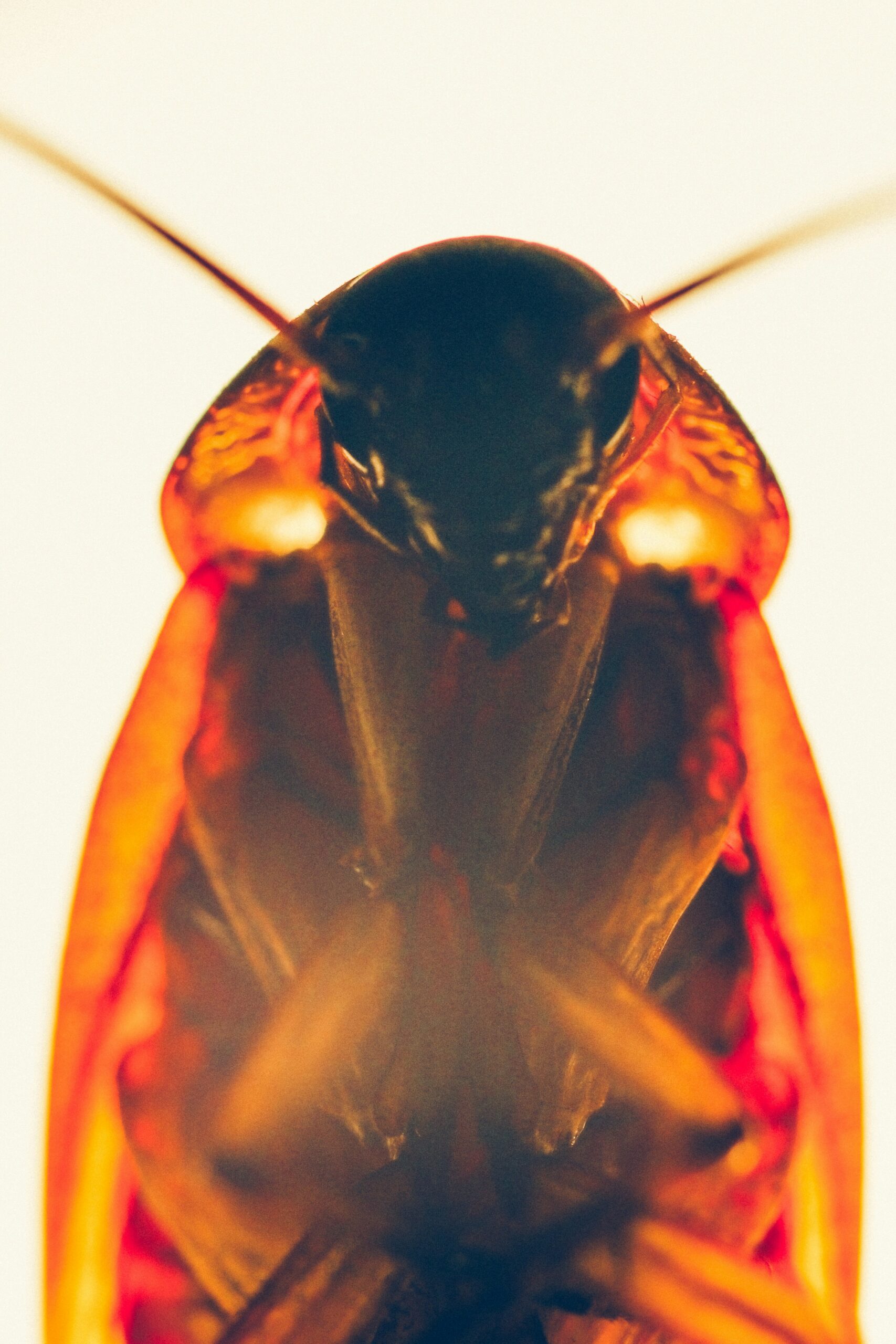
She wanted a human Gregor, Chika realized from behind the counter. A cockroach Gregor was of no use to her, unfortunately. And this one before her seemed particularly impractical. The little creature was terrible to look at, and terribly hypnotic. Chika felt spell-bound by it, its sprawling legs and hefty body. She knew she would never be able to tear her eyes away unless it stopped moving, unless it was dead.
Her co-worker couldn’t take his eyes off of the cockroach, either, it seemed. His name was Elijah. He worked at the cash register next to Chika’s. She loved him desperately. Perhaps even more so than human Gregor. She thought she might die without him. For he was not unattractive and he seemed to be about her age.
Did you see that shit? Nasty as fuck.
(Elijah was no fan of bugs.)
Yeah…I think I’m gonna go kill it.
(Chika was no fan, either.)
Good luck with that shit.
(Elijah didn’t want to go through the trouble himself.)
Thanks.
(Chika would do anything for him.)
Chika put the “checkout closed” sign on the counter and emerged from her 8-hour pillory to briefly rejoin the rest of the world. She cared little whether her boss, Mr. Colombo, would come out from smoking cigars in the back room—and trying to forget that the IRS would soon be after him—and catch her in the act of neglecting her very serious cashier duties.
He had a soft spot for her, said she reminded him of his niece, so she never worried very much about getting in trouble. Not for things like clocking in late after having stayed up all night watching old No Doubt music videos on MTV Classic (Gwen Stefani was her favorite—she liked her cool girl hair). Not even for abandoning her register to go and execute an insect.
Mr. Colombo once showed her a photo of his niece—Chika failed to see the resemblance. His niece also appeared to be no older than thirteen.
(Chika often thought Mr. Colombo was perhaps on drugs.)
The cockroach crawled onto a shelf of cereal boxes and other pre-packaged breakfast foods, and as Chika lost sight of it amongst the Cheerios and Pop Tarts, she wondered whether she was doing a bad thing.
The insect’s desperation to hide itself frightened her.
But what frightened her more was her own patience waiting for it to reappear. The way she stood there unperturbed, knowing that she was bigger than it was, and that if she truly wanted to kill the creature it was, indeed, in her power to do so.
While reading The Metamorphosis, Chika was quite certain she would’ve never treated Gregor the way his family had! She would’ve shown him kindness, and compassion. She would’ve shown him love. But how could Chika be sure this cockroach wasn’t another Gregor? Transformed one day with no warning, forced to adapt to this strange new life? Or maybe it really was just a bug, but it had been a person reincarnated as such. Didn’t people who had behaved badly in their past lives take on lower ranking lives?
(Chika sometimes suspected she must’ve been quite dreadful in a past life.)
Maybe that meant she shouldn’t feel so bad about killing this roach. But then again, what if he’d turned things around? Was it even possible to be a good roach, or a bad one for that matter? Could roaches suffer things that made them become bad?
But maybe the roach felt ready to part from this world and enter into the next. Roaches lived much longer than house flies or fruit flies, Chika recalled. Those sad creatures only lived two weeks or something. But maybe they think we’re the sad creatures, for living seventy years. Seventy years is much too long, said the fruit fly. Chika thought she understood. It was like when she read about that man from the Bible who lived to be 900. His name was Methuselah. When she first read that he lived to be 900 she felt nauseous and afraid. She hoped it wouldn’t happen to her, too. The idea of dying always scared her, of course. But the idea of never dying, even more so. This meant Chika was scared all the time—for she was always in the process of dying or not dying. But she usually preferred watching old Gwen Stefani music videos to dwelling on what she knew to be unoriginal, unresolvable anxieties.
The radio in the store was playing the rock music station as it always did, never anything as fun or retro as Gwen and No Doubt. Chika hummed along, nevertheless, as she scanned the shelf for the brown blur of the tenacious roach. She had never been sure if it was Elijah who refused to turn on the pop oldies or Mr. Colombo himself, but she didn’t bother to ask. It wasn’t so much that she loved to listen to Gwen, anyway, as it was that she loved to watch her. Not look at her—watch her. When Chika first discovered Gwen Stefani on MTV Classic, it was as though she was discovering for the first time that she was a girl, and how wonderful this could be.
As a child, Chika was never allowed to watch the television set her family kept in the basement. Her parents restricted her to books and the occasional board game. They wanted to see her become a child genius. It was the best shot for parents trapped in low-paying jobs to make some real money, they’d believed. But when she turned eighteen and it was clear she was not a young genius, and that it was too late for her to become one, she wandered downstairs one night to see what this television business was all about.
Her father came down shortly after, saw her there, and said nothing. From that point on, Chika quickly learned that along with MTV’s late-night re-run programming, she enjoyed thrifted VHS tapes of romantic comedies, going to the movies with her cousins and buying overpriced snacks, and diet Coca-Cola. And her sometimes made-up boyfriends.
Elijah was one of the made-up ones. He was a real person, of course. But he was hardly aware that Chika had been going around telling her cousins, and sometimes strangers in passing, that he was her boyfriend.
Not that she had never had one before.
Chika had been raised Catholic, but her first boyfriend was Muslim. His name was Omar. They’d dated, very clandestine, at an age that was much too young to be taken seriously, but slightly too old to be considered cute, or endearing.
Omar had once told her a story about why spiders were considered sacred in his religion. They had been walking home after school, eating candy bars from a nearby gas station. A spider had latched itself onto Chika’s shoe and she remarked that she could never step on one, for spiders were much too elegant and graceful. Like ballerinas—she’d always wished she had done ballet as a child.
(Unfortunately, ballet was one of those things where if you only started doing it after you had gained human consciousness, it was already too late to be any good at it. And unfortunately, when Chika’s parents first came to America, they neglected the very important duty of signing their daughter up for such lessons, right away. Sometimes Chika feared she’d never forgive them for it.)
But Omar, who cared little for ballerinas and could not quite see spiders that way, still agreed that he would never kill one, either, but for reasons of his own. He said when the prophet Muhammad was being chased by people who wished to kill him, he hid in a cave. A spider came along and made a great big web over the entrance, saving his life. So his enemies wouldn’t try to cross through it? And get spider web stickiness and maybe baby spiders all over them? Chika had asked. So that they wouldn’t think that anyone could possibly have been in there, unless they’d lived there a hundred years. Omar explained.
Chika felt humiliated and went home after this. Why hadn’t she thought of that? She resented feeling as though he had outsmarted her, and told him he couldn’t call her anymore a few days later.
Cockroaches were not elegant like ballerinas, nor did they help to save any important religious figures (as far as she knew). If the roach before her did not find some other way to prove itself worthy of life, Chika was sure she would kill it.
Chika felt Elijah’s eyes on her back as she began to interrogate the shelf for the cockroach, picking up boxes and putting them back down, muttering half-baked threats under her breath. She hoped she somehow looked beautiful, even performing this odd ritual. That way, he would love her, too. It was certain.
Chika once caught Elijah sneaking Playboy magazines behind the counter. He’d been staring down below the register, his mouth slightly hanging open. She snuck up behind him and peered over his shoulder. Bleached blonde hair and breasts the size of Chika’s head! She couldn’t believe it. Chika asked him what he was reading even though of course she knew what it was. She wanted to make him feel embarrassed. But Elijah only looked up at her and grinned.
Chika remembered this. And then she remembered Gregor. Maybe she would’ve preferred him to Elijah, after all. She would’ve loved him even if he was ugly.
For Chika, herself, had been born ugly. And for a time, she felt dignified in this. It was an act of protest. But then it got to be very tiring, so she bought red lipstick instead. Wore her hair longer. Life improved significantly after that, and this made her so furious she almost wished to return to her former state, out of spite! It was a wonder how beauty made people so pleased, yes, but more importantly, why the lack of it made people so angry. And Chika never understood how it was decided something was ugly to begin with—like the cockroach.
Maybe it was its very ugly name. “Cockroach” really was a very ugly name. Maybe that made it look ugly, too. Or, what came first? Kids used to call Chika ugly, and she always thought maybe that had to do with her name. Like maybe if she’d been named…Chelsea, instead, people would look at her and assume she was prettier. But maybe, maybe her parents—who had always wanted a son, anyway, and who were already disappointed enough to see the vacancy on her crotch when she emerged from that of her mother—saw her ugly newborn shocking cherub face and thought: very very ugly! She must be named Chika now. We’d originally planned to call her Chelsea if she had in fact been a girl, but now we feel as though we probably shouldn’t use that name after all. It would jeopardize the brand of the other pre-existing Chelseas; it would taint their legacy. And we are good, considerate people.
Maybe that’s what had happened.
(Not-Chelsea was certain this had happened.)
The cockroach scurried back into Chika’s line of sight, foolishly retreating from the protection of its breakfast cereal box labyrinth and onto the open floor. Chika, unashamed, chased the insect into a corner of the store, paying little attention to the disapproving customers. If only they had seen what was causing this young cashier to go rogue, they too would surely lose interest in the frozen dinners they were placing ever so importantly in their baskets.
Chika grabbed a plastic cup from a shelf a foot away and slammed it down over the bug. She was victorious. It was trapped. She waited a few moments, cautiously, for the feeling of the roach squirming around the inside of the cup to cease and for the creature to accept defeat. Once she no longer sensed movement, Chika lifted the cup, and in a swift motion, raised her shoe to kill the roach once and for all, when she heard a squeal. She stopped. Please, let me explain, he said.
Then he explained.
He told her his name was William, and that he meant no harm. He only wanted to share his word.
Chika slowly lowered her shoe to her side. She studied William’s earnest face for a moment, and thought this sounded fair enough.
She decided to let him stay.
It was a peaceful time for both Chika and William after that. Sometimes they went for walks together around the convenience store and discussed big ideas like universalism versus relativism, or whether their families would ever truly love them for any reason beyond a sense of obligation. Chika found William to be quite impressive, indeed!
Mr. Colombo and Elijah, however, were not nearly as impressed. Mr. Colombo couldn’t quite think of any relative whom William resembled. And William had denounced Elijah’s Playboy magazines.
But Chika began, tentatively, to introduce William to the people who frequented the store. Many remained skeptical. They did not know this cockroach, and wished for him to return whence he came. They did not wish to converse with him about the hypothetical—they had jobs to get to and bills to pay and families to feed.
A few, however, were quite taken with William. They remained at the store every day to hear him speak, and never saw their families again.
After a few days of this, William went away for a trip. He would not tell Chika the nature of this journey, but when he returned, he appeared with others like him. They came bearing weapons.
Chika was as bewildered as she was fearful. Where did all of this come from? What was all this about?
William, what is all this about?
Precautions. To keep things orderly around here. You should have nothing to worry about.
But Chika no longer trusted her new friend. She thought him a filthy liar and couldn’t believe another word from his cockroach mouth!
Okay, that’s it! Get out of here…or I’ll squish you with my shoe!
At this, William’s men crawled onto her body, infinite legs, all the way up to her neck, itchy and tingly, where they brought their pointy speckled weapons to her skin.
No more of this, Chika. Please restrain yourself. William said calmly, still on the ground.
And so Chika did, for she really did not wish to find out what those cockroach weapons could do. She did not say another word against William or his men, who, after that day, began to grow in number in orderly infestation.
Mr. Colombo’s 24-hour convenience store took on a new name, and was now under new management. The whole town soon followed suit. The roaches began to eat at everything, leaving their town in brown decay, leaving behind swarms of flies that buzzed with unhelpful guilt.
(These were the kind of flies whose only purpose was to warn you of the presence of filth.)
Many years later, Chika’s children would wish they looked more like the roaches. How pretty they were! How much nicer everyone was to them. Maybe these things were interrelated, they’d start to consider. They’d attempt to recreate their features with makeup from drugstores. This did help, a little.
But as the roaches had left their town in ruins, Chika and her children would eventually have no choice but to immigrate to the golden land of the cockroaches, where they would be regarded as sub-sub-human, treated as something lower than vermin.
(Chika sometimes suspected she must’ve been quite dreadful in a past life.)
CHIDIMA ANEKWE is a Nigerian-American short story writer and essayist and a recent graduate from Yale University, where she studied English literature. Her words have appeared in or is forthcoming from Torch Literary Arts: Friday Feature, Chapter House Journal (formerly Mud City), The Madrid Review, and elsewhere. She has received scholarships and support from the DuPuy Prize and GrubStreet. She is currently based in Brooklyn.