Imagine living in a world in which a phone call from a stranger may announce the bombing of your home, the destruction of your neighborhood, and the deaths of your loved ones.
Imagine making a living from this destruction, by weaving shrouds for the bodies of those whom the bombs flying overhead will soon kill.
Imagine trying, amid this perpetual suffering, to make sense of it all: your love, your sorrows, and your passions.
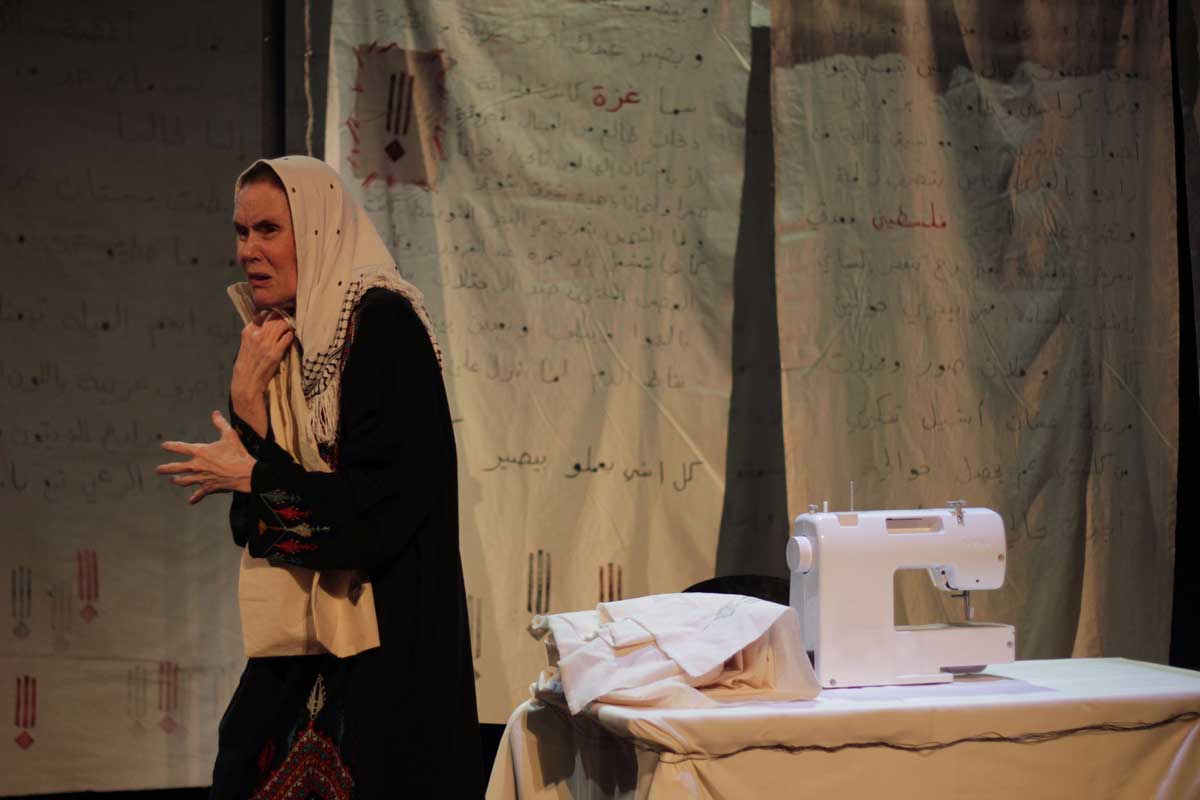
Faced with the tragic absurdity of such an existence, you might resort to humor, since otherwise there are no words to express this horror. The life of Hajja Souad, the protagonist of Palestinian writer Ahmed Masoud’s one-woman play, The Shroud Maker, unfolds against this darkly humorous background.
As anyone who has watched the annihilation of Gaza since October 2023 knows, these horror scenes are not fictional. On February 28, 2024, Al Jazeera ran a story about an undertaker in Gaza named Abu Jawad who has acquired gruesome expertise in burying the dead. Yet the annihilation of Gaza is a process that has been underway for decades, beginning on many accounts with the Nakba of 1948.
The Shroud Maker was conceived a decade ago in 2014, amid another of Israel’s wars on Gaza. Over a decade later, amid a genocide worse than Gaza has ever known, the play has only increased in relevance and power. I first watched The Shroud Maker at Bristol’s Palestine Film Festival in southwest England in 2021. This review captures my memory of what I saw then and the ways in which it has stayed with me since. The Shroud Maker was published in book form by Bloomsbury Publishing in 2018, so it is accessible to readers everywhere who cannot attend a performance.
The Shroud Maker is a feat of the imagination that encapsulates the history of Palestine since the British Mandate (1918–1948) to the creation of the state of Israel in 1948 to the bombings of Gaza by the Israeli Occupation Forces in 2017. I will interweave the key moments in the story into my commentary below, since the play is not currently part of any theater company’s repertoire and no recorded performances are available.
The play opens with Hajja as a child, born in Palestine before the founding of Israel. Her father finds work with Mrs. Cunningham, the wife of the British High Commissioner. Like much of the play, this part is based on historical fact: Alan Cunningham was the High Commissioner of Palestine from 1945 to 1948. He was in charge of operations against the Zionist paramilitary organization Hagana. Judging by the outcome of the conflict in 1948 and the fate of Palestinians during the Nakba, Cunningham did not do his job well.
In a short but blissful sequence, we are introduced to Hajja’s father, who works as a gardener for the Cunningham estate. Mrs. Cunningham takes Hajja under her wings, offering to take her to London and adopt her as her daughter. Then suddenly, with the end of the mandate in 1948, the Cunninghams abandon Palestine, leaving their home behind. Although Hajja never sees Mrs. Cunningham again, she writes long, thoughtful letters to her during the entire course of the play, many decades after their departure.
After the British leave, chaos erupts throughout Palestine. Soldiers storm the Cunninghams’ former residence and kill her father. Hajja is suddenly all alone in the world, with no parents and no one to take care of her. She is also in danger, as Jewish soldiers ravage the city of Jerusalem, looking for Arabs to kill. Hajja flees the city. While escaping Jerusalem, she comes across an abandoned baby, still in his swaddling clothes.
The baby’s parents are nowhere to be found. Hajja decides to adopt him as her own son. She calls him Ellian. After running for many days, Hajja and Ellian end up in a refugee camp for Palestinians who have been forcibly ejected from their homes by the Israeli army. The refugees are then relocated to Gaza, where Ellian grows up. His life is full of fear and deprivation, and he develops an obsession over his absent father. The play’s dialogue is punctuated by Ellian’s repeated probing question to his mother: “Mama, who was my father?”
Ellian falls in love with Basma, an English teacher in a nearby girls’ school. Together they raise their beloved only son, Ghassan. Hajja begins to believe that she is finally going to have a peaceful life and looks forward to growing old alongside her son, his wife Basma, and her grandson.
As events soon reveal, Basma’s hopes were misplaced. In 1987, the First Palestinian Intifada begins. Basma is arrested on a pretext of engaging in revolutionary activity, and Ellian tries to protect his wife from the arrest. He punches an Israeli soldier in the face, and the soldier shoots him in the head. When he dies after falling to the floor, Ellian leaves behind his 5-year-old son Ghassan.
Just like his own father decades earlier, Ghassan is haunted by the memory of his absent father. While growing up, he is stricken with a depression that makes him silent, a symptom of the trauma that every Palestinian in Gaza endures.
The play skips ahead by several years. One day, Ghassan escapes from Gaza. The exact details of his escape are unclear, but the point is that he is gone, seemingly forever. Hajja searches desperately for him for many years. She asks the Red Cross and even the Israelis about his whereabouts. He is nowhere to be found.
The final scene takes place amid another bombardment of Gaza, during which an Israeli soldier visits Hajja to extract information from her. As the shroud maker of Gaza, Hajja has access to a lot of information that could be useful to the IDF’s military operations.
Hajja proudly refuses to become an informant. Then, the soldier reveals his identity. In a revelatory moment, we learn that he is in fact Ellian’s lost son Ghassan — her own grandchild — who escaped Gaza many years earlier. Ghassan grew up in a Druze family while assimilating to Israeli society. When he became a young man, he was recruited into the Israeli army.
Certain aspects of this plot recall 1969’s “Returning to Haifa,” a classic story by Palestine’s greatest 20th-century writer, Ghassan Kanafani. In “Returning to Haifa,” we similarly come across a young man who was born into a Palestinian family but was, through a fluke of historical circumstances, raised by an Israeli family.
In both stories, the son has internalized the values of the Israeli occupation and become a soldier. The son’s transformation brings anguish to his Palestinian elders while also reminding us of the close links between Jews and Arabs in the land of Palestine that cross family lines, even when one side is intent on the other’s annihilation.
Although the story of Hajja’s life features many different characters, remarkably, the entire play is a one-woman show. Hajja was played by actress Julia Tarnoky during all of the play’s performances from Liverpool to Plymouth to Bristol to London. In her memorable performance, Tarnoky ventriloquizes every character who appears on the stage, giving us a taste of their personalities, while conveying their role in her personal story. She expresses her loves—as well as her passions—through the shrouds she weaves for the dead.
As a one-woman show, The Shroud Maker is technically a monologue. While watching it, however, I felt as if a series of dialogues were following one after the other in quick succession. The many different characters who filter through Hajja’s life introduce us to the range of different ways in which the Nakba and the ongoing occupation and genocide has been experienced by the Palestinian people.
When it was performed at the Bristol Palestine Film Festival in 2021, the play received a standing ovation. The feeling in the audience was electric: The story of Hajja Souad was the story of Palestine, and of one the world’s greatest historical injustices, an injustice that is no closer to resolution now than it was when it was conceived a decade ago.
The Shroud Maker should be staged again today, amid Israel’s genocide of Gaza, in every American and British city. The audience might then be able to see that the story of Hajja Souad is the story of our own humanity, or rather of our collective failure to be human when it comes to Palestine.
REBECCA RUTH GOULD is Distinguished Professor of Comparative Poetics and Global Politics at the SOAS University of London. She is the author of Erasing Palestine: Free Speech and Palestinian Freedom (Verso, 2023), The Persian Prison Poem (Edinburgh UP, 2021), and Writers and Rebels: The Literatures of Insurgency in the Caucasus (Yale UP, 2016) as well as Prison Hunger Strikes in Palestine: A Strategic Perspective (International Center on Nonviolent Conflict Research Monograph Series, 2023). She is currently working on famine and food security in the context of the Gaza genocide, as well as on a family history of the genocide with The Lighthouse Collective in Gaza.
