 <h1> The body is. The body is not. What is the body when it is not the body? What can a body be when it is not the body? Is the body ever just the body? What is the body even when we claim it is not the body? </h1>
<h2> This is what I wonder: when we experience digital and new media poetry, what happens somatically? Society often discusses the screen as if it is another realm, but as digital writers, does this put forth a harmful dualism, or does it open a new potentiality? </h2>
<body> I wrote this on a computer, getting migraines from the screen. I clicked buttons with the mouse, which clicked from my finger, a marionette of my arm. I typed with my calloused digits, digitizing myself but also feeling my body on the chair, the towel rolled up for lumbar support and lodged in the small of my back. I felt my upper vertebrae’s rock candy chunks, the crackle of my neck as I pulled it back—or if I turned too quickly, the numb side of my tongue and sharp occipital pain. The slow flare of pelvic pain that accompanies most extended sittings. </body>
<!–Frankly, sometimes I think it would be nice to divorce my body and let digitality be my speculative escapism. My avatar.–>
<!–But then again, sometimes I think it would be nice for digital spaces to recognize my body’s womanness and chronic illness that continues to oscillate diagnoses. What I mean is: it would be nice for the digital to be decoded from its white-cis-straight-abled-masculine default. The “neutral” that is never, never neutral.–> <!–And by nice, I mean necessary. And by necessary, I mean urgent.–>
<p> Numerous scholars have discussed the falsely perceived neutrality of technology. As early as 1980, political theorist Langdon Winner discussed the inherent politics of artifacts and technologies, not as either socially constructed or technologically determinist, but rather as engendering particular social ramifications. From there on, Science, Technology, and Society (STS) scholars have pressed against this problematic belief that technologies and digital systems are objective, unbiased, or separate from the entrenched codes of society itself. </p>
<embed> Scholars Ruha Benjamin and Safiya Umoja Noble, for instance, detail and critique the racism of algorithms. In Race After Technology: Abolitionist Tools for the New Jim Code, Benjamin discusses an AI beauty contest that awarded only white faces. The historical Kodak films were designed to develop white skin tones and not black or darker tones. Noble reveals the ways that Google search engines repeat and reinstate the racist stereotypes that are fed to it by users. Their examples and analyses abound. Although technologies and digital spaces are often presented as “objective” or “logical,” this is profoundly far from the truth and deeply harmful in material ways. </embed>
<blockquote> In her article “Feminist Rhetorical Practices in Digital Spaces” published in the journal Computers and Composition, rhetoric scholar Carleigh J. Davis argues that this perceived objectivity has led to the belief that digital spaces are “disembodied” and therefore “pure.” Discussing the so-called disembodiment and neutrality, she writes:
“[It] creates an assumption that any attempt to engage with embodied issues as they relate to technology is both unnecessary and counterproductive in digital communities. In other words, if technology is logically-based then it is already ‘for everyone’ (read: for everyone who fits normative social patterns), and so there would be no need to illogically bias technological systems with concerns about gender, race, sexuality, or other issues of embodiment. This pattern of thinking results in the proliferation of digital cultures that are hostile to participants who identify outside the assumed white cis-male norm precisely because, through such an identification, these participants are marked as embodied individuals and therefore are (according to the logic of these systems) diametrically opposed to the disembodied purity that defines technology.”
Davis’s words reflect precisely what concerns me about digital spaces—about writing into them as an “embodied” individual. </blockquote>
<p> And to decode this harmful default arguably necessitates bringing embodiment into the digital. Which isn’t to say it wasn’t always there to begin with—or that technology wasn’t already embedded within embodiment—but rather that we can assert it further. Theorize it further. Short-circuit and glitch the system until our materiality is viscerally recognized. Until the digital is no longer a dualism, a default setting, a dividend of body and screen. </p>
<body> Here, I take a breath. I wonder about the ways that I engender this dualism myself (meaning this dualism between body and digital, real and artificial, but also intersecting dualisms between page and body, feeling and documenting, even written text and voice). I read this text aloud while I wrote it, as my own voice gradually became scratchier as each night progressed. Then, I read it aloud to conference attendees and later returned to the text. Ultimately, I’m trying my best not to simply write “from the body” to “the screen” (or even the technology of the page). In this weaving in and out, I’m attempting to shift from dualism to dynamic interplay. To stitch together and also to layer. </body>
<embed> In 2011, sociologist Nathan Jurgensen coined the term “digital dualism” to discuss the ways that digital, on-screen lives and experiences are thought to be disembodied and intrinsically separate from “real” life (i.e. physical, in-person experiences). But with the rise of smartphones and social media, the boundaries between “away-from-keyboard” and digital lives have especially blurred. </embed>
<embed> In her book-length manifesto Glitch Feminism, Legacy Russell discusses Jurgenson and this digital dualism. She counters it with glitch feminism, arguing that “one is not born, but rather becomes, a body.” She does not simply argue for embodiment in digital spaces; in fact, she oppositely posits that bodies and gendering have always been abstract, and the glitch becomes a radical potentiality for rethinking the body. She talks about the “anti-body” and how contemporary artists are utilizing digital tools to “reimagine what a body means, how it can be redefined, what it can do, and what to continue celebrating.”. Through Russell, I begin to reach toward an answer to my earlier dissonance (of both wanting and not wanting my body in digital space). </embed>
<p> With Russell’s insights in mind, I turn here to digital poetry. In the fields of electronic and new media literature, writers continue to theorize and reimagine the body and anti-body in ways that move beyond dualisms or biocentricity. I think, <i> perhaps I can channel into a malleable digital body or avatar a new one. Perhaps we can make space to remake ourselves/our bodies and thereby challenge the perceived white-male-cis-abled-straight “default” of digital realms. </i></p>
<!–The handful of new media poetry pieces I’d like to share with you represent different ways that artists/writers are working with/through/around/into/out of the body. The methods I discuss are far from exhaustive and far from intended to canonize. Rather, they’re works I find intriguing in terms of my own craft and practice—and therefore that I hope might be similarly useful for you (the audience). They prompt me to rethink the interpolation of embodiment, screen, language, sound, identity, interactivity, and place.–>
<p> Definitions of digital and/or new media poetry are numerous and varied, as are definitions of electronic literature. We might borrow N. Katherine Hayles’s definition of e-lit as “born digital” work to be experienced on a screen, or the Electronic Literature Organization’s subsequent move in naming it any work created with, or experienced on, a networked or standalone computer. Here, I’m not as interested in definitions (bounding) as I am in exploring (unbounding). For my purposes here, I will discuss a haptic mobile poetry app and a mixed reality poetry game/installation. Regardless of what definition you choose to work with, each of these pieces represents a unique mode of somatic engagement mediated through screens, digitality, or computer technology. </p>
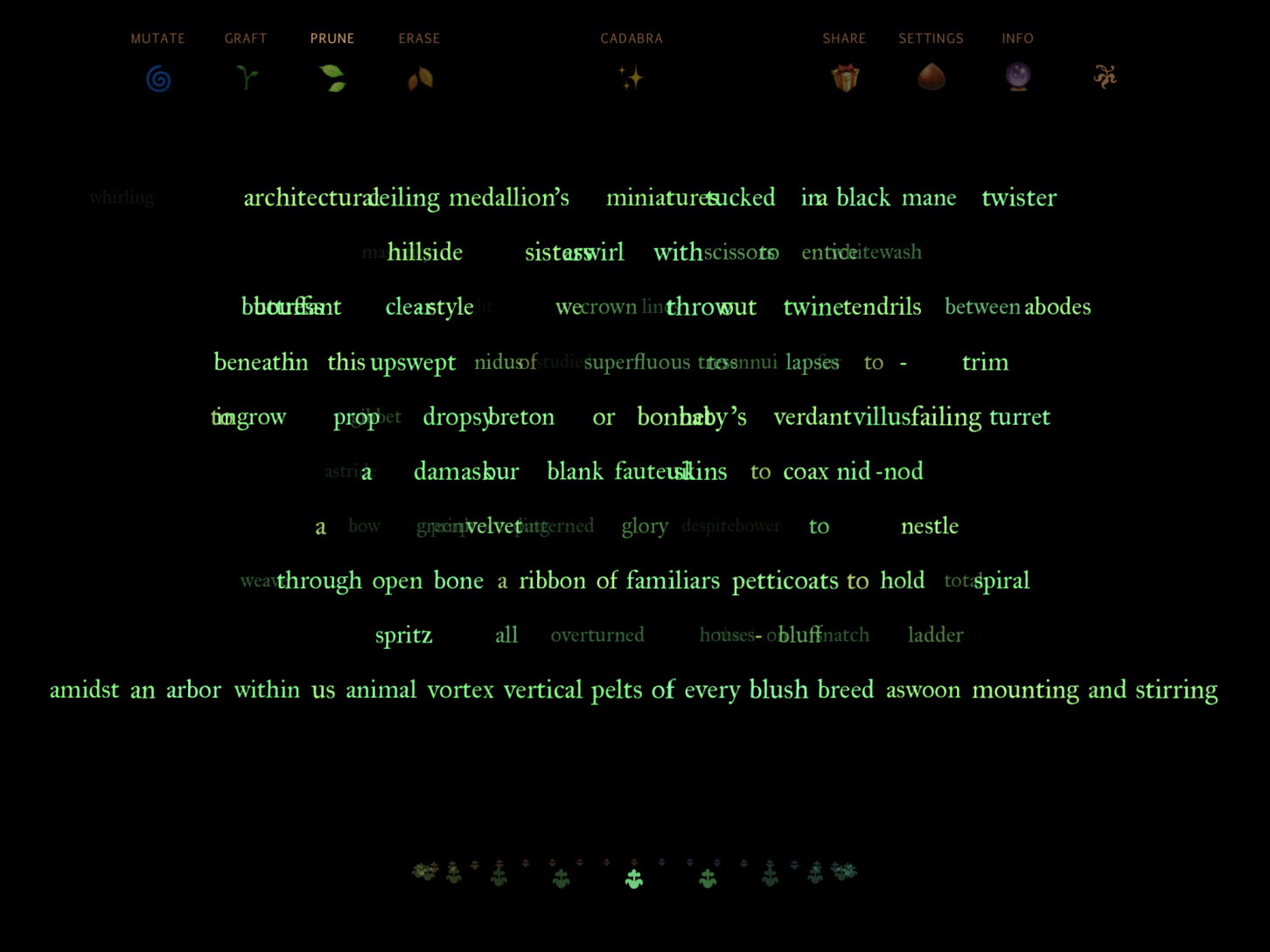
<figure> For our first example, “Abra” is a collaborative intermedia project by Amaranth Borsuk, Kate Durbin, and Ian Hatcher. Dubbed a “living text,” it complicates these surfaces of page, screen, and body—largely via the concept of touch. The project includes a textured artist book with cutouts and an insert in which to place an iPad. It also features an iOS app that is free to download, which will be the focus on my reflection here. </figure>
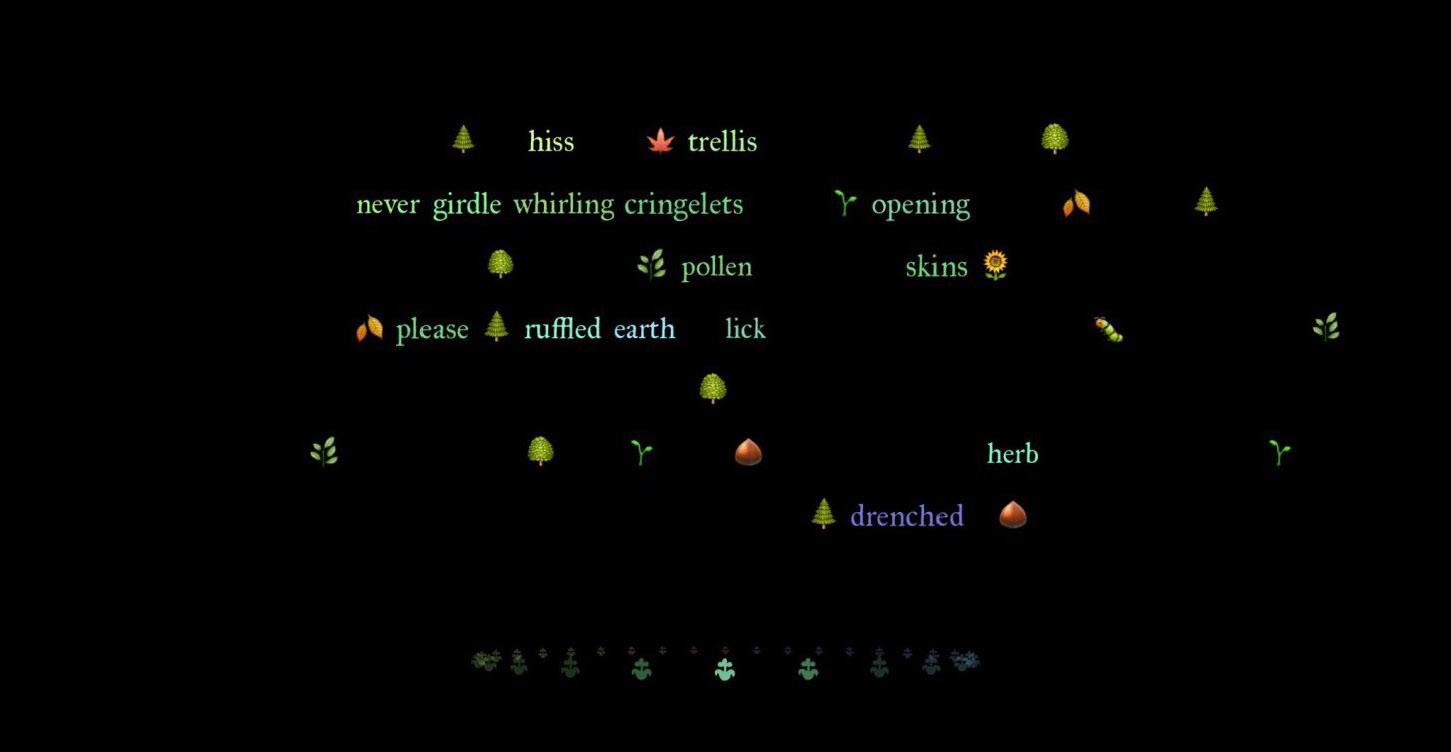
<body> Opening the app, I’m met with a centered, static stanza. Instinctively, I touch the words, and they soon begin to dissolve, replace, shift, transform. The warm font colors gradually veer toward cooler greens and even bright pinks, and the stanza starts to expand horizontally. <quote> “heaving” “arched lip” “singing” “into bones!” “candy hind siren saddled heads aswirl” “spasm strophes” “mouthing bones” “ ” “bookbulge” “read drift feel” “spin tear snare” “rasp” “striptease sisters” “
 ” “sinew around” </quote> My touch sifts through the stanza. The language too contains visceral verbs, alliteration that mouth-feels, and corporeal nouns that reference physical bodies and the text as a body (“spasm strophes”/“bookbulge”). In the 2014 ELO Conference, Borsuk discusses the artist book’s thermochromatic ink with curator Kathi Inman Berens, and she (Berens) breathes on the book to reveal the palimpsest-text beneath. Borsuk laughingly admits: “[T]he language in this book is very erotic, so to have a reader come up and breathe their hot breath on the page is completely appropriate.” The app, too, shares much of this same language—and perhaps the stretching, punctuated stanza also carries the invocation of breath. </body>
<p> I present “Abra” as an example not simply because erotic language necessarily makes a text inherently somatic, but rather because it showcases how touch and haptic/gestural interaction on a mobile interface can become a means for somatic engagement. “Abra” is hardly the first or only piece of mobile haptic writing, but it crafts such a comprehensive meditation on the body via its sonically rich language, somatic themes, and inviting design that encourages touch. In addition to the main stanza that I picture above, there are a handful of further options in the app’s header: “mutate,” “graft,” “prune,” “erase,” and “cadabra” (plus the righthand buttons for “share,” “settings,” and “info”). Notably, the “graft” option allows the user to incorporate their own units of language into the poem, including emojis, thereby opening further avenues for interactivity. <body> </br> <!–In his essay “Somatic Poetics,” Thom Donovan gestures toward a multifarious definition of somatic poetry. He writes:
“Whereof the poem is a site of movement(s).
Whereof the poem is a site of bodies coextensive in movement.
Whereof the poem is a site discrepant bodies co-constitutive through different (and oftentimes incommensurable) movements.”
I wonder about “Abra” as a living text—both site and body. It moves and is moved. On the artist book’s front page, beneath the author list, it reads: “& you.” Co-constitutive bodies.
“Whereof the poem is a place where these (potential) movements become organized.
Whereof the poem is a place where these (potential) movements become expressed.”
And in “Abra,” the potential of movements is enormous. Although, as scholar Jeneen Naji writes in Digital Poetry—and directly about mobile haptic poetry, including “Abra” itself—the potential is co-constituted. Naji maintains, “[We must] recognise that in a similar way to how technocentric approaches to digital literature are criticized so too must we question humancentric or anthropocentric approaches that assign all interpretive authority to the human agent” (46). The haptic digital poem is then perhaps both body and site, organizing and expressing an array of (potential) co-constituted movements along with the user’s body. Thus, one branch of somatic digital poetry.–> </br> <!–<a href=“https://jacket2.org/article/somatic-poetics”> </a>–>
</br><!–<a href=“https://link.springer.com/book/10.1007/978-3-030-65962-2”></a>–>
</br>/////////////////////////<body>
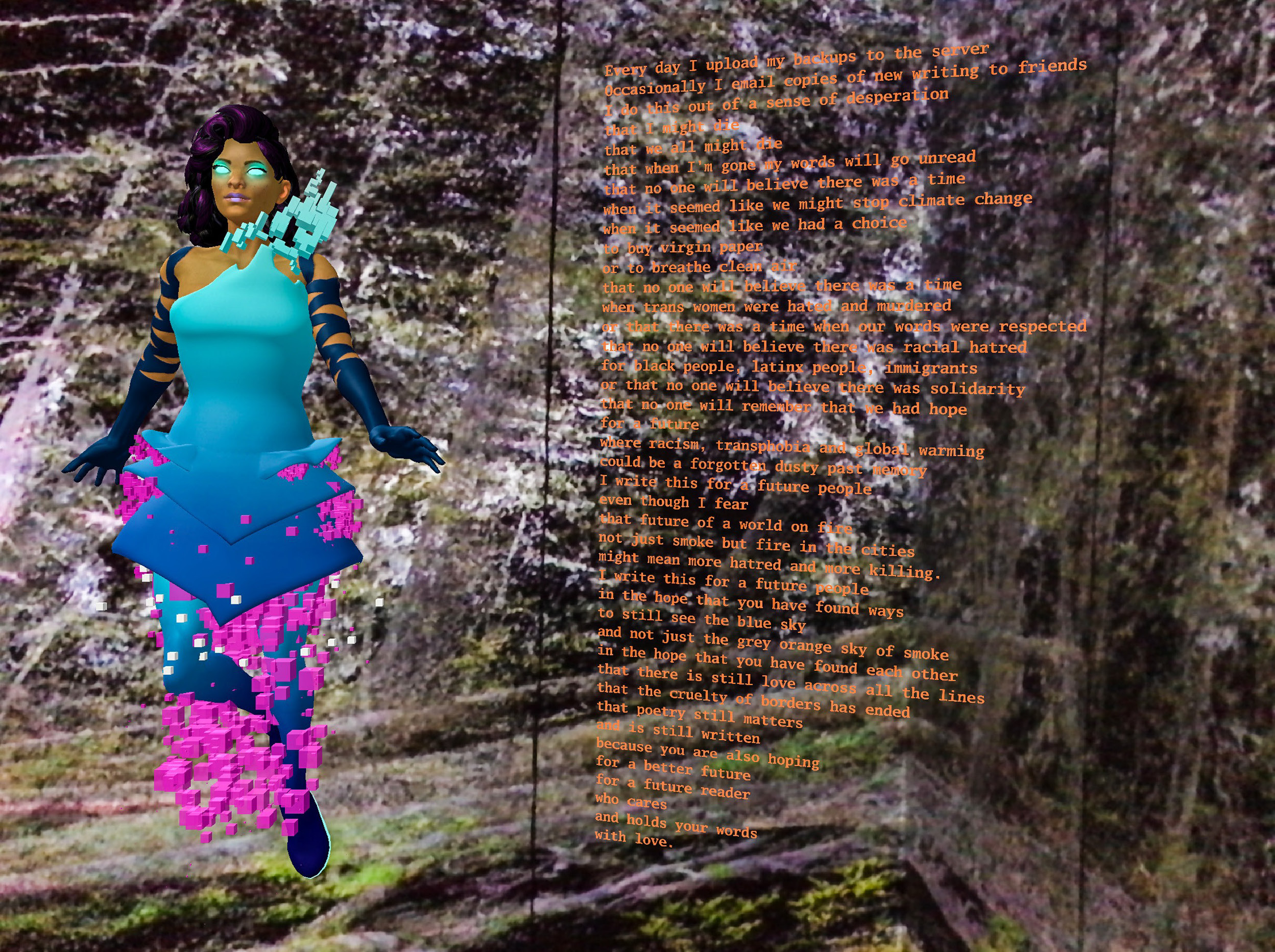 <figure> My second example is a mixed-reality poetry game by micha cárdenas. Sin Sol/No Sun is similarly available on the App Store, though it has also been exhibited in gallery settings. In such a setting, viewers use suspended iPads to navigate the panels of narrative poetry (also voiced sonically by the narrator, a trans Latinx AI hologram named Aura) within the immersive environment developed by Abraham Avnisan. </figure>
</br>/////////////////////////<body>
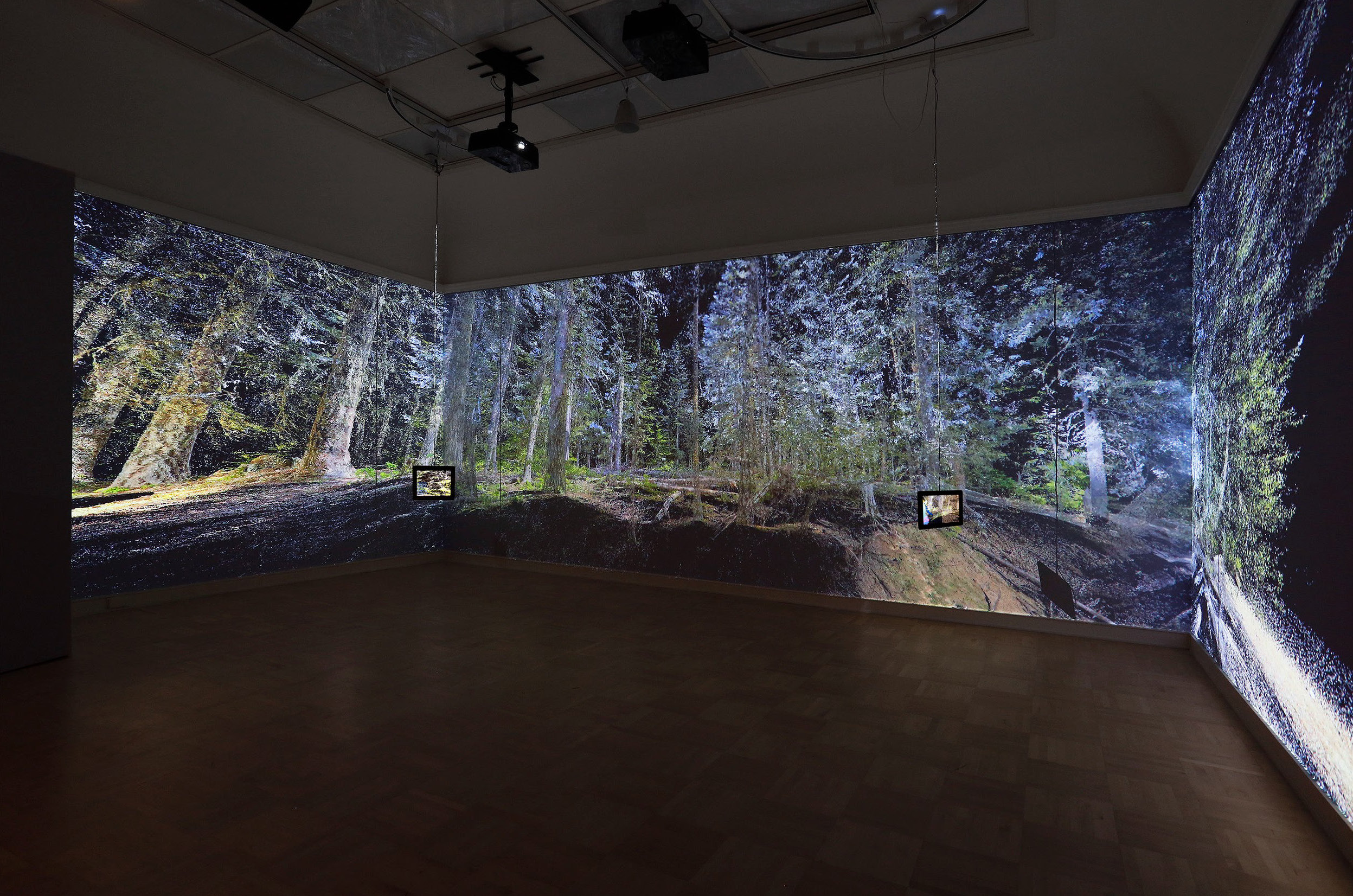
<body> When I first downloaded the app on my iPhone, I tried standing in the center of my living room. Too enclosed of a space, I climbed onto couches, counters, chairs to get a better view of the poetic architectures, squinting at the artificial distance. The next morning, I did the proper thing and moved to an outdoor space (the ideal setting) and then each sheet of poetry floated in the distance, intermingled with the environment of grass, trees, and distant trails. I felt my own slow deciphering as I inched nearer to each section. I attuned to the narrator’s voice in my ears.
<!–The body tags, how can I claim to close them?–>
</br>
<figure> Sin Sol/No Sun is a story relayed through poetry and virtual reality about the disproportionate impact of climate change on immigrants, trans people, and disabled people. It is set fifty years in the future, though Aura tells the story from the past (in this case, 2018). Ultimately, Aura’s dog, Roja, becomes the lead for the user as they escape wildfires and acquire oxygen capsules of poetry. To progress through the narrative poem, the user navigates this virtual reality as it is overlaid atop their own, thereby sending an urgent message about the present day climate disaster that is unfolding in real time. </figure>
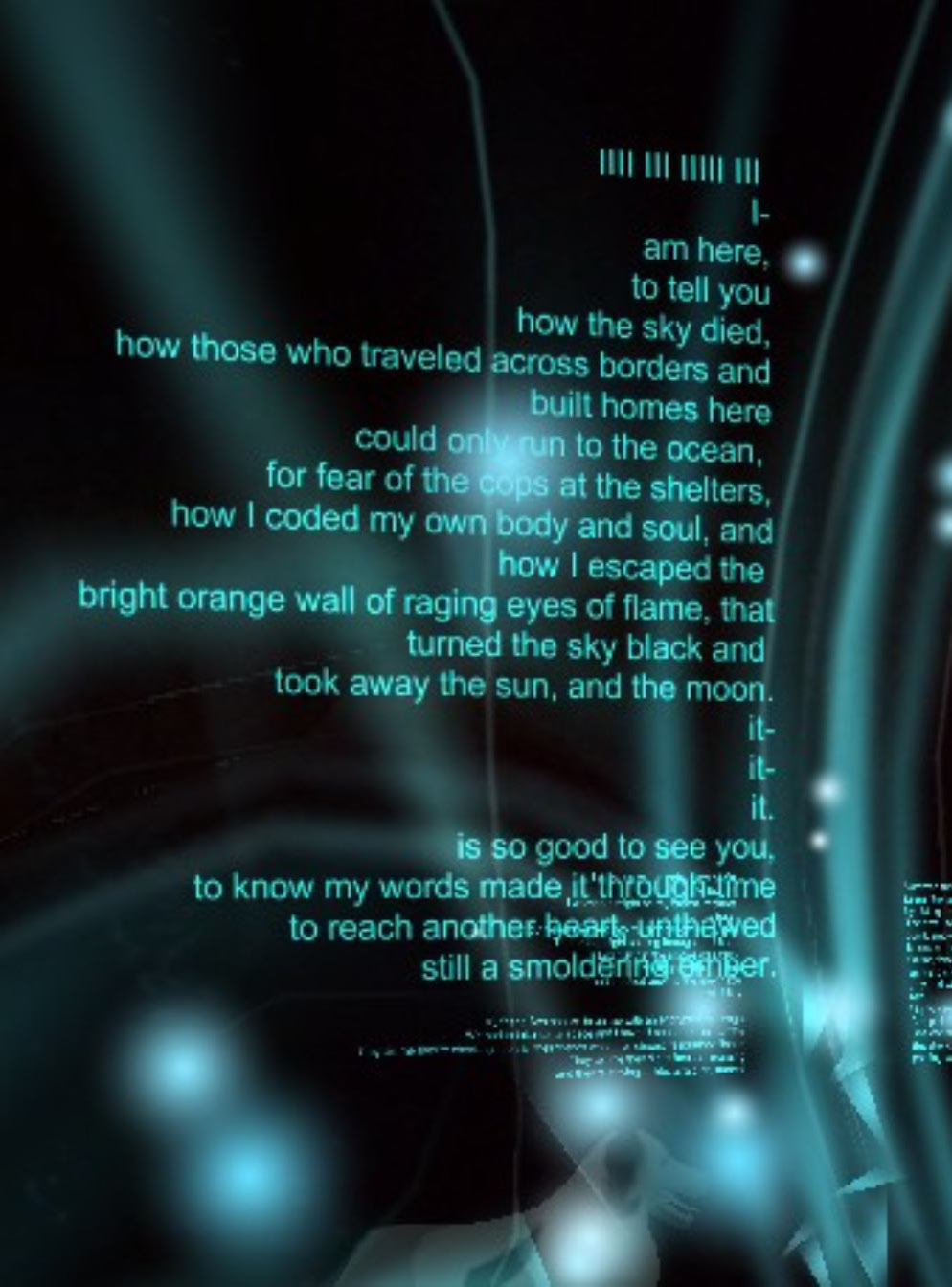 <p> cárdenas’s work reminds us of another potentiality of somatic new media/digital poetry—that it can unfold spatially and be experienced/mixed via user ambulation or movement. Readers navigate through space, engaging with both the real and virtual fused together. I turn again to Donovan in thinking about somatics and space. Understanding the body as an accumulation of place via sensation and interrelation with other bodies, Donovan argues that “[s]omatics is a site—the aesthetic site—where we undergo these places.” In this way, place is palimpsestic and experienced differently across bodies (the latter is perhaps an obvious point, but one that bears mentioning). In engaging with Sin Sol/No Sun, I’m struck by how it interfaces the body and place via somatics; the 3D scans of Pacific Northwest forests are overlaid onto the user’s environment, not blocking it out, but impressing upon it. Likewise, the lyric panels of text provide interiority for the hologram character, Aura, whose experience of place (under the duress of climate disaster) is deeply intertwined with bodily pain and violence. Sin Sol serves as an impactful example of somatic digital poetry that not only engages the body in its (plat)form, but also incorporates environment and place as part of an intimate web of bodily experience. </p>
<body><!–Moreover, Sin Sol/No Sun offers a crucial response to my earlier meditations by showing that digital experiences and environments can reimagine the body in ways that are still empowering, subversive, and important. Digital dualism can be countered in manners that honor the body as both material and abstract, neither essentializing nor indiscriminately social constructivist. Aura voices: “I found the way out of their training, /I repaired my neural network, /Self-coding witch lying under the moon” (càrdenas).–>
</br>///////
</br> <!–<a href= “https://michacardenas.sites.ucsc.edu/sin-sol-no-sun/”></a>–>
</br><!–<a href= “https://vimeo.com/424403639”></a>–>
</br>
<body> As after any marathon, I give my body a break here. Gradually, the HTML text has become more and more unruly (or glitched, if you will). As Russell explains in Glitch Feminism:
<blockquote> “Inevitably, the presence of a virus shakes us into an awareness of our bodies and being. The presence of a virus prompts an awakening. This comes through the recognition that the loop between online and AFK [away from keyboard] is not seamless. Rather through its fissures and faults, the virus makes brokenness a space, placing us within the break itself.” </blockquote>
Reaching the conclusion of my essay, this break is welcomed. I’m heartened by this double- exposure of the word “break,” of understanding the broken glitch as a site of both rebellion and respite. To break from the norm. To take a break from the norm. This break is necessary and restful and restorative and whatever else can be imagined and planted in its fissure, just as I hope this reading has been a break for the audience—in whichever sense of the word you needed most.
AMANDA HODES is a writer and new media artist. She is a Lecturer of Poetry in Creative Writing at Oberlin College & Conservatory. Her poetry has been published in Black Warrior Review, Prairie Schooner, Pleiades, AMBIT, Denver Quarterly, PANK, West Branch, and elsewhere. As an artist, she is interested in sound installation as a route to a somatic, spatial poetics. Her new media work has been exhibited in venues such as the Crisp-Ellert Art Museum, Torpedo Factory, Abington Arts Center, Hirshhorn Sound Scene Festival, Ammerman Center for Arts & Technology, AUDIRE, and Dartington International Music Festival. She is a recipient of a 2021 writing residency at the Banff Centre for Arts and Creativity and was a finalist for the 2023 Sappho Prize for Women Poets. She has also been supported by the Arts Club of Washington, Koster Foundation, Salzburg Summer Academy of Fine Arts, and the Fulbright Commission. She also has an MFA in Creative Writing from Virginia Tech and an MA in Creative Writing from the University of East Anglia.
