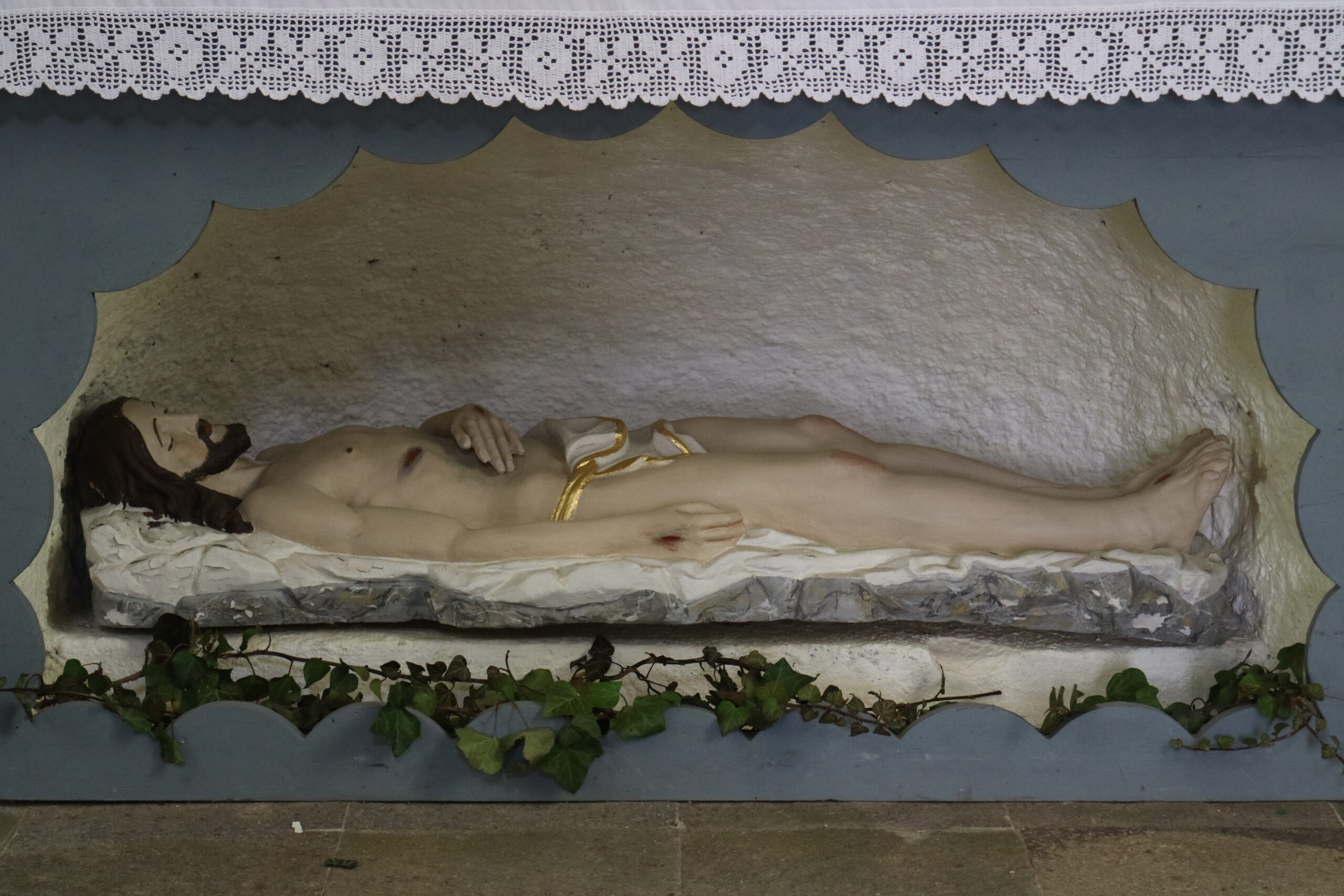
 Christ icon in the Chapel of St. Augustine near Sveti Duh na Ostrem vrhu. (via Wikimedia, CC BY-SA 4.0)
This essay is written by MAYDAY magazine’s Critic in Residence for Spring and Summer 2025.
When you grow up religious, you grow up steeped in media the likes of which secular folks cannot even imagine. Some of this religious media has bled into the mainstream and might trigger name recognition: VeggieTales, for example, an animated series in which talking vegetables act out Bible Stories. But others were far more niche. Instead of Alice in Wonderland (the psychedelic visions of Lewis Carroll), my family basement bookshelves were lined with all 28 installments of the illustrated picture book series, Alice in Bibleland. My parents were devotees of Charles Swindoll and his nationally syndicated radio show, Insight for Living, and so we read large-format books that expressed his beliefs to children and in which he was depicted as a friendly, paternalistic grandpa-bear known as Paw Paw Chuck. At night before bed, my mom would read aloud to my brothers and me from The Bible Animal Storybook, in which Bible stories were narrated by the animals who starred in them: Balaam’s talking donkey, the ravens who fed the prophet Elijah, the rooster who crowed three times after the Apostle Peter betrayed Jesus. Of course, there was also Adventures in Odyssey, the popular radio drama that revolved around lovable town inventor, Avery James Whitaker, and his homey ice cream shoppe, Whit’s End: a production of Focus on the Family, the conservative Christian media empire helmed by child development psychologist Dr. James Dobson and headquartered in Colorado Springs, Colorado, less than two hours from where I grew up. Religious media speaks in unison, each program and picturebook reiterating the same fundamental ideas and beliefs.
When I started reading on my own, I restricted my taste to books that I could trust would affirm and strengthen my evangelical beliefs, bias, and worldview. While it’s become more difficult over the past decade to pin down the particularities of “evangelicalism,” Kristin Kobes du Mez, in her sweeping work of American sociology, Jesus and John Wayne, writes, “Rather than seeking to distinguish ‘real’ from ‘supposed’ evangelicals, then, it is more useful to think in terms of the degree to which individuals participate in this evangelical culture of consumption.”¹ I participated enthusiastically. My favorite retail store was Family Christian Bookstores. When I went to the Borders or the Barnes & Noble in my town, I gravitated toward the Christian Living section. All of my favorite novels came to me via the Young Adult Fiction shelf in the one-room library at my church. And oh, how I gloried in those novels—teen girls who accepted Christ and their whole lives were changed; teen girls who prayed to God for love and he gave them handsome, popular, devoted boyfriends (as long as they promised to wait for marriage to have sex); and teen girls gifted with supernatural abilities who solved cold cases! But everything that I read reiterated the central tenets of my faith: that God was real, that God had a plan for me, and that God would execute that plan in his timing, so long as I stayed faithful and pure. I lived inside an airtight geodesic dome of dogma.
Religious media serves the implicit function of siloing the imagination of its audience. From this vantage, I can recognize that my adolescent approach to media was rooted in fear. I loved the Regina Spektor song that accompanied the credits in the movie version of The Chronicles of Narnia: Prince Caspian, but I chose not to risk listening to her other music, because she was a secular artist and her lyrics might contain swear words or unseemly ideas. The album cover for Soviet Kitsch struck me as dangerously racy—and the Apostle Paul instructs Christians to “avoid even the appearance of evil” (I Thessalonians 5:22). I hungered for critical thought and rigorous engagement with the world around me, but I didn’t know where to find that in a way that wouldn’t threaten my belief system.
For years, I sated my critical appetite with Plugged In Online, the Christian film review blog. Plugged In was another ministry of the many-armed Focus on the Family. The site wasn’t a venue for movie criticism the way I think of it now; rather, the blog existed to help parents determine in advance whether or not a movie would be appropriate for their kids. Each post contained sections on sexual and romantic content, violence, drugs and alcohol, and crude language. Notably, the posts didn’t include anything about the overall “message” of a movie.
My brothers, however, had no problem with “worldly” media. Every once in a while, I would let down my guard and allow them to afflict me with their hedonistic tastes—which is how I came to see the 2006 comedy Accepted, featuring Justin Long, Blake Lively, and Jonah Hill. Accepted is a low-brow comedy about guys who, upon failing to get into any college they’d applied to, devise their own university to deceive their parents. The institution they invent? South Harmon Institute of Technology (note the acronym). When one of the guys builds a website for their fake school, he promises, “Acceptance is just a click away.” And, like the numbskull he is, he makes the button clickable. Before the guys can catch up with their snowballing scheme, South Harmon Institute of Technology has hundreds of undesirable students arrive on “campus”—a barely renovated former psychiatric hospital—for orientation.
The movie is undeniably trashy. Lively and Long’s characters hold a wet T-shirt party in the cafeteria; Hill’s character tries to join a fraternity and is forced to wear a full-body hot dog suit and run around the quad yelling, “Ask me about my weiner!” Plugged In takes issue with the film in every category it evaluates.
And yet. There’s this scene when the guys decide to go for it, to make their school real. They’ve accidentally gathered together all these freaks, rejected from all the other schools. “When I got accepted here,” one character announces, “it was the first time my parents ever said they were proud of me.” The other “students” all applied elsewhere, and all got rejected from everywhere else. Bartleby (Long) gives this speech: “I know what it’s like to be rejected, it sucks […] Shouldn’t we all have a chance to be said ‘yes’ to? At South Harmon, we say ‘yes’ to you. We say yes to your hopes, we say yes to your dreams, we say yes to your flaws! So welcome!”
It seemed to me to be one of the most beautiful portrayals of the gospel I had encountered in film. After all, I reasoned, that’s what Jesus does: He accepts us, along with our hopes and our dreams and our flaws and our fuck-ups. I copied the speech onto a sheet of college-lined notebook paper and hung it up inside my high school locker. For all of their attention to S-words and F-words and sexual innuendo, Plugged In Online missed the whole point. That was when I stopped reading Christian movie reviews—because I realized that the scrupulous avoidance of the “appearance of evil” isn’t the same thing as seeking and recognizing goodness where it exists.
I’m interested in themes of spirituality, including when—no, especially when—they don’t intersect with the performance of morality. I am so uninterested in sanitization. This is my own bias, but it seems to me, after spending so long soaking in a landscape where media operates in service of an explicit agenda, that the more sanitized and careful and cautious the product, the less I’m able to trust the motive and the intention behind it.
When I decided to leave the silo of evangelical media, I expected to find that mainstream media operated differently, unconstrained by bias. Whereas evangelical media automatically rejected anything that didn’t meet a certain kind of purity test, I expected that the mainstream literary world would operate on the basis of merit rather than conformity. What I did not anticipate is that there seems to be a certain unspoken consensus around atheism in the mainstream literary world. By aligning itself with the academy, mainstream publishing seems to take for granted a conflation of intellectualism and areligiosity or anti-religiosity.
What I’m here to lament is that there seems to be a gap in the literature, or even (bear with me) a gap in the literature about the literature. As someone whose life has been shaped around faith and religion, these topics still hold great meaning and significance for me. I want to be able to continue to engage with them in a way that feels authentic to my current position. And yet, I’ve found so few spaces that consistently do that. Where do you go when you’re too angry for the orthodox but too grieved about leaving for the exvangelicals?
In its simplest sense, “exvangelical” refers to someone who used to be an evangelical and is no longer. However, that would be ignoring the word’s politically freighted origins. Coined as a hashtag on Twitter in 2016 by writer Blake Chastain, the word is heavily associated with millennials and Gen X-ers, characterized as highly online, angry, and vocal about the repugnant (and theologically problematic) alignment of white American evangelicalism and Donald Trump. One stereotype of exvangelicals is that, by defining themselves according to what they reject, the exvangelical movement perpetuates the binary worldview inherent in evangelicalism and keeps people’s growth tethered to a place of rejection, argument, and ideological superiority.
Jeanna Kadlec, author of the memoir Heretic, recounts that her religious deconstruction in 2012 and 2013 preceded the online proliferation of resources and role models for people re-evaluating their faith. “Chrissy Stroop, PhD, the creator of #emptythepews, wasn’t yet a prominent ex-evangelical voice sought out for interviews and comment by major news outlets,” she writes. “Anthea Butler, a professor of religion at the University of Pennsylvania, hadn’t yet written the essential White Evangelical Racism. There was no TikTok, let alone an entire community of ex-evangelical TikTokkers, such as Abraham Piper, one of the children of ‘biblical manhood and womanhood’ co-creator John Piper, giving pithy breakdowns on evangelicalism, calling it ‘a destructive, narrow-minded worldview.’ Joshua Harris, the author of I Kissed Dating Goodbye, hadn’t yet denounced his work and his faith.”²
The years immediately following Kadlec’s personal deconstruction—years that neatly aligned with the first Trump presidential campaign, then election, then its early impacts—saw a veritable explosion of online content about religious deconstruction. Twitter and TikTok are often referenced for being highly influential at this stage. But I can’t speak to that—I wasn’t on Twitter back then. From 2015 to 2018, I was wrestling through different stages of my own deconstruction, living in a communal house with housemates procured through a progressive Christian volunteer service corps. I’ve never managed to be Extremely Online™; I read books. In a cozy, white-walled bedroom I shared with two other young women, I read Rachel Held Evans’ spiritual memoir, Faith Unraveled (originally released as Evolving in Monkey Town), published by Zondervan in 2010. On the bunk bed opposite my twin, one of my roommates read Is It Okay to Call God “Mother”: Considering the Feminine Face of God by Paul R. Smith and Sarah Bessey’s Jesus Feminist.
At the time, I was disenchanted with evangelical culture and commercialism—I told myself I was done with books from Zondervan, Multnomah, Tyndale House, Thomas Nelson—though I remained a devoted follower of Christ. I didn’t know what to read. As someone who had grown up within the insulated dome of religious thought, I had no idea how to go about shaping my own aesthetic preferences or commitments. How do you start making choices when choices have always been made for you—and you were taught that the wrong choice meant damnation?
I didn’t yet know the kind of texts I was looking for: texts that refuse to settle into the platitudes of evangelicalism, that reject dogmatic thinking, and that wrestle with God. “Wrestling” is a reference to the Genesis passage wherein Jacob grapples with an unknown visitor—God, or an angel³—but I think the word “wrestled” is overused in this context. There’s a partner dance called milonga: a subgenre of Argentine tango, commonly accepted as the oldest form of tango, likely developed by Argentinian and Uruguayan dock workers. Milonga is danced in close embrace, with heavy steps and quick rhythms, accents on the off-beat. When I dance it, I feel like I’m fight-dancing. That’s the kind of wrestling I mean. I want to find writers who are unwilling to take the language of faith at face value, writers to whom there are things that matter more than sounding correct.
I found Christian Wiman. His book, My Bright Abyss, came home with me from the library, and I inhaled it. I drowned in it. Heady but visceral, his prose exfoliated my existence. Dead tradition and outdated feeling flaked off me like dandruff. “The minute any human or human institution arrogates to itself a singular knowledge of God,” he writes, “there comes into that knowledge a kind of strychnine pride, and it is as if the most animated and vital creature were instantly transformed into a corpse. Any belief that does not recognize and adapt to its own erosions rots from within. Only when doctrine itself is understood to be provisional does doctrine begin to take on a more than provisional significance. Truth inheres not in doctrine itself, but in the spirit with which it is engaged, for the spirit of God is always seeking and creating new forms.”4 I love the complexity of Wiman’s writing, his dense whorls of thought, and his seemingly endless self-interrogation, a refusal to see a thought as finished, fixed. But other days, his elevated voice puts me off. It feels too white, too academic, too cloistered. I want messy, angry, ragged.
Enter Priestdaddy (Penguin Random House, 2017), by Patricia Lockwood. Damn, what an unfairly hilarious book. Poet and critic Lockwood uses her memoir to present a portrait of her father, an unconventional Catholic priest who received special dispensation from the Pope to retain his wife and family after converting from ministering as a Lutheran. Lockwood’s inimitable voice and uncanny observations give this book its renegade spirit, but structurally, she flounders a bit. The book reflects a chilling knowledge of the Catholic Church’s institutionalized misogyny and the sexual abuse of minors. And while she takes the Church as a whole to task, Lockwood’s courage wilts a bit in the face of her father. He’s depicted as particular, rather than oppressive; his microaggressions are showcased somewhat reluctantly, painted as quirks, even as he makes irresponsible decisions like spending his daughter’s college fund on another guitar. I adore this book, and it leaves me wanting.
While I was seeking books that touch on the experience of leaving faith and faith communities, I came across the work of Meghan O’Gieblyn. Her book, Interior States (Anchor Books, 2018), is a collection of essays that cover topics ranging from Hell to AA, from whitewashed historical idealism to futuristic techno-optimism. O’Gieblyn writes about attending Moody Bible Institute during and immediately after 9/11, reckoning with seeker-friendly Christianity and megachurch pastors and the evangelical insistence that the unreached are damned. “Sniffing Glue” is one of my favorite essays about the knockoff-rock genre of Christian Contemporary Music (CCM), second only to GQ contributor John Jeremiah Sullivan’s dazzling and devastating “Upon This Rock.” Because Interior States is assembled from essays originally published in a smattering of mainstream outlets (Harper’s, The Believer, and elsewhere), O’Gieblyn seems to skirt certain connective threads that would give her story a fuller shape. She pulls out biblical hermeneutics like a party trick but wants to convince the reader that she feels entirely detached from her religious past. However, the detachment reads like a self-preservation tactic. Her unresolved relationship to belief seems to be simmering just under the surface, beyond what she’s willing to divulge. Her book left me wondering: How does one stay in conversation with the themes and arcs and problems of religion, even after one leaves it behind? Meghan O’Gieblyn, Patricia Lockwood, Jeanna Kadlec. All three of these writers released fairly successful nonfiction books wherein they ultimately broke from the church. Is that—their vocal dis-affiliation—the factor that allowed these books to do well?
The mainstream publishing scene doesn’t take belief seriously. The expectation is that any self-respecting intellectual/writer wouldn’t fall for something as woo-woo as faith. Calvinist novelist Marilynne Robinson admits the embarrassment of belief: “No one,” she writes, “wants to be found among the credulous.”5
Furthermore, the assumption is and has long been that believers and nonbelievers partake of entirely different books, to support our differing worldviews. Christians like my teenage self read Christian books (books of all genres—there’s even such a thing as Christian horror!—published by religious publishing houses), and nonbelievers read “normal” books. Believers are skeptical of the stories and values and mores of nonbelievers; nonbelievers can be dismissive and arrogant when it comes to listening to believers. Both parties wonder, “What could they possibly have to say to me?” This divide in the publishing world diminishes the human, empathetic, and spiritual capacity of all of us.
A major portion of the population has experience with organized religion, whether that be Catholic school or church camp or a brief period of fervent belief or that one Mormon they dated in high school. Religion is an incredibly significant slice of American life. Mainstream literary publishing does itself and all of us a major disservice by siloing considerations of religion, faith, spirituality, and religious institutions exclusively within religious publishing.
When mainstream publishing houses eschew religious/spiritual content solely for topical reasons, that reiterates the message that all religious material must be handled by a religious entity, like a publishing house. This reiterates the idea that only certain people are qualified to talk about God, separating individuals from the Divine and imposing a mediator (even if that mediator is [allegedly] qualified by their religious fervor, like your passionate Assemblies of God preacher who doesn’t have more than a high school diploma). Even more dangerously, this kind of siloing implies that anyone who wants to dabble in traditional forms of religion or spirituality will only find an ally in institutions that are increasingly dominated by and aligned with the religious and political right. It reinforces extremism, polarization, isolation, and gatekeeping.
I believe there is space in the literary landscape for stories that touch on spiritual themes without being “religious books.” Lit by Mary Karr is one of them; Yaa Gyasi’s novel Transcendent Kingdom is another. However, these books strike me as exceptions that illustrate the rule. For the most part, earnest religious experience remains a taboo topic in mainstream American publishing.
One of the most surprising things I’ve discovered while tracking spiritual themes in books is the willingness of Christian publishers to support books that are not unequivocally positive about church and American Christianity. The first time I noticed this was with The Woman They Wanted: Shattering the Illusion of the Good Christian Wife, a memoir written by Shannon Harris (ex-wife of former megachurch pastor and purity culture figurehead Joshua Harris) and released in 2023 by Broadleaf Books. Broadleaf Books is the adult nonfiction imprint of Augsburg Fortress Publishers, the official publishing house of the Evangelical Lutheran Church of America (ELCA), a progressive mainline denomination. I was impressed to see that Broadleaf has published books on topics like anti-racism, incarceration, Indigenous erasure, raising transgender and gender-diverse kids, infertility, resisting Christian nationalism, and more.
As a literary critic, I was already seeking to prioritize narratives of women’s experiences within faith communities. And as a memoirist, I want to be aware of who’s helping usher into the world stories like mine. Shannon Harris, I discovered, is represented by Ingrid Beck, an agent at The Bindery Literary Agency, headquartered in Colorado Springs. Also represented by agents at the Bindery are Cait West, author of Rift: A Memoir of Breaking Away from Christian Patriarchy (Eerdmans, 2024); Tia Levings, author of A Well-Trained Wife: My Escape from Christian Patriarchy (St. Martin’s Press, 2024) ; and Liz Charlotte Grant, author of Knock at the Sky: Seeking God in Genesis After Losing Faith in the Bible (Eerdmans, 2025).
Ever since I’d sworn off reading books from religious publishing houses back in 2013, I’d stopped keeping track of what was being published there. (And, as is the case with effective silos, very little news of what’s going on in Christian publishing reaches “the outside world.”) But my childhood best friend—the same girl who pointed out the Young Adult Fiction shelf in the church library when we were both 11—is more online than I am, and she read in a Reddit forum about When We Were on Fire (2013) and Night Driving (2016), two memoirs about growing up evangelical by Addie Zierman. Both books sold to Convergent, a controversially liberal Christian imprint that’s now a part of Penguin Random House.
Zierman’s books are breathtaking memoirs about childhood indoctrination, purity culture, fervent adolescence, and the fallout that arrives in adulthood. They are everything I want my work to be: tender, bittersweet, searing, personal. Zierman, who holds an MFA from Hamline University, writes with an artist’s finesse. She writes about protecting her purity at great cost:
“You should have let him kiss you.
“If you had, maybe this would not be your story, your journey, your burden. If you had done what you wanted to do instead of watching over the boys and their vows […] If you had allowed yourself to be hurt the usual way that teenage boys hurt teenage girls instead of falling so nobly on the sword of the Spirit, a constant sacrifice, dying again and again to your own desires, then maybe it would not have gone like this.”6
One of the things I love about Zierman’s books is her willingness to include the “unsavory” part of her journey: excessive drinking, flirting with other men, questions about Christian dogma. Her writing is courageous and uncompromising.
Zierman defines evangelical jargon for a non-indoctrinated readership; she establishes recurring literary motifs (“the last of the missionary boys”); and she employs sophisticated callbacks. While I read, I felt like the book was firing on all cylinders, working in concert with itself, sweeping me along with its language and its story and its metanarrative.
And I had never heard of it before. Because I was so jaded I refused to consider work from Christian publishing houses. And it baffles me that the work most aligned with the tensions in my spirit is coming from the same entities I turned away from, however long ago.
The books about faith out in the mainstream, for the most part, reiterate the mainstream skepticism about belief: Heretic, Priestdaddy, Interior States. And strangely, even books published by religiously affiliated publishing houses can abide a considerable margin of liminality, as found in books like The Woman They Wanted, psychologist Dr. Laura Anderson’s When Religion Hurts You: Healing From Religious Trauma and the Impact of High-Control Religion (Brazos Press, 2023), and Zierman’s books. I did not expect that some of the most courageous and engaging stories about wrestling with all the nuances of belief are being published by religious publishing houses. I’ve learned how to find the kind of books I’m looking for—but it’s taken me years, and I don’t think you should need to be a literary critic with a side hobby of internet stalking to be able to track down writers covering these topics with nuance and vulnerability. I was thrilled to find the story “What I Do and Do Not Say to the Girl on the Plane to Panama” by Kristi Ferguson in MAYDAY magazine. Jia Tolentino’s essay “Ecstasy” and John Jeremiah Sullivan’s aforementioned “Upon This Rock” are also gorgeous, weird, literary, irreverent pieces that affirm the mixed experience of wrestling with God. This is the kind of surging fight-dance I am always looking for.
Institutional religion taught me that only those as educated as I was could offer me any useful ideas or thoughts or guidance about devotion. But I don’t read to achieve some higher level of gate-kept knowledge. I read to empathize with others, to dip my toes into the pool of the shared human experience. I’m not seeking elitism; I’m seeking connection. Not professionalism, but authenticity—in Liz Charlotte Grant’s words, “earnest religious experience.” And I believe that earnest religious experience includes experiences absent any recognizable Godhead.
This is why I no longer eschew books from religious publishers, and why I simultaneously push to find more books with spiritual themes in the mainstream. I’m continuing to untangle the knotted threads of my own beliefs. But while I do so, I’m relieved to discover that there are certain spaces within the literary world-–though not the spaces I would’ve pinpointed—that seem capable of abiding disagreement in the service of a grander pursuit.
1 Kristin Kobes du Mez, Jesus and John Wayne: How White Evangelicals Corrupted a Faith and Fractured a Nation (LiveRight Publishing, 2021), 8.
2 Jeanna Kadlec, Heretic: A Memoir (HarperCollins, 2022).
3 Genesis 32
4 Christian Wiman, My Bright Abyss: Meditation of a Modern Believer (Farrar, Straus and Giroux, 2013), 111.
5 Marilynne Robinson, Reading Genesis (Farrar, Straus and Giroux, 2024), 6.
6 Addie Zierman, When We Were On Fire (Convergent Books, 2013), 76.
MCKENZIE WATSON-FORE is a writer, artist, and critic currently based in her hometown of Boulder, Colorado. She holds an MFA in Writing from Pacific University and a BA in Biblical Studies from Gordon College. She serves as the executive editor of sneaker wave magazine, and her work has been published or is forthcoming in Full Stop, Christian Century, the Offing, CALYX, and elsewhere. When she’s not writing, she dances Argentine tango, knits baby cardigans, and watercolors her feelings. McKenzie can be found at MWatsonFore.com.
