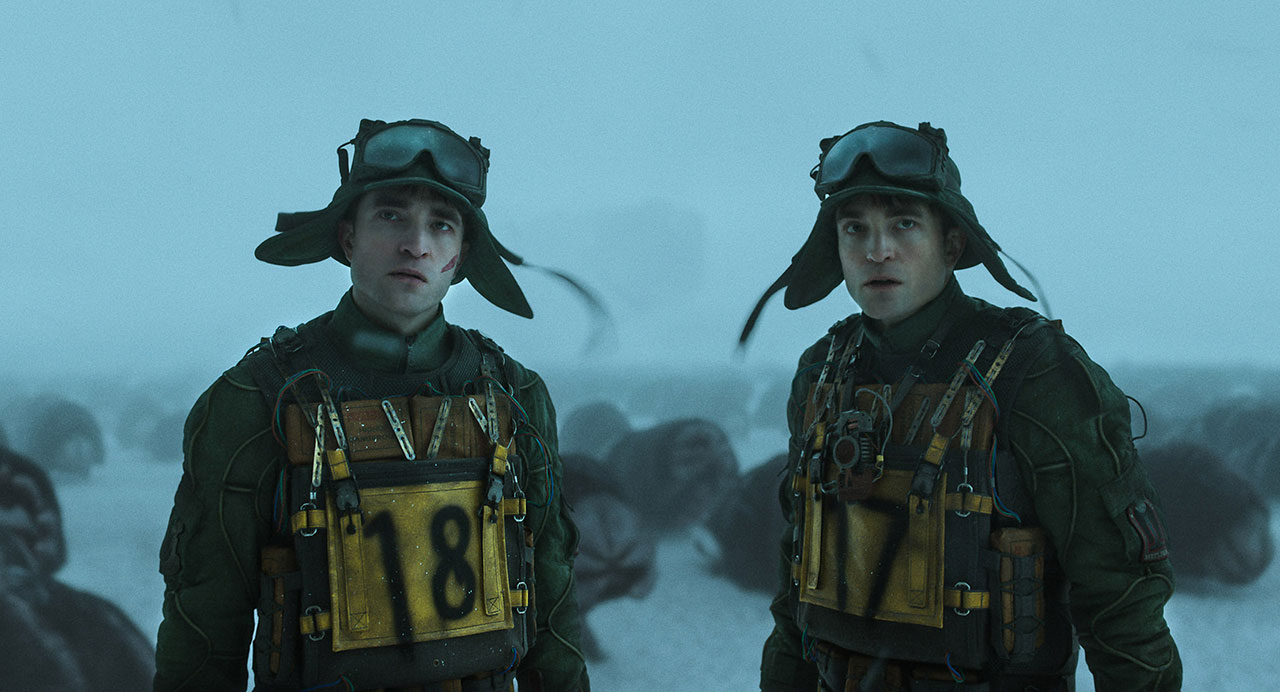
Thirty years from now, humans will be colonizing far-off planets. Legally dubious clones called expendables will be used for deadly grunt work. And everything else will be, unfortunately, very much the same. Such is the vision of the future in Bong Joon-ho’s sci-fi gonzo adventure Mickey 17, starring Robert Pattison as one of those expendables on an interstellar voyage.
Pattinson’s Mickey, escaping loan sharks, desperately joins up with a spaceship crew leaving Earth alongside his business partner, Timo (Steven Yeun). Commanding the flight is the delusional, egomaniacal wealthy nutjob and former senator named Kenneth Marshall (Mark Ruffalo) and his sadistic, sauce-loving wife, Ylfa (Toni Collette). At the start of the trip, Mickey falls in love with security agent Nasha Barridge (Naomi Ackie). But duty calls regularly for Mickey, whether as a lab rat for an untested vaccine or a canary in the coal mine for a planet’s unknown atmospheric conditions. And every time Mickey perishes, a fresh Mickey is simply produced via the ship’s human printer. In a detail that will likely give Bong’s fans Snowpiercer flashbacks, the reprinted human skin, organs, and bone is made using organic waste — bodies, food, and shit — broken down in the ship’s incinerator. Like the dispossessed and abused of the working class, be they Amazon warehouse workers or cobalt miners, Mickey is seen as disposable, more a sack of flesh than a living, breathing person.
South Korean filmmaker Bong Joon-ho shook the global film landscape when he claimed three trophies on Oscars night for Parasite in 2020. That film rightfully solidified Bong as not just one of the greatest living international filmmakers, but also as one of modern cinema’s great social issues directors. Bong took problems like class stratification and the necessity of class consciousness for social change and organically wove them into a compelling, artful, entertaining picture. Before Parasite, of course, Bong also made socially relevant films. He tackled issues like toxic pollution in The Host; class warfare, climate change, and social revolution in Snowpiercer; corporate greed and animal abuse in Okja; and the powerlessness of the lower class in Mother. With Mickey 17, the director delivers a scathing critique of capitalism and American imperialism, approaching the disintegration of ethics and the boorish, inhumane grotesqueries of the ruling class through a story about technological exploitation, medical experimentation rivaling the Nazis and Imperial Japan, and the commodification of human life.
In Bong’s vision of the future, corporate control over his characters’ lives and identities is central to the narrative. The shitty, claustrophobic, military barracks aesthetic of the ship recalls the dingy retro-futurist production design of Ridley Scott’s Alien, in which space travel became an unglamorous, dangerous, and poor-paying job and, instead of the trope of the “brave astronauts,” we got blue-collar space-truckers. Mickey 17 continues that dissociation from the chrome splendor of the imagined future. Not only are the accommodations prison-like aboard the ship, but the passengers (with the exception of Kenneth Marshall, his wife, and their ilk) eat the same calorie-controlled slop and nutrition bricks day in and day out, their lives and diets lorded over as though attached to an abacus. Marshall literally patrols their calorie intake and energy expenditure, even trying to control how much people have sex.
Corporate control even extends to religion in Mickey 17. Mark Ruffalo’s space-faring demagogue is seeking to establish a racially pure colony called Niflheim, backed by a zealous church often called “the Company.” This unification of church and corporation invites comparisons to American evangelicals and the connection between the far-right in America and Christian conservatives. There’s certainly enough room to interpret Marshall as a Trump analog — just look at his pursed lips, awkward strongman behavior, under-eye concealer, fake tan, and bad hair. His supporters even wear red hats. But the clearer parallel to Marshall might be L. Ron Hubbard and the Church of Scientology. Where Marshall delights in the responsibilities of being a spaceship commander, Hubbard operated a private navy called Sea Org that roamed international waters, where he could cosplay as a Navy officer and, with complete impunity, openly abuse anyone with a high enough Thetan count or whatever.
Driving the themes of corporate control, rising fascism, labor, and imperialism is a measured, weary reticence toward technology. Humanity can travel to distant planets, but the spaceship is only marginally more appealing than the squalid back of the train in Snowpiercer. Cloning technology is available, but the process is only used exploitatively and messes with its participants’ minds and personalities. The colonizer scouts arm themselves with flamethrowers, but they jam regularly, and their main use among the crew seems to be the drug-like substance they use for fuel. The characters can grow meat in a lab, but it tastes vile, looks like a placenta, and makes Mickey vomit and convulse on the floor. Technology in Mickey 17 does not unify people or make their lives easier; on the contrary, technological advances only further dehumanize people. Sounds familiar.
Mickey is a character you could imagine in a Kurt Vonnegut novel about the gig economy. Once, he’s barely out of the printer before a scientist is injecting him with something and telling him it’ll make him bleed out of every orifice. Mickey has no choice but to lie still and wait to bleed out. He signed a contract, after all. His infinite reprinting allows for infinite exploitation. The more he’s resurrected, the more Mickey’s existence becomes cruelty — the irony of the characters always asking him, “What does it feel like to die?” is that Mickey is never allowed to simply die. Nor is he permitted the opportunity to live.
Mickey’s repeated deaths dramatize the almost pathological disregard for human life shared by powerful people. Jeff Bezos doesn’t give a shit if he’s not paying his factory workers a living wage or if his delivery drivers are so overworked that they need to piss in a bottle in the back of the van. Elon Musk doesn’t care if his biggest cobalt supplier, Glencoe, treats its workers like cattle and forces them to work 12-hour days in intense heat with no food, inadequate water, and a meager $350 a month salary. The unrelenting humiliation, torture, and torment Mickey experiences doesn’t mean a thing to Marshall or the scientists who reliably print him out every time. To them, he’s just an “expendable.” He signed up for this, they say. He’s signed away his human rights. It’s the sort of hellscape that Peter Thiel and his libertarian buddies dream about, and the exact one that would have been useful to Thiel’s father, who was a manager at a uranium mine in Namibia where workers died like flies.
Mickey’s body and identity become corporate assets. The company literally has the power to kill him and bring him back from the dead, time and again. Every day Mickey spends alive is at the will of the company. When he performs unsatisfactorily, his rations are halved; though one wonders why even give him rations at all, since after Mickey 7 or 8 it’s clear that his only utility for the company is to die again and again. The cruelty, then, is the point.
The erasure of the self and total corporate control are far from new ideas in sci-fi. The practices of the anonymous company in Mickey 17 wouldn’t be far-fetched coming from Weyland-Yutani, for example, the megacorporation at the heart of the Alien franchise. And Frank Herbert preempted the story’s reprinting technology when he invented gholas. What Mickey 17 brings to the table is Bong’s endless fascination with the barbaric cruelty and sadism of the ruling elite. Peter Weyland might be a monster, but he never forced a shackled woman to bite down on a rope to prevent a baby from falling into a pit of lava.
In some respects, Mickey 17 feels like Bong Joon-ho’s Avatar, a confluence of his favorite ideas and tropes set against a colonial mission to an alien planet. Like James Cameron’s blockbuster series, Bong’s film criticizes resource extraction, territorial control, and genocide in the name of “progress,” and the human colonizers attempt to wage war against a benign alien race. The difference lies in the tone and execution — Avatar is a rollercoaster ride that spawned literal rollercoaster rides. It’s audience-friendly and feels market-tested to death. Mickey 17 is a goofy mess that in the same scene will have Mark Ruffalo threaten genocide and Toni Collette chop off an alien’s tail and blend it into sauce. The aliens, rather than painstakingly rendered anthropomorphic cat people, are giant tardigrades that look just real enough. But like the monster in The Host, they feel a little off, more rubbery than real. And of course, the film features drugs and sex and lots of it. Nobody in their right mind would make a theme park out of this.
In contrast to Mickey 17, the politics of Avatar melt beneath its fiery explosions and gunfights. It’s a message movie where the message is at once so obvious and also so perfunctory. Mickey 17, on the other hand, clumsily and earnestly underlines its own praxis constantly. The story of exploitation shows in the high-and-low dynamics of the screenplay, as Mickey very slowly begins to fight back against his oppressors and decides to fight for what’s right. By playing Mickey 17 like a patsy, Pattinson makes the character an unwitting vehicle for Bong’s story of social inequality and workers’ rights. He’s reluctantly drafted into a revolution. On the one hand, this approach neuters the film’s revolutionary message; Mickey just wants to keep his head down and not die. “Class consciousness” is a totally alien concept to him. In a movie whose resolution hinges on revolution, that makes Mickey a hard character to root for.
But Mickey also slots in nicely with the working-class average joes at the heart of the movies of Bong’s idols, socialist filmmakers Ken Loach and Mike Leigh. “I’ve always been inspired so much by Mike Leigh,” he told The Guardian. “I love his films – Naked, Secrets & Lies – particularly with his working-class characters and how lived-in they seemed. And I met Ken Loach in France a couple years ago, and he had so much energy.” By putting us in the shoes of the lowest rung on the ladder and showing us the toll that being disposable takes on Mickey throughout the film, Bong makes his hero into the perfect avatar for exploring not just the monstrous abuse of a capitalist imperialist system, but the humanity of resistance as well. Being strong in the face of oppression is an exhausting business — Loach, Leigh, and Bong understand that deeply.
Bong’s thoughts on the hollow, despicable ostentatiousness of wealth are visible in the stark contrasts between sterile wealthy environments (complete with priceless Persian throw rugs) and the gritty parts of the ship devoted to labor — the hangar, with its dozens of pipes dangling overhead, or the incinerator room, where shadows hug the walls and a slim, threatening tube leads down to the fire. Bong and cinematographer Darius Khondji find many fascinating visual metaphors to dramatize the class conflict, whether it’s the furnace in the floor where Mickey’s body is thrown like trash after every death or the way his body is printed out anew like a sheet of paper, stuttering every few seconds. That he’s always printed naked underscores his lowness — Mickey is at the bottom of the food chain, little more than an animal.
The scenes where Mickey wanders outside the ship are the film’s most visually striking — on the snowy planet’s surface, Mickey feels impossibly lost. That Fargo was a touchstone for the filmmaker and Pattinson during production makes sense. On Niflheim, he’s dwarfed by this big, beautiful world and finally has a chance to live outside the purview of the company. Think of Frances McDormand at the scene of a car accident or Steve Buscemi trudging through the snow to bury a suitcase of money — these vast, whiteout compositions emphasize the characters’ smallness in the face of nature. Mickey is similarly a tiny part of a larger story.
Mickey 17 is far from perfect. The performances are all over the place, and though the actors are always game to go to 11 when Bong calls for it, nobody in the cast can be accused of being subtle. And while even Bong’s greatest movies are terribly unsubtle, their bluntness never inhibits their storytelling, whereas Mickey 17 feels like one long, exhausting shout from start to finish in a way that tramples the nuance of its characters. Within that messiness, though, there’s beauty: Robert Pattinson plays astronomically against type as Mickey 17 in a performance that channels the himbo energy of Jason Mendoza from The Good Place. Naomi Ackie is perfectly charming until the third act, when she finally bucks the one-dimensional love interest role the script pigeonholes her in. And Mark Ruffalo is still doing the same (great) Sir Laurence Olivier impression he brought to Yorgos Lanthimos’ Poor Things. If he played Duncan Wedderburn like Olivier on uppers, then Kenneth Marshall is definitely Sir Laurence on downers.
The grander issue I have with Mickey 17 has to do with the film’s unrelenting and indulgent nihilism, brutal violence, and overwhelming darkness. Bong spends so much time making us hate the villains and the system that supports them, yet he tries to patch everything up in a tidy five-minute sequence at the very end. That third act in particular leaps off the rails — whereas Parasite turns first to horror and then to overwhelming melancholy in its finale and Snowpiercer gets somehow even more bleak, Mickey 17 goes for a rushed happy ending.
Spoilers — the revolution seems to only ever comprise three people, and most of it happens in a montage after the denouement. Bong’s hasty resolution sort of reveals the toothlessness of the whole production. You can tell he’s excited to show the vicissitudes of his working-class characters, the abominable violence and comically outsized egos of the wealthy elite, and the sadistic indifference of the scientists. But when it comes to recognizing the evil of these people, punishing them accordingly, and putting measures into place to prevent such human rights abuses from happening again, Bong comes up short.
What of the complicity of the people who were enacting cruelty but just following orders? What of the ship’s security, like Nasha? Was she not complicit in protecting the ruling class? Does Tim Key’s Pigeon Mascot Man deserve to be tried at the Hague? Not every film concerned with revolution needs to offer a playbook for how to do it, but the characters in Mickey 17 find a happy ending too easily for it to be satisfying. The film advocates for institutional change without fully righting its own world or grappling with the nuances of Marshall’s fascist leadership and the systems that enabled it. In that regard, it might be too naïve for its own good, much like Mickey 17 himself.
CLEMENT TYLER OBROPTA is a culture editor at MAYDAY. He studied film at Ithaca College and the University of St Andrews, and his work can also be found with Film Inquiry, The Slice, and Gen Z Critics.
