Madhu parked his rickshaw in front of his cottage and laid himself over the veranda. Startled, Chameli asked, “Are you not feeling well today? Won’t you take the rickshaw?”
Madhu blabbered, “They have called for a strike today.”
With apparent curiosity, Chameli inquired, “What’s that?”
“Everything, I mean everything — the market, the transport, the schools, the colleges and the offices — will be dysfunctional today,” returned Madhu, with an air of resignation.
“But why?”
“This is a protest against the rising prices, Chameli.”
“So everything will be cheaper and affordable now,” she gushed with a twinkle in her eyes. After a moment of silence, she realized the immediate problem and asked,
“But what will we eat today if you don’t take out the rickshaw?”
“I’m thinking of the same. If I dare to pedal out of the street, the mob will annihilate our sole source of livelihood. Don’t you have anything to cook?”
“I think, there’s a little quantity of finger millets.”
“Then make some porridge with it.”
At noon, Chameli served a frugal brunch and summoned Madhu.
“I’m not at all hungry, you better eat it,” said Madhu.
Chameli caressed his cheek and averred, “I know you are concerned for me. But we will halve all that we have and then eat together.”
Tears surfaced in the corners of Madhu’s eyes.
“Ever since you married me, you are struggling for two square meals a day,” he admitted. “Luckily though, till now, we are childless and there are no more beneficiaries,” he added.
“Who cares about food? We are actually living with love, peace and happiness. The whole rat-race of society is for this end only. Look at our neighbor, Shashank Babu. He has ten trucks yet happiness eludes him. The spouses have regular scuffles.”
After her long deliberation, she dragged Madhu and the couple had their lunch with ecstasy.
***
The next day, Chameli walked to the nearby shop to get her groceries.
“Because of the strike, stuff couldn’t be transported yesterday. Thus, the prices have increased,” informed the fat, bespectacled shopkeeper.
“But how?” resented Chameli.
“It’s not my duty to educate you. If you are willing to buy, you can buy or you can simply leave,” he added curtly.
Chameli hurried back to her home and complained to Madhu, “You said that the strike would cutdown the prices. The prices, as a matter of fact, have gone up.”
Madhu replied, “Hush! Keep quiet. If any politician hears you, he’ll call for another strike and we’ll die of hunger.”
PRASANT KUMAR MISHRA superannuated as an S.A.A.G.C.S. under the Government of Odisha, India, in the year 2017, and passed away a couple of years later. He was a prolific writer of flash fiction and satire in Odia. His work has been published extensively in the regional newspapers and magazines.
DEBASISH MISHRA, the son of Prasant Kumar Mishra, is a native of Bhawanipatna, Odisha, India. He defended his doctoral thesis at National Institute of Science Education and Research, India, in 2024. His work has been published or in forthcoming in The Penn Review, Amsterdam Quarterly, Prism Review, Consequence, Flint Hills Review, and elsewhere. His first book Lost in Obscurity and Other Stories was published in 2022.
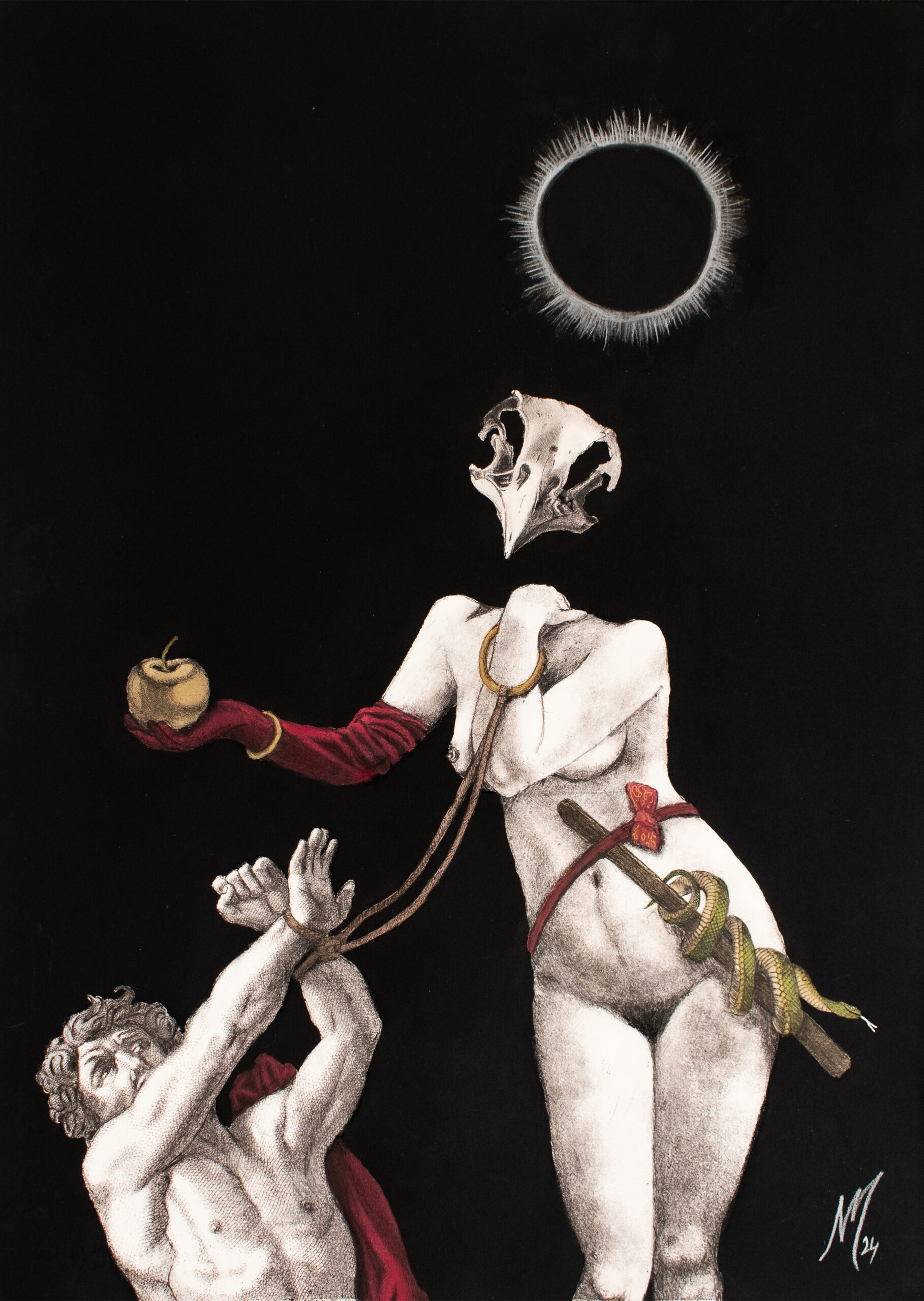
NIKI MCQUEEN is a visual artist from South Africa whose richly coloured, finely detailed and otherworldly artworks are created using a variety of materials. Her work expresses powerful personal symbolism, exploring realities beyond reason and the familiarity of everyday existence. She has been published, exhibited, and sold globally.
