- BREEDING MUTTS
“And there is only one thing in our way and, at times, (this) invalidates our qualities. I want to allude to what I could call a ‘Mongrel Complex’. I am imagining the reader’s shock:—‘And what would that be?’ I will explain—by ‘Mongrel Complex’ I mean the position of inferiority in which Brazilians put themselves, voluntarily, when facing the rest of the world. That (happens) in all sectors and, especially, when it comes to football. To say we deem ourselves ‘the greatest’ is clinically untrue. In Wembley, why did we lose? Because, when facing the English, blond and freckled, the Brazilian team whimpered in humility. Never before had our complex been so evident and, I would say, spectacular. In the already cited fiasco of [1950], we were superior to our opponents. Moreover, we had the advantage of a tie. And yet— we lost in the most abject of manners. For a very simple reason:— because Obdulio [Varela] kicked us around, as if stray dogs we were.”
–Nelson Rodrigues, May 30, 1958
The passage above, written after Brazil’s first World Cup win, is the key reference to understanding the idea of patriotism in the country. Every four years, high school students are forced to write essays considering “The Question of National Identity” in a profoundly unequal nation. If the discrepancies in experience are already extreme when comparing different groups in the same city, imagine what it would be like to grasp the identity of a huge country. Brazil is a Venn diagram without a center, just circles spreading around. Apart from language, which is hardly a motive for borders anymore, there is nothing all of us arbitrarily have in common.
That is, until it’s time for the World Cup. Sure, I might be running the risk of sounding stereotypical when I express interest in a football championship, but to me the World Cup was never really about football, even when I was a kid: at first it was about geography and learning about the countries, their capitals and flags, and then it gradually became about international politics and the many ways in which people maintain and try to negate national identities. And sure, it is kind of fun to wear green wigs and chant World Cup songs—yes, it has songs the same way any self-respecting holiday does. And what’s the Cup if not a monthlong National Holiday? It’s that time when we decorate our streets in Brazilian flags, throw viewing parties with our friends and family, and don’t really have to go to school. The 2014 Cup was during my last year of high school, and they scheduled finals earlier so we could watch the games. The country just stops for a while, and for a while you know what everyone is doing.
This is not “our Super Bowl,” because it is inescapable. People who do not like American football do not participate in the Super Bowl, is my understanding. There is no teeming-with-geopolitical-sublimation aspect to the Super Bowl as far as I can tell, except for the USA exceptionalism of playing a sport no one understands just so you get to be the best at it.
The World Cup, on the other hand, is a total social fact—something first designated by Marcel Mauss and, per Erving Gofman, “specific ontological entities […] distinct from other social facts […] phenomena which penetrate every aspect of the concrete social system.” Anthropologist Edison Gaspaldo in 2013 categorized a World Cup as a period of “hyper-ritualization of the bond between football and national identity.”
I am not what you would call a football fan in any way: I don’t care about teams or championships or players. I have lived for years within walking distance of a stadium I have never entered—the only time I have ever gone inside a stadium was to see a Paul McCartney concert. But when it comes to the World Cup, I get as excited as a kid on Christmas Eve.
Just before Brazil plays, the streets become flooded with anguished drivers trying to get to someone’s living room before it starts, and by the time it does, there’s no one in the streets. Some caught in the flood have made it, and some, having been defeated, decide to watch it at a bar or a restaurant or, really, anywhere, because no television would dare play anything else. It looks like an abandoned country out there; everyone is watching the match. This constitutes, according to Gaspado, a “focused interaction,” which occurs when “a group of people focus, both visually and cognitively, solely on one event.” You can see how the World Cup holds a unique position in Brazil’s national imagination. There is no way of understanding Brazil without knowing the history of the championship or the narratives around it.
Disclaimer: I am not claiming to understand Brazil, nor am I claiming that it is possible to understand Brazil at all. However, this is our national equalizer. This is the one thing we all pay attention to. And playwright Nelson Rodrigues’ theory of the Brazilian inferiority complex provides the basis for our traditional understanding of national identity, the archaeon (the most ancient/ founder) of a particular theme or discussion. The commonplace expression “mongrel complex” (complexo de vira-lata) is considered the starting point to understanding Brazil’s relationship to football and patriotism. The narrative about the mongrel stray turning into the underdog is always compelling—however, much has changed (and not changed) since Rodrigues declared that we had beaten our hang-ups.
People love to cite the complex while forgetting that the central point of the text has been long disproven: We never did get rid of the complex. Having won four more World Cups, Brazilians are hardly considered the underdogs anymore—but alas, there are things in life other than football. I could argue that even during the World Cup we are generally dissatisfied with the team, spending considerable amounts of time insulting everything from the team to the national anthem, being subsequently shocked at the words coming out of some family elders’ lips, and deciding that you just can’t take it anymore only to come back with more popcorn five minutes later.
The thesis most frequently drawn from Rodrigues’ text is that patriotism is incompatible with Brazilian society. Considering the horrors that patriotism has caused and continues to cause in the world, that was always something to be thankful for.
Patriotism has always seemed to me utterly nonsensical when applied to anything other than sports. The idea of Nation as we understand it today was forged in the 19th century by European liberalism as a response to capitalist expansion. Borders were traced with priorities being given to certain cultural and economic aspects while completely ignoring others, which in turn left many peoples dissatisfied, who in same cases remain dissatisfied to this day. Nevertheless, even the inhabitants of freshly coined Nation-States that made a lot of sense, such as Italy, were not used to thinking about the land as an entity. Massimo d’Azeglio famously said, “We have made Italy, now we have to make Italians.” If this was a problem in Europe, where some consideration had been given to these lines in the sand, it was even more salient in the colonies. Africa, for instance, was divided between colonial powers without any regard whatsoever for native populations, and America maintained colonial frontiers even after independence. America Española was liberated by parts, but Brazil’s independence was only a split of the Portuguese royal family branches.
That is why Brazilian political and cultural elites spent the whole 19th century preoccupied with forging a National Project. From 1825 to 1828, Brazilians fought—and lost—a war with the Cisplatine province, today known as Uruguay. Their only request was that the Emperor let them speak Spanish, but D. Pedro I would not compromise. In a newborn nation as fragile as Brazil, language may have been the only thing that provided a sense of unity.
Author José de Alencar, whose work comprises a great deal of the country’s literary canon, made it his mission to paint a complete picture of the country. In his works he portrayed every demographic in Brazil, aiming for a comprehensive mosaic of a nation a la Balzac. In other words, by attempting to separate us from Europe, he followed European concepts and models. Alencar’s books terrorized me in high school, but his failure to promote an artificial national ideal is also central to understanding our “mongrel complex.” Like many of his contemporaries, he promoted the idea that the “mixture of races” encountered in our population was what made us special. All over 19th-century literature, one can find references to the “Three Races” (white, Black, and indigenous—the last two thoroughly fetishized) as our national advantage against other nations, even though this misrepresented the power dynamics in Brazilian society. A foundational myth based on the racial harmony of equal population, forged at a time when slavery was still rampant, and genocide of indigenous populations was ignored, is a contradiction exemplary of our continuous existential crisis. As the Clara Nunes song “Canto das Três Raças” goes, “A sad lament has always echoed [in Brazil]/ Ever since the warrior Indian was put in captivity/ And from there sang/ The Black man chanted/ A song of revolt in the air/ In the Quilombo dos Palmares/1 Where he sought refuge.” Incidentally, the nonchalant Brazilian attitude toward immigration has always been explained as a consequence of our “lack of prejudice,” an untrue notion rooted in this 19th-century myth. At the same time, I think our nonchalance toward immigration can be easily explained by our lack of patriotism, which in turn is explained by the mongrel complex.
It should also be noted that “race” and “breed” can both be translated as “raça” in Portuguese—we use the same word to speak of people’s ethnicities and animal breeds (and daring and boldness at times). For this reason, we must not overlook the ethnographic implications of the Nelson Rodrigues text.
Though the seminal piece hints that our inferiority complex came from being the result of the mixture between several ethnicities, the clear narrative arc is from 1950, when Brazil lost the World Cup final to Uruguay in Rio de Janeiro, to 1958, when we finally triumphed in Sweden. The defeat on Brazilian soil had been so demoralizing at the time that a whole generation was traumatized by the Maracanaço.2 If only D. Pedro had let the Cisplatine province speak Spanish! We would have two more World Cups on our belt! Not to mention today we would have the likes of Forlán, Suaréz, and Cavani at our disposal. What we would not have experienced was generational trauma due to an honorable defeat. Yes, little did the grievous 1950 spectators know how much more mortified we would be next time Brazil hosted the tournament: In 2014, we didn’t even make it to the finals, having been run over by Germany in a match that ended in a disastrous 7 to 1. That had immediate consequences in the football field, but far more dangerous in the political.
- PRELUDE TO A WAR3
One shoe just dropped: It’s the World Cup, every four years, like clockwork. Three months later, the other shoe drops: the Brazilian national election.
Before you scoff with skepticism, the connection between politics and football is not new. The battles played in football fields have been many, and a World Cup match always hides numerous possibilities: whenever a poor country beats a ruthlessly rich one, the world order is inverted if only for a minute.
British journalist Simon Kuper has approached this intersection between football and politics much more deeply in his 1994 book Football Against the Enemy, where he chronicles his travels, from a newly freed European East to Africa to South America, trying to see what football says about each place and drawing amazing connections. Kuper’s book is an unparalleled example of how football and politics are intrinsically connected. For instance, here are some of the most telling passages:
Africans reckon that Nigeria or Ghana could have given Costa Rica as much of a game in 1990 as Scotland or Sweden did. As they see it, the West excludes them from the World Cup just as it does from the UN Security Council — but the World Cup matters more.
Had football helped? “Enormously! You see, many people do not know where countries like Senegal, the Ivory Coast and the Congo are. Often they do not even know they are in Africa. The World Cup put Cameroon on the map.”4
Whether we admit it or not, the World Cup plays an immense part in our politics. A victory from Brazil is a victory for the incumbent government. In 1970, for instance, the military dictatorship used it as a propaganda vehicle—much in the same way that Triumph of the Will served as Nazi advertising.
The military junta in Argentina famously bought off the entire Peruvian team, in the 1978 World Cup, known as the “Dictatorship Cup.” The fact is that, whenever a Cup is won, we get a false sense of hope for our country, and that greatly suppresses our revolutionary energies: Lívia Gonçalves Magalhães writes that “the 1978 victory marks a milestone in the conflict between cheering versus resisting the regime.”5 Magalhães also notes that the Argentinian team’s coach declined to accept the trophy from the hands of dictator Jorge Videla. Even so, the entire team remains tainted by association simply for participating in it. As much as they have declared their disgust for the government and said the Cup was “for the people,” the legacy of Argentina’s first victory is complicated. It unquestionably helped legitimize military rule in the country and garner international support for it.
In “The World Cup and Presidential Popularity in Brazil,” authors Gleice Meire Almeida da Silva and Pedro Santos Mundim delineate the obvious connection between the two and how a World-Cup-gone-wrong may backfire on the incumbent.6 For instance, between July 3, 2014 (when Brazil had not yet been eliminated and humiliated), and July 18 of that same year (10 days after the humiliating semi-finals loss to Germany), President Dilma Rousseff’s approval ratings dropped from 57 percent to 30 percent. In October, she was reelected in the second round with only 51.64 percent of votes, a three-point lead on her rival. In 2015 and through 2016, she was illegitimately impeached through a coup d’état.
Yet the question remains: would any of this have happened—or, if so, happened the same way—if we had actually won our World Cup and people had been, say, happy for a while? Even if there’s no way of knowing just how things would be different now, it’s safe to say a 2014 Brazil victory would have been (no pun intended) a game-changer.
- FIFA GO HOME
FIFA has come and gone, but the graffiti, though faded, can still be seen on the way to University. At some point in the blurry history of my high school years (and Brazil’s spiraling), a bout of protests aimed at seemingly nothing and everything began raging throughout the country. Despite their initial motivation being an increase in public transportation tickets, the demonstrations soon became the sites of violent outbursts from groups who had appeared apolitical until then. The bizarre characters who decided to rebel against the vague establishment varied from hippies to looters at first, and no one, not even the media, knew what to make of this development. One would read Facebook posts such as “The Giant Has Woken Up” and would wonder what to, by whom, and why. By all accounts, the situation in Brazil was stable. Neoliberal publications crafted generic criticisms to Dilma Roussef’s government, the ghost of corruption scandals past had not wanted to haunt a president who had not even been a politician before her election, and the Brazilian real was depreciating in price once more compared to the U.S. dollar.
While most right-wing people blame “inflation” as the cause of their grief, it stayed under 6 percent for that year, notwithstanding that damning piece on the price of the tomato in Veja magazine (Brazilians will understand). This publication in particular, along with TV Globo, played an immense part in demoralizing Roussef’s presidency. While mainstream media has attempted to repair the systems that it helped mangle in the mid-2010s, mostly by rightfully exposing President Jair Bolsonaro, these institutions have yet to apologize for their obvious role in electing him. Even if they never actively supported this fascist in particular, they were instrumental in dismantling the Workers’ Party’s political capital and excusing the actions of neoliberal hacks. While the result was not what they had hoped for (the Brazilian Social Democracy Party, also known as PSDB, Veja and Globo’s preferred party, has become a shadow of its former self, all emptied out), they were the ones who first stirred the pot against the Workers’ Party, hailing Sérgio Moro, then a judge on a personal vendetta against Lula, as a national hero. Anti-corruption icon Moro went on to quit his tenured job to become Bolsonaro’s justice minister, surprising, somehow, loads of people. Now he is a disgraced ex-minister and failed pre-presidential candidate. Sure, 2013 was the worst year of my life for personal reasons, but at least I had never heard of Moro then.
As the protests took on a right-wing shape, grievances became more clearly outlined: While most criticisms, if still incredibly vague and misinformed, seemed to make sense, one did get the feeling something else was taking place. Something deeper, angrier, and reactionary. We were not yet at that point (though we would soon get there) in which people are comfortable identifying as fascists. Sociologists tend to perceive this as the white bourgeoisie’s brimming rage at the infrastructural policies of the prior decade,7 which were yielding satisfactory results—meaning poor, non-white people were beginning to show up in places where they would not have been expected. It is important to note that protests against the 2014 World Cup, which were mildly publicized by international media, were led by this disconcerted bourgeoisie. By scoffing at the “unseriousness” of football, they were frowning at what had been, up until then, the only form of vertical mobility available to boys in the favela.
That was no longer the case, as the song “País do Futebol,” by MC Guime featuring Emicida, poignantly illustrates. Written for the 2014 World Cup, just as the Brazilian upper middle class was establishing clear right-wing talking points, Guime’s buoyant song “País do Futebol” celebrates Brazil’s newfound destratification, within and without football. Although now it sounds like as a reluctant swansong, the calm before the storm—whatever you call it—the song credits popular culture as a motivator of progress where most people would have seen it as a hindrance: “Look how far we’ve come,” says Guime, “I am the country of football, bro/ Even gringos danced the samba/ Because Neymar goes goal,” while also marveling at the notion that now, there were other ways out of poverty. Emicida’s verses bring home the point, as he recites “Yesterday tears, today a treasure/ The chorus shouts: Looking good!/ I’m from the back-ends of Zona Norte/ a vagabond’s swing/ of those that beat malnutrition/ and today will rule the world,” almost as if he is Brazil singing of itself.8 After all, 2014 was the year in which the UN declared we had exited the hunger map. (We were back on it after Bolsonaro.)
Disquieted by this vertical mobility and the failure to articulate their outrage in acceptable terms, conservatives decided to frame their prejudices as security concerns, advocating for “zero-tolerance” law enforcement, stricter punishments, minors being tried as adults, and altogether dehumanization of criminals. Meanwhile, they protested against “political correctness,” affirmative action, and “corruption.”
Their primary point of contention and trump card against Rousseff in 2013–14, however, was the World Cup. The questions themselves, taken out of context, seemed reasonable enough: Why are we spending all this money on silly things like stadiums when we could be using it for our public health and education systems? And indeed, while any politician might spin this easily (e.g. put a rush on infrastructural transportation plans that are still in development, get children excited about sports, boost the tourism industry, generate jobs) Rousseff was not a politician, and whatever she said fell to deaf ears. My grandmother stored cans of sardines in the pantry, fearing a coup. We laughed at her at the time.
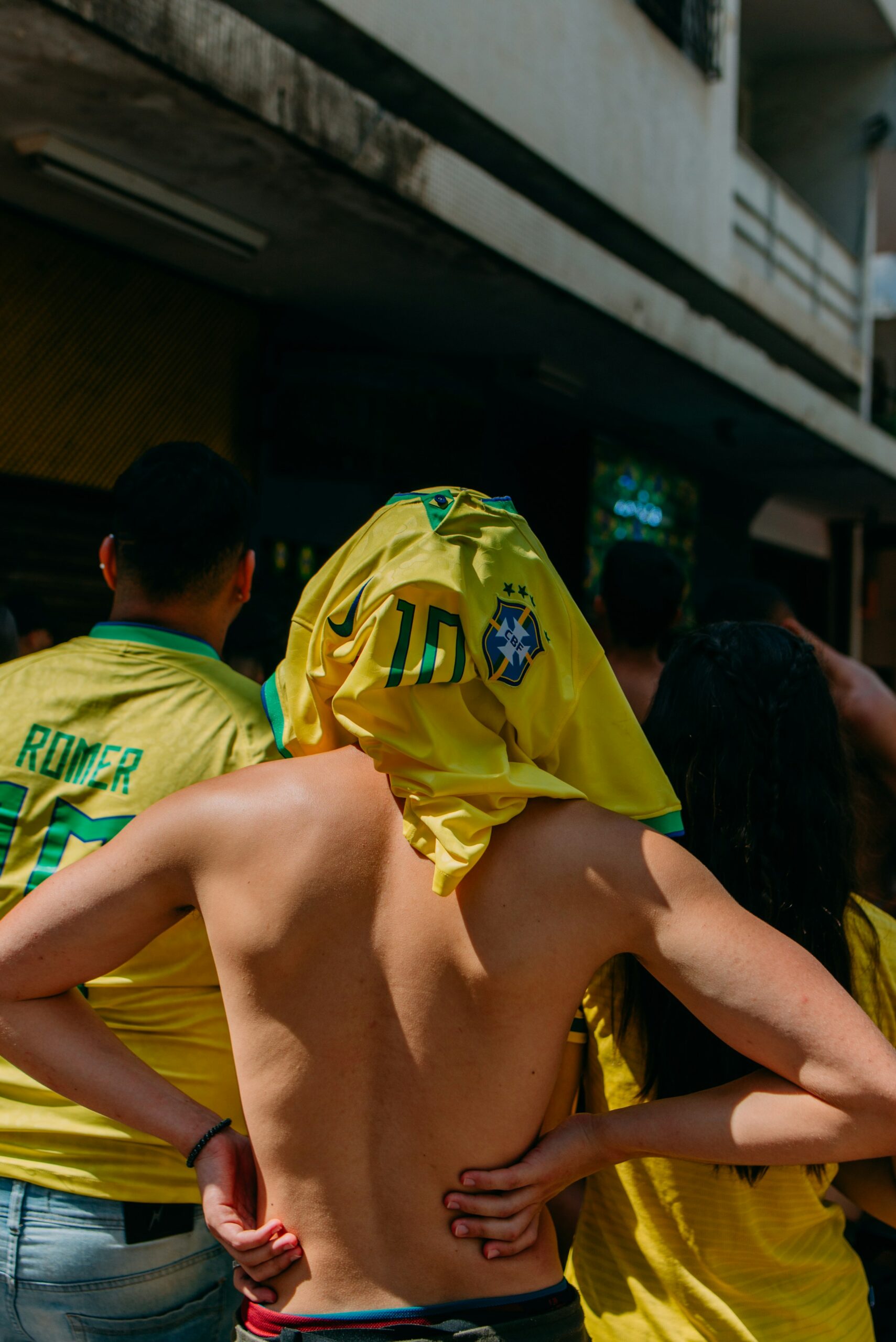
After a frustrated threat to bar the public from attending the World Cup, as well as a half-hearted booing session at Rousseff during the Opening Ceremony, protesters’ spirits seemed to settle: although they sneered at the national flag, pretended they were not watching or were rooting against Brazil, they largely fell silent for most of that month. Later on, they would open their mouths to say “I told you so” and “serves them well.” No one remembers this about the 2014 World Cup these days, how the soon-to-be patriots scorned the Brazilian flag and rooted for a catastrophe. By 2022, these “patriots” would have weaponized the Seleção’s shirt as the Bolsominion’s uniform, wearing it to Bolsonaro rallies, national elections, and anti-democratic protests asking for a military coup. The “brand” of the Brazilian Football Confederation (CBF) was so damaged that it had to actively campaign for the, I kid you not, “depoliticizing of the national flag.”
No matter how ridiculously stereotypical, the fact that people who wish to portray themselves as patriots (a concept entirely foreign to Brazilian identity, as we have already discussed) would choose the national football team’s shirt as their common identifier reveals, once more, just how much any bizarre version of or attempt at patriotism in Brazil is inherently reliant on football symbols.
Of course, Brazil is not a country. Not just in the way that no country is actually a country, but in a way that it is too many contradictory realities coexisting paradoxically. No one actually knows or understands Brazil. It is difficult enough to compress all the realities of one’s city into one autonomous picture, but one’s country? I don’t envy anthropologists. None of us have that great a number of shared experiences—I’ve never been to a favela, even though I live right next to one. Plenty of Brazilians have never been to a movie theater. Some others have never taken public transportation.
Whether we look from inside or outside does not change the incredibly blurry picture, which might only be captured by some outdated census. We mostly believe we might as well be anywhere in the world. That is not necessarily true, of course, but it is the impression most people seem to have: We happen to have been born here. It’s the filter of normality, no add-ons. Nothing special about it. There is nothing about this country that would drastically change who I am as an individual. At least, I’d like to think so. You read interpretations of texts by Brazilian authors, and your professors say there is something “distinctively Brazilian” about them—what? Name the thing. I can’t spot it. Unless it’s the confusion at being Brazilian, the randomest of nationalities.
Think about it—you’re a baby about to slide down your mom’s birth canal, and the powers-that-be inform you that you will be born in Brazil. You can do nothing with that information—there is no indication of how your life will be. You might be the malnourished child of a drug addict or the heir to a multinational or abandoned in front of a hospital. You would have had an idea of what your life was about to be like if the powers-that-be had told you Germany or Gabon or Saudi Arabia, but with Brazil, you still don’t know how your luck might turn out. Which I guess means you are marginally lucky. Is that what this “pride” is? The feeling of luck at having been born somewhere?
Personally, I cannot wrap my head around feeling proud of things I cannot control. Why should I be proud, much less ashamed, being this or that nationality? I did not choose it, and it did not choose me. It is neither our merit nor demerit that we are stuck with each other.
On the other hand, a more general—and generous—perspective on the curious case of the Brazilian mutt complex points to its social benefits: The welcoming of immigrants and inexpressive xenophobia rates, for instance, probably have something to do with our realistic attitude about our country. In fact, Brazilians have a pathological need not only to be liked by gringos, but for gringos to love Brazil in return. Strangely, Brazilians are only known to express xenophobia toward one another.
I used to believe—and, in fact, wrote in the first draft of this essay—that national low self-esteem was a matter of paradoxical pride. That our dissatisfaction with Brazil meant nationalistic movements would never credibly arise in an anti-nationalist country. Imagine my frustration when I had to scrap my revised manuscript because some idiots decided they “loved” their “country.”
- COPY-PASTE PATRIOTS
That is the only brand of patriotism available to us, imported from the U.S. It had not been popular until a former military captain decided to run on it. Jair Bolsonaro, appropriating the Brazilian flag, anthem, and colors, extinguished any sort of appreciation a normal person may have for these things. Now, seeing a Brazilian flag on a balcony does not mean that it’s World Cup time, but that the person who lives there is a brainwashed fascist. Note, however, that this group (no longer consisting of individuals, only controlled masses) still cannot understand the concept of patriotism. Loving Brazil means turning it to a minimal state in which every human right is privatized and everyone who strikes them the wrong way goes to prison. Sure, the United States hinges on the same principles, and no one can say Americans are lacking in patriotism, as unfortunately American exceptionalism seems to be thriving even in “leftist” circles. Brazilian conservatives, however, will fall for the stupid idea of patriotism but execute it quite poorly. Bolsonaro Twitter bots frequently display it next to the U.S. and Israeli flags, for instance. Their idea of patriotism is being the U.S.’s favorite client state, only more theocratical in its rulings. The country they love is a country filled with natural resources and workers to be exploited, but also with more lax regulations. They love what they could make of this country, what they could steal from it. Which is why they are trying to steal the election—in fact, they missed the 2022 World Cup while attempting to rally the Armed Forces into a military coup. It almost worked.
On January 8, 2023, after the World Cup had ended, a band of far-right terrorists invaded the National Congress, the Brazilian Supreme Court, and the Presidential Palace. All located at the Square of the Three Powers, all UNESCO World Heritage sites, designed by architecture legend Oscar Niemeyer. They smashed all that they could, shat on drawers, shattered furniture—including a one-of-a-kind 17th-century clock by Louis XIV’s clockmaker Balthazar Martinot, which is “beyond repair”—and vandalized paintings—including Emiliano Di Cavalcanti’s As mulatas, punctured in numerous points. Sculptures, like Victor Brecheret’s Ballerina, have also been broken and destroyed.9 Neither the police nor the military stopped them.
There are many things that could be said about that here, but the one that is to our point is just how purposefully reminiscent this attack on democracy was of what happened in the U.S. in 2021. From the start, it was clear that these “patriots” had been trying to enact a tropical remake of the January 6 Capitol attacks. I can even picture Bolsonaro planning it on January 6 and Donald Trump telling him that the 6th is his, so he’d better pick a different date. Again, these people buy their patriotism when on vacation in Miami—wherefrom Bolsonaro was watching the coup attempt.
The great irony is that, given Bolsonaro’s close association with Trump and the alt-right, President Joe Biden had no choice but to condemn the right-wing Brazilian terrorists. He’s been backed into a corner to support a leftist government that Obama’s administration had helped tear down.10 We all know that there is nothing the United States government hates more than leftist administrations in the Global South. It has a well-documented history of interfering through coups—like the one suffered by Dilma Rousseff in 2016. The U.S. government might have even been willing to portray the events of January 8 as a sincere protest against “election fraud” (as it did in Venezuela) or “corruption” (as it’s been doing in Argentina). Bolsonaro might have been able to successfully implement his military coup, too, if only he hadn’t kissed Trump’s ass quite as passionately as he did.
In any case, this whole ridiculous affair has outraged society at large, isolating Bolsonaro supporters even further. Their antics since the election have alienated them from other conservatives, who now consider Bolsonaro toxic and would like the party to move on. They have managed to infuriate every sector of Brazilian society they are not a part of, from horse girls (they beat up a police horse) to Marvel fans (Globo’s transmission of Avengers: Infinity War was interrupted for urgent news coverage of their little stunt). Their roadblocks have inconvenienced even the most Bolsonarista businessmen, whose flights were canceled when the flight crew got stuck in traffic. My flight was also canceled on that occasion, but I already hated them, so there was no bright side to the whole ordeal. Except hearing people who had voted for him get angry at other people who had also voted for him. “I have to be in New York ASAP!” a man in a suit said, raising his voice at the airport gate. An upper-middle-class family with Brazilian flag pins had their five-day Disney World excursion become a three-day long weekend. They had used up all their vacation days, thanks to Bozo’s Labor Reform.
Football fans were among those most pained by the blockages. Barriers in national highways were keeping them from watching matches. One such hindrance, in Fernão Dias Paes Leme, the highway that connects Minas Gerais to São Paulo, was finally breached by furious fans of Atlético MG, who were playing in Morumbi that evening. Most Brazilian teams have representative animals, Atlético’s being the rooster and, their organized fan group, the Galoucura (a portmanteau of Rooster and Madness).
The ultras had managed to do what the police couldn’t—and perhaps did not want to. Fans called themselves the barricade-busting troop, declaring nothing would keep them from seeing their team play. And nothing did—they made it to Morumbi on time for the game. The memes, of course, were impeccable: People were calling on the Galoucura to visit their towns and coming up with future Brazilian history test questions about which organized football fan association breached the blockage. It would be harder to answer than we realized, because by the end of that week many of them had followed in the rooster’s footsteps when faced with the same problem.
In the aftermath of the terrorist attacks of January 8, football fan associations once again took a stand against fascism. Mancha Verde and Gaviões da Fiel, the fan associations for Palmeiras and Corinthians, came together in a demonstration in favor of democracy. Their rivalry is perhaps the most famous in Brazilian football—there is a beloved 2005 romcom titled Romeo and Juliet Get Married based entirely around the grievance. It may seem like an exaggeration, but in reality these are people who semi-regularly kill each other. Since 2016, they have been forced to take turns watching matches between their teams because they cannot be trusted to share a stadium.11 Incidentally, it was a judicial decision by Brazilian Supreme Court judge Alexandre de Moraes, also known as Bolsonaro’s eternal nemesis. While the terrorists called for Moraes to go to prison and stole his robes, football fans don’t seem to resent him for doing his job. The Mancha and the Gaviões, having dealt with their fair share of sore losers as well as the consequences of their actions, combined their powers to organize a protest at Avenida Paulista and were soon joined by the fans of the state’s other big teams, Santos and São Paulo. Hatred of Bolsonaro and his supporters had managed to unite people who have spent their whole lives fighting each other. On a Monday.
Football fought back. After all, Bolsonaro supporters have been wearing the Brazilian team’s official shirt as a symbol of “patriotism” for years now—although they did take a break during the actual World Cup, as reported by several news outlets: “Pro-Bolsonaro protesters will be sticking to black for the World Cup so as not to be mistaken for football fans.”
These individuals, camping out in front of the military quarters, were soon stupefied to see one of Bolsonaro’s sons in the bleachers of a game in Qatar, celebrating a Brazilian goal. How could he go to Qatar amidst the fight of a lifetime against “communism”? His response, after denying that he was even there at all, was that he had wanted to hand a flash-drive to the Qatari Emir. This thumb-drive, according to him, contained proof of election fraud. What the Emir could do with it is still unclear. Those terrorists claimed they vandalized inestimable public property not because they wanted a military coup, but because they wanted proof of election fraud, and they might have done well to ask Bolsonaro’s son for a copy—or, in case he forgot to make one, petition the Emir of Qatar. If he feigns ignorance, there’s another name for their list of communists, which already includes billionaire George Soros and the Pope.
On his last day as president, Bolsonaro left early for Miami, where football means something different and the disease of nationalism is far more advanced. It doesn’t seem to be able to adapt, though, no matter how much the host may beg. Because even if the very worst consequences of patriotism are present in this knock-off Brazilian brand—fascism, racism, militarism—Brazilian “patriotism” lacks the vital ingredient: pride. That became clear after Jair Bolsonaro’s defeat: His supporters have nothing but disdain for their country. No Brazilian has ever believed in anything close to Brazilian Exceptionalism. If those people had been any different, they would have spent more time worrying about colonizing our neighbors as opposed to selling the country out to be colonized by true imperialists. Obviously that would also have been terrible, albeit in a different way.
Pride only cometh before the World Cup, then vanishes.
- WHERE WERE YOU IN THE 7×1?
When the 7×1 happened, that legendary loss against Germany in the 2014 World Cup semi-finals, there was a moment when people just stopped screaming. By the fifth goal, the streets were as silent as they were unpopulated. You could hear the dead quiet heartbeat of the moment just before we realized what was happening. And then something fascinating followed: People just decided that, unlike all previous—and more honorable—World Cup eliminations, this time it was funny.
There was a shift between the two halves of the game. At one point, my father called me, I said hello, and we laughed. Then we hung up. My neighbor had started celebrating when Germany scored another goal. Some other guy was screaming “Neuer!” (the German goalie) at the top of his lungs. Everyone had logged on to Facebook, and a meme was born. For a whole year or so, whenever something kept happening so fast that by the time it happened again we’d hardly been able to process it, we’d call a German goal.
Even now, the expression “every day, a new 7×1” (todo dia é um 7×1 diferente) is a popular saying when reacting to mild inconveniences. The expression shows no signs of falling into disuse, meaning Brazilians centuries from now could be saying it without any notion of its shameful origin (one can only hope).
For the time being, however, the event is etched into the national consciousness enough to have inspired songs all over the board. In one Sertaneja (country) song, for instance, the singer declares that losing his love would have had him suffer more than he did in that 7×1.12 Spotify itself has published a playlist called “pov: suffering more than in the 7×1,” the description of which reads “sobbing while thinking of [German midfielder Sami] khedira.” The songs listed are garden-variety Sertanejo, all happy to populate the interpretative border of metonymy. Metal band Merda has also internalized the symbolic nature of the match, declaring that “their lives are a 7×1,” “failure after failure,” in their song titled, yes, “7 x 1.” On a more serious note, Rapper Omnira, in her own work titled after the match, speaks of a future (an allusion to the optimism of the Lula years) she saw die before her eyes, echoing another rapper, Thiago Elniño, whose 7×1 song features lyrics such as “I’m here inside this packed bus, realizing that outside the world is worse than I first found it,” juxtaposed with “the beaten-down folk accompany through the screen of a TV the seven goals by Germany” (still rhymes in English!).
This song is perhaps the most interesting in that it goes on a tangent to lament the loss of samba’s political relevance, tying two of Brazil’s most self-defining cultural practices and questioning their capacity for endurance. “With so many allegories, we can barely see”—a clever wordplay, as allegorical floats are part of Carnaval shows—“the sad samba that showed up to bring me joy.” The commodification of Carnaval and consequently samba music, away from its origins in the favela to expensive first-row seats to a parade of telenovela actresses, is analogous to the history of Brazilian football in the past 20 years: joylessness.
Many sports journalists have written, spoken, and complained about this fairly recent problem. Brazilian players, they’ll say, used to be artists, and now they’re machines. Every World Cup year, footballers who play in Brazil are ignored in favor of those who play overseas. What annoyed people the most about this new European technique adopted by the Brazilian team was not necessarily that it was unattractive, but that they couldn’t execute it well, despite having been selected precisely for that supposed ability.
The consensus between football commentators became that going to play in Europe ruins Brazilian players. It teaches them that winning the game is more important than winning the audience. It pleads with them not to dance around the opposing players, or try and score a goal from an unusual angle, because those exhibitionist habits cost them time. European football is for journalists; Latin-American football is for poets. Football being theater, there will obviously always be clashes in terms of style. When a hungry Brazilian player arrives in England to play in the big leagues, they are normally the target of criticism for what English commentators call “showboating” and we call “football-art.” The player soon learns to fall in line and play joylessly and efficiently, though it is a myth that those come hand in hand (or foot in foot).
Even in this last World Cup, former football player Roy Keane commented during the BBC transmission of Brazil versus South Korea that he thought Brazilian players celebrating goals was “disrespectful.” On roared a fruitless discussion that nevertheless exposed the difference in our approaches to the game. In fact, perhaps I should not have assumed that Europeans see it as theater—perhaps they only see it as a sport. That would certainly explain the lack of interesting characters and narrative arcs in European football, although not its popularity: As a game that hinges greatly on luck, it seems counter-intuitive to the technocracy Europeans try to impose on the game. Are they playing against it on purpose? Football is not a precise science or even a precise sport: It’s the improvisation of fates, a balancing of individual luck. The games we remember are not necessarily those that go our way, but those that astound us—Italy and Germany in 2006, Ghana and Uruguay in 2010, Belgium and Japan in 2018, and, yes, Brazil and Germany in 2014.
There is no narrative without distinguishable characters, and our designated Main Character (Number 10) had just been injured—Neymar was out. Whether or not he would have necessarily made any difference by himself, his presence might have stimulated the other players and avoided such a fiasco. Whereas the merits of Neymar as Brazil’s main player not only are debatable but have been debated with tiresome frequency, he is what we have right now. It’s no use talking about “the team” because our model of football is more focused on individual players with individual tricks. In this, too, we favor the view of the footballer as an artist, not a teammate. The crowd wants to see one lonely Brazilian forward take on the opponent’s entire defense, run circles around them, make them look like idiots, have them bump into each other, and only then score. That’s the game.
Yet that is not how the Germans play, much less how the Germans won in 2014 (although they did make us look like idiots). They didn’t have one footballing savant on the field, but they had a team. A stereotypically German team, too—the most efficient machines you could find. Perhaps the BBC commentator would not have been offended by their manner of celebration, which grew more apologetic with each passing goal. We would not have cared, in truth—it would never have occurred to us that they would have been celebrating our defeat rather than their victory.
No matter how well they played, however, a serialized product isn’t the same as that which was made by hand. And this indifference to the aesthetic element, in our society, is far from being limited to football.
In the end, regardless of how you choose to explain the 7×1 fiasco, the fact is that the Brazilian team played ugly football during that entire Cup, and despite our opponents’ kind efforts, the list of reasons why we lost does not expand much beyond “well, we sucked.”
The immediate aftermath was one of uncertainty: while most people probably wished to pretend the match never took place, no one could ignore that the World Cup was still happening under our own roof without us. Most Brazilians, I would guess, decided that we were done for. We were no longer Football Country.
Eight years later, everybody seems to see that infamous 7×1 as a fluke, just a really bizarre event explained by the Germans being astronomically (or maybe astrologically) lucky, in addition to Fate’s decision that it would be the worst day in the history of Brazilian football. Soon the players adhered to that same narrative that the 7×1 was simply a streak of bad luck. The Germans were very kind afterward, declared their respect for the Brazilian team, and went on to stop Argentina from winning a World Cup on Brazilian soil—which frankly would have been a much greater catastrophe.
Come to think of it, July 2014 was just a weird time altogether—the cosmos must have gone a little mad, because I remember it raining ice pellets and everyone being confused as to why actual rocks were falling from the sky, because we never really get hail around here. It was actually quite enjoyable, though—looking through my building’s window, all that white, covering the grass fields and the concrete and the palm tops, looked like snow. I hadn’t seen snow in so long. So things were out of orbit when Germany trounced Brazil, and we can’t really blame those who’d rather just write the loss off as a bizarre twist of fate.
And yet some folks have managed to find more outlandish interpretations of the 7×1. For instance, at the time, whenever Brazil advanced a round, there was a tendency of saying that this was because Dilma Rousseff had bought off the Cup. It was so common, in fact, that some of us just started saying that Dilma had bought us off when we failed at something. When this theory was—most tragically—disproved, people delved into variations of that: Rousseff did buy it off, but she did it so the players would throw the game and we would lose, because she hates us. Rousseff had bribed all the teams we had played against, but the Germans didn’t need the money. Neymar knew that we would be defeated by the Germans, so he arranged for that Colombian player to hurt him so bad he couldn’t play any more matches. And my personal favorite: Rousseff did buy it off somewhat, in that she made sure we got to the semi-finals (and that’s why Neymar got hurt in the previous game, he didn’t want to risk his reputation), but she was too cheap to buy the whole thing. She did not know, however, the extent to which our players actually sucked, and once they were on their own, a national calamity unfolded. I love this theory, because it manages to blame everyone at the same time. And it demonstrates precisely why we’re all still self-hating mutts willing to believe the very worst about our own country.
All these theories seek rationalization—for better or for worse—for something that will never be properly explained. As much as Europeans try to eliminate the chance aspect of football, the best matches are ultimately about luck—and, if we as Brazilians can only understand patriotism as a matter of comparative luck, of course we will put the comprehensive weight of our incomprehensible nation on the results of a game. Because that game is the only time we all understand each other. It is the one moment we spend in unison.
In 2022, the World Cup was held in November-December as opposed to the traditional June-July dates. That is because it was held in Qatar, a country that apparently gets so hot during the Northern-hemisphere summer months that planning a World Cup then became inconceivable. That was a welcome change for Brazilians because it meant that, for the first time, the World Cup was to be held after the general election. We let out sighs of relief once we realized that we would not have to root for a title that might consolidate Jair Bolsonaro’s government. On the contrary, Brazil winning this World Cup could have meant a boost in popularity for our newly elected president Lula. After all, we did win the 2002 World Cup, and that was the year he was elected—the symbolic optimism in those two things happening again could have signified a whole new era of prosperity. Alas, it was not to be.
In any case, what the country desperately needed, it turns out, was not the hexa-championship, but just the experience of the World Cup: After the most difficult four years in recent memory, how else could we come to forgive our country? Look at Neymar, who actively campaigned for Bolsonaro, signing off his redemption arc with a goal in extra time. I texted my friend, “all sins forgiven.” It was a joke, but only because we ended up losing anyway.
Watching a World Cup far from home, as I am now in Italy, also brings on the tinge of melancholia. While it is fortunate that I associate the holiday with just this sort of weather we’ve been having in Rome, I miss the general atmosphere of a Cup in Brazil—for a whole month, the entire country holds its breath. I missed that, which has led me to go watch games at Brazilian spots and celebrate goals with complete strangers whose only presumable shared characteristic was nationality. I have missed classes to watch Brazil play and had to justify this perfectly natural attitude to classmates. I have texted my cousin, dressed in yellow and green, asking her if I looked like a Bolsominion. I have put on the Seleção shirt for the first time since Bolsonaro was elected. For the first time since then, a Seleção T-shirt in a crowd does not denote a fascist. A Brazilian flag on a patio is now given the benefit of the doubt. Slowly we are being given back the colors; there has been a lot of talk lately of “reclaiming” the flag.
As fascists burned tires at military camps, regular Brazilians celebrated Argentina’s win as a win for South America. Like Mancha Verde and Gaviões da Fiel, we put our rivalry aside for a greater cause. The World Cup clears the air like an end-of-summer downpour or a tropical storm, and you start reconsidering your pessimism, if only for a minute.
- LATE OBIT
Much has been said about Pelé’s legacy following his death on December 29, 11 days after the 2022 World Cup finals. Yes, he had helped the military dictatorship by winning all those World Cups. Yes, he had been perhaps too complacent and apolitical, then and now. Yes, he refused to acknowledge one of his daughters for a long time.
Consensus is still that he was only human, except for when he played.
In a wave of internet comments declaring that Messi, after his victory, was “the greatest player of all time,” football fans were forced to confront history. “All time” does, in fact, mean “all time” and not “that I remember.” Whatever play you are thinking about, Pelé did it first.
Perhaps it is whiplash from reading comments from Bolsonaro supporters, but I am sick and tired of people questioning the things we learn at school. It might be anti-Cartesian of me, but I do not believe that people’s minds have the same brain power as Descartes’. In truth, I even doubt some folks have fully developed object permanence—people are too quick to forget. They have forgotten the Holocaust, the military dictatorship, and even the pandemic.
In contrast to those, football fans debating who “the GOAT” is does not greatly concern me. Fifty years from now, Messi will be given the same amnesiac treatment, unfortunately; and football will have become even duller in pursuit of greater efficiency. Ultimately, those who fail to recognise Pelé’s particular greatness are the same people who believe that every scene in a book should move the story forward. Well, maybe I just want to see it move me.
- VIVE LA RESISTANCE
At Lula’s inauguration, a curious member of his entourage stole the scene. Since Bolsonaro fled the country and refused to pass on the presidential sash, Lula’s team decided the sash would be delivered by a group representing the Brazilian people—representatives of the inherent diversity of our country. They climbed the presidential ramp with Lula, first-lady Janja, and their dog, Resistência. Though Janja was holding the leash, the dog seemed adamant on making her way to Lula, who eventually had to grab the leash as Resistência zig-zagged her way through the symbolic path.
Five years before, then-judge Sergio Moro (the hack who went on to be Bolsonaro’s justice minister) sent Lula to prison for 12 years on charges of corruption. At the time, it seemed that Lula was done for. There was no evidence that he was responsible for the corruption and money laundering he was being accused of, but that did not matter for people who’d been told that he was corrupt by mainstream media. People who rallied on behalf of lovely things like the death penalty and the end of penal majority. People who believed that the Constitution was too soft. People to whom everyone was guilty until proven innocent. Back then, I found myself in the middle of the stupidest discussions. Lula’s imprisonment was unconstitutional because the crimes he was being investigated for were not violent, I would say again and again. Reus sacra est, I would repeat. Move to the U.K. if you don’t like it.
As a form of protest, supporters made their way to Curitiba, Paraná, and organized a stakeout camp near the prison where he was being unjustly kept. A stray dog would at times wander into the camp, looking for food and cuddles. According to her Wikipedia page, two metalworkers from São Bernardo took her in, and she became the vigil’s mascot. Thus she received her name, Resistência—Resistance. (While that is a cute and politically conscious name, it should be noted that dogs can only pay attention to three syllables at a time, so I hope she has a nickname that’s less of a mouthful.)
In frigid Curitiba, a mutt is likely to see life as a perpetual state of coldness in varying degrees. When winter came, Lula’s wife Janja—whom he started dating while in prison, so this was a fruitful period for him after all—took Resistência to her home in Curitiba. There she stayed, until Lula’s arrest was deemed illegal by the Supreme Court and he returned to São Paulo. Resistência soon slipped into symbolism. A vagabond dog, down on her luck, now the national mascot. A First-Lady-and-the-Tramp story for every underdog.
Before Resistência, the last dog at the Planalto had been a white Maremma sheepdog. Bolsonaro’s wife, Michelle, decided to adopt him, naming him Augusto Bolsonaro and announcing the new addition to the family on Instagram. This was how the Maremma sheepdog’s real family found their lost dog, whose real name was Zeus Zeidan.13 Jokes about the Bolsonaros’ unquenchable thirst for stealing ensued. I am just happy poor Zeus got rid of them and that hideous army vest they’d put him in.
Unlike Zeus, Resistência does not inspire commiseration. She is a black mutt, though there’s clearly a little Schnauzer in her, since her snout and hair are long, meaning it should be called hair, not fur. She seems wholly unaware of her official government position as national ambassador for canine adoption, which is sure to be criticized on a slow-news day. I hope she inspires every little pup out there, especially my lazy piece of Shih Tzu, Uli, who would never remain that calm in the middle of a noisy crowd.
Maybe we lost this last World Cup, but the dog has certainly had its day.
- ONE FOR MIROSLAV
In 2017 my uncle and I found a hurt dog on the street. He’d hurt his back and had been whimpering loudly. We ended up taking him to the vet, getting him neutered, vaccinated, and cleaned up. He was a tall, beautiful stray, and even though he desperately wanted to go back to the streets when we took him inside, he started showing up at my uncle’s door at night.
I named him Miroslav, after Miroslav Klose, the football player who holds the record for the most goals scored in World Cups—and yes, Klose is German. I understand how this may sound for someone who finds symbolism in everything—you may be inclined to tell me that Brazilians hate Brazil so fervently in their mutt complex that even the stray dogs are compelled to negate their Brazilian identity, and forced to adopt a German one instead. Of course, we are all most likely overanalyzing the whole situation; either because the sample for the thesis of such a cultural criticism is limited in size, or because at the end of the day Miroslav is just a good name for a dog.
My uncle eventually found people to take him in, a group of nuns with a Rottweiler and a huge backyard. At first Miroslav seemed to be adapting quite well—he could walk about freely and come back at night, which was what he liked doing anyway. One day, though, he showed up with a neighbor’s chicken in his mouth—and then he stopped showing up altogether. We think the neighbor killed him or something. It was disconcerting. I wondered whether he’d have been better off unvaccinated, hurt, and flea-infested. If we should have left him in the streets.
It got me thinking, though, about the ill-fitting mutt metaphor—the thing about stray dogs is that they are unbelievably clever and admirably independent even as they show kindness to people. Brazilians, on the other hand, are more like lapdogs to our pack master, American Imperialism. We follow it around, always do what it tells us to do, and get histrionic whenever it says we’re being good. Whatever conclusion is drawn from this analogy, however, it is clear that strays don’t deserve the moral diminishment of having their attitudes compared with the dignifying humiliation we put on for, as the expression goes, the Englishmen to see.
As if these unprecise comparisons weren’t complicated enough, there is the matter of whether it really is such a bad thing, after all, to be astray—in the metaphorical sense meant by Nelson Rodrigues. Maybe what we need is for no one to think we’d have a realistic chance of winning ever again, after all—a scenario comparable to the win at the 1994 World Cup in the United States, which marked the end of a 24-year dry-spell. Ever since 7×1, sports journalists have been telling us our glory days are over. As we leave Qatar in the quarter finals, our sights are already set on North America 2026, when it will have been once again 24 years since our last World Cup—and at the same host continent that witnessed us break our fast. I don’t know what coups and revolts and emergency state declarations await us, but I do know that Brazilians will make time for the matches. It wouldn’t hurt to be the underdog all over again, because everyone loves an underdog, especially if it’s a mutt.
NOTES
- A Quilombo was an isolated community made up of freed and fugitive slaves, a symbol of resistance. Palmares was the biggest Quilombo in Brazil.
- Editor’s note: The Portuguese term “Maracanaço” refers to Rio de Janeiro’s Maracanã stadium, where the infamous 1950 World Cup loss happened, and is now used to describe any loss of the Brazilian team on its home turf. Rory Smith, “The Pitch.” The New York Times Magazine, June 8, 2014.
- “In this event, the opening rites do not dramatize human universality, but the national civic. The ritual of a World Cup is summed up by the raising of flags and the playing of the disputing countries’ national anthems. It’s as if it were the prelude to a war.” Roberto DaMatta. Around the Dialectic of Equality and Hierarchy: Notes on the Images and Representations of the Olympic Games and Football in Brazil. In: A Bola Corre Mais que os Homens. 2003, rev. 2006.
- Simon Kuper. Football Against The Enemy: Football Against The Enemy (London: Orion, 1994). Kindle Edition.
- Lívia Gonçalves Magalhães. “The World Cup of Dictatorship or Resistance? Commemorations and Disputes of Memories about Argentina in 1978.” Historical Studies (Rio de Janeiro) 32, no. 68 (September 2019): 675–94. https://doi.org/10.1590/S2178-14942019000300007.
- Gleice Meire Almeida da Silva and Pedro Santos Mundim. “The World Cup and Presidential Popularity in Brazil.” Brazilian Political Science Review 13, no. 3 (2019): e0001. https://doi.org/10.1590/1981-3821201900030001.
- Professor Rosana de Pinheiro-Machado has written extensively about this particular period in Amanhã vai ser Maior.
- In Portuguese: “Ontem foi choro, hoje tesouro/ E o coro grita: Tá bonito!/ Eu sou Zona Norte, fundão/ Swing de vagabundo/ dos que venceu a desnutrição/ e hoje vai dominar o mundo”
- For a complete list go to https://g1.globo.com/pop-arte/noticia/2023/01/10/as-obras-de-arte-vandalizadas-nas-invasoes-em-brasilia.ghtml
- Sergio Moro’s leaked messages showed collusion not only with Lula’s prosecutor Deltan Dallagnol, but also with U.S. authorities. “Conversa de Deltan e Moro mostra troca de informações com os EUA,” PODER360, https://www.poder360.com.br/poder-justica/justica/conversa-de-deltan-e-moro-mostra-troca-de-informacoes-com-os-eua/.
- Editor’s note: This refers to the Torcida Única ruling from 2016, which dictated that only home fans could attend games between São Paulo’s four major football clubs: Santos, São Paulo, Corinthians, and Palmeiras. The ruling was not very effective at curbing violence at Brazilian matches. Tom Sanderson, “Warring football fans in São Paulo call a truce – for the most unusual reason.” The Guardian, 19 April 2023.
- The song is “7X1” by Felipe Araújo and Sorriso Maroto. “Eu não podia te perder de jeito nenhum/ Senão ia sofrer mais do que naquele sete a um.”
- Ernesto Londoño, “A Lost Dog’s Brief Stint as Brazil’s Presidential Mascot,” The New York Times, 1 July 2020. https://www.nytimes.com/2020/07/01/world/americas/bolsonaro-dog-adoption.html.
BEATRIZ SEELAENDER is a Brazilian author from São Paulo. Her fiction has appeared in Cagibi, AZURE, Psychopomp, among many others, and essays can be found at websites such as The Collapsar and Guesthouse. Her novellas have earned her both the Sandy Run and the Bottom Drawer Prizes. Seelaender’s poetry has been published by Inflections Magazine, VERSION [9], etc.
