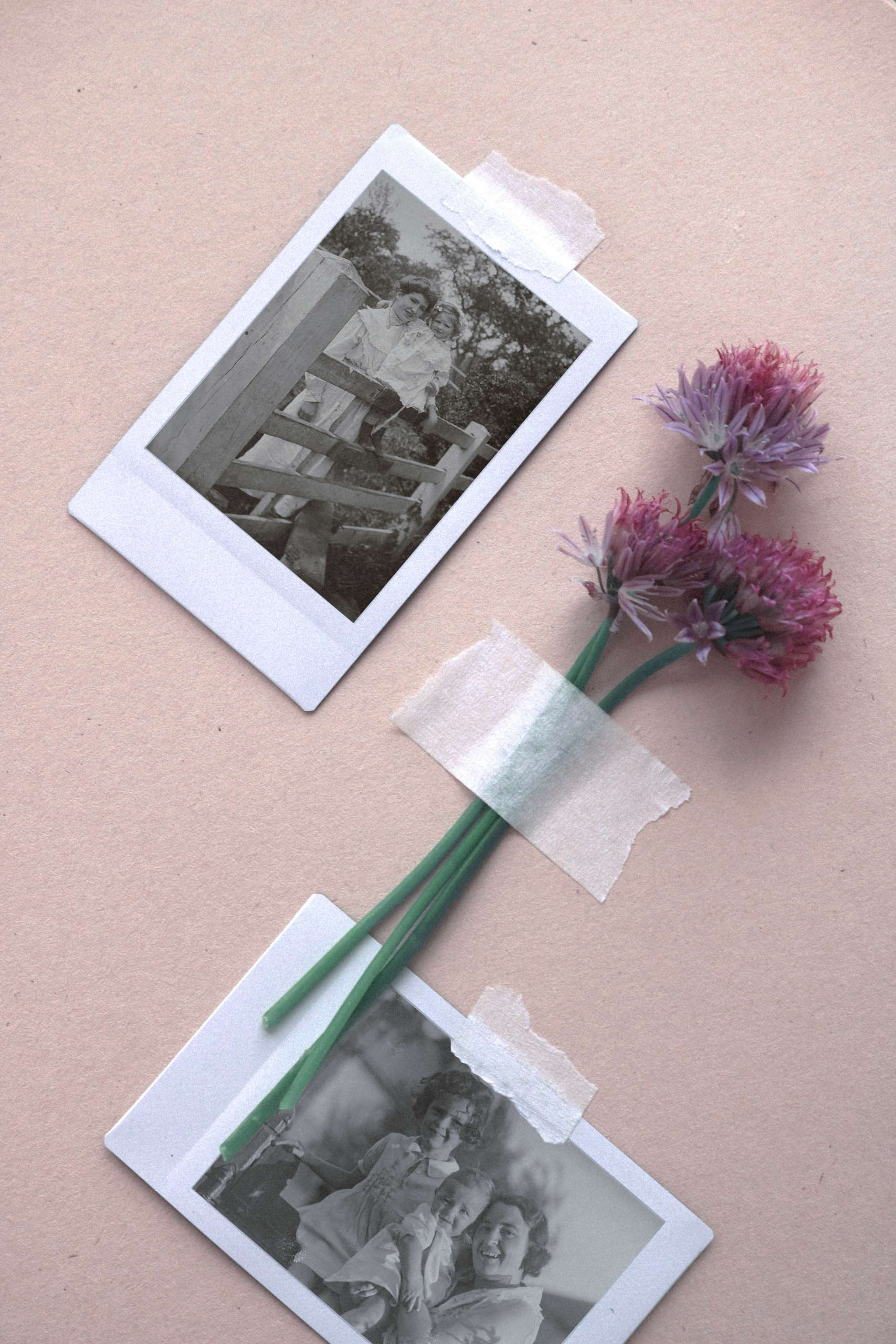
In November 2017, I stumbled upon a photo of a person I didn’t recognize. Buried amongst my mother’s socks, it was a picture of a baby girl in a white, ruffled dress. The girl—I’d guess she was about a year old—was seated alone in the middle of a long, mid-century vinyl sofa with brass buttons. She sat beneath an intricately carved silver mirror. One of the girl’s arms was extended outwards towards the camera in a half-wave. Her tiny body, propped up precariously against the vastness of the sofa, magnified her solitude.
The rose tone of the print and the tarnished silver frame suggested a fairly old photograph. As the image was so faded, I couldn’t quite make out the baby’s face. With her light-colored hair and pale skin, she looked vaguely like my sister, R. But then again, not really.
When I happened upon the photo, I was in the middle of helping my 86-year-old mother move into a new apartment. “Who’s this?” I asked, holding it up for my mother to see. “Is this R?”
My mother was engrossed in sorting through the 25 packages of unopened support hose she’d just unearthed from a different drawer. When she turned to look at the picture, she stopped abruptly. It wasn’t anything in her face that caught my attention. It was how she answered.
“No, that’s another baby,” she said, detached but certain. Not: “Oh! That’s cousin X!” or “Oh! That’s my best friend from elementary school!” Or even: “I have no idea! Just toss it!”
My mother clearly knew exactly who this person was, but chose not to identify her. “Keep it,” she added. Put it in the ‘nostalgia folder.’” She was referring to a filing cabinet I’d purchased the day before to help her organize her papers. I’d created a folder inside it labeled ‘nostalgia’ to house random, personal items I didn’t know how to categorize.
If my mother had responded in a different tone, I might have pushed back and asked why she wanted to hang onto the photo of the little girl with no name. Instead, I dutifully inserted the picture into the nostalgia folder, no questions asked. On some level, I already knew who that little girl was. And why my mother would never throw her photo away.
Many years have passed since that incident, and I now have good reasons to believe that in her early twenties, my mother had an unwanted pregnancy. Like many women in the years before abortion became legal in the United States, I think she gave that child up for adoption. My mother never talked about any of this with me. Nor did we discuss it as a family. That exchange about the photo was the closest we ever came to addressing her secret head-on. But in my mind, that photo concretized a hazy feeling that had been sitting in the shadows of my consciousness for years. Once I beheld the photo of my other sister, a host of seemingly disparate memories began to crystallize. They rendered a fuller, more complex portrait of my mother and how that little girl came to define her life.
“What do you think was the most important invention of your lifetime?” I asked my mother one day as she was driving me to one of my after-school activities. I was 13 or 14 years old.
After a brief pause, my mother said: “The birth control pill.” Her voice was resolute.
“Really?” I was expecting something more like penicillin or the atom bomb, the sorts of things we’d been discussing in my eighth-grade social studies class.
“The Pill liberated women,” she explained. “They weren’t forced to have children they didn’t want or couldn’t care for properly.”
But the confidence with which my mother discussed reproductive freedom as a policy issue belied her ambivalence on a personal level. There was, for starters, her conflicted relationship with the Catholic Church and its policies on family planning. When my parents met in the late 1950s, they were both observant Catholics. My brother M and my sister can still recall the long, white gloves my mother donned to attend mass in the early 1960s. Once I came along in the middle of the decade, however—her fourth child and fifth pregnancy in six years (she’d had one miscarriage)—my mom left the Church.
She told me later that her decision had to do with rigid Catholic doctrine around birth control. In those days, the Rhythm Method was the only acceptable form of contraception for Catholics. This notoriously unreliable technique effectively compelled Catholic women to bear lots of children. It was no secret that my mother had gone on the Pill right after I was born. It had also not escaped my notice that her birth control pills were stored in our basement, keeping company with a few bottles of stale Budweiser atop an old, half-abandoned refrigerator. As a teenager, I’d assumed she kept her pills down there because she didn’t want her kids asking too many questions about my parents’ sex life. Today, I question whether the subterranean location of her contraception wasn’t instead symbolic of the abiding guilt she felt about her sexual liberation.
Nor could I make heads or tails of her feelings about abortion. Mom always said that while she could never have an abortion herself, she firmly supported a woman’s right to choose. During my junior year in high school, for example, her input was crucial in helping me draft an essay on why abortion policy in the United States was misguided and unjust. The essay was for a national persuasive writing competition. With my mother’s guidance, I wove together a compelling blend of logic, statistics, and examples to make my case, and went on to win the prize.
But I distinctly remember exiting church one Sunday in the early 1970s right around the time the Roe v. Wade controversy erupted. As my siblings and I emerged from the nave with my father, lay clergy were handing out bumper stickers at the door. The stickers were bright blue, reading “ABORTION IS KILLING” in bold white print alongside a black-and-white photo of a fetus. I must have been seven or eight at the time, too young to know what abortion was. Like most kids, however, I loved free stickers, so my brother N and I grabbed a bunch to bring home. When we walked through the kitchen door brandishing our newfound souvenirs, Mom started to cry. Her reaction to those stickers went way beyond a policy disagreement with the Church. Something about them struck an unspeakable nerve.
Finally, there was her puzzling attitude towards my own sexual development. If the Pill were so terribly important in the sweep of 20th century innovations that it ranked above the likes of the personal computer, why did she never once broach the subject of contraception with me? I had a serious boyfriend throughout my last two years of high school. Given the amount of time I spent alone with him, she must have wondered if we were having sex. (We were.) One morning during my senior year, I asked my mother casually if it might be time to start seeing a gynecologist.
“Oh, you don’t need to see a gynecologist until you’re sexually active, honey,” she replied, whisking away the breakfast dishes.
I choked on my Cheerios. Had she not clocked my hint? Or, as I now suspect, did addressing my sexual awakening force her to confront the dire consequences of her own youthful escapades? Surely, if that were the case, the logical thing would have been to get me on some form of birth control as soon as possible. But none of this was logical. And the message was clear: “Don’t talk about this. Not with me.”
A few years later, my mother visited me at college and took me out to dinner with some friends. Early the next morning, she showed up at my apartment, unannounced. I was lying in bed with a college boyfriend when I heard her voice just outside my door. One of my house mates deftly ran interference. Raising a blanket high up over her shoulders, Batman-style, my friend blocked the entrance to my room. “Delia’s not here right now,” she said to my mother. “She went to the library early this morning to write a paper.”
A week later, a letter arrived in the mail. In it, my mother told me how nice it had been to see me the previous weekend. She ended her note with a standalone paragraph bearing the following quotation: “Tempora mutantur, nos et mutantur en illis.” (Time changes, and we change with it.) It was the closest she ever came to discussing sex with me.
In Latin.
My mother’s inability to speak to me about sex wasn’t only due to her unwillingness to revisit the agony of her “Original Sin.” After that early, defining event in her life, I believe she could simply no longer “do” emotional intimacy. That, to my mind, was the lasting toll the pregnancy exacted upon her life.
I came to this realization in the summer of 2022, five years after I’d discovered that photo of the other baby. By then, the United States Supreme Court had overturned the Constitutional right to an abortion. I’d always been pro-choice, but in a knee-jerk sort of way, paying lip service to the words “bodily autonomy” without really contemplating their deeper significance. The Court’s decision in Dobbs v. Jackson Women’s Health Organization changed all that. Confronted with a barrage of commentary about what Dobbs would mean for women who were unable to get a legal abortion, I began to reflect on my mother’s journey into and out of her own unintended pregnancy. I tried to imagine what that experience must have felt like—physically, socially, and above all, psychologically.
I started doing some research. I took the photo of my other sister out of its frame and turned it over. (Following my mother’s death in 2020, the picture was now in my possession.) The image was time-stamped “Chicago, June 1955.” Presuming the child was roughly one year old when the picture was taken, that would have made my mother 23 when she had the baby. Immediately an array of other questions surfaced: Where did Mom give birth? Was it in Chicago, where this picture was taken (and where my mother had grown up)? Had my grandparents known about my mother’s pregnancy? How had they reacted? Who else knew about it? Above all, who’d given my mother this photo and were there any others of this girl among my mother’s things?
I felt I needed to know more, and not just about my mother or the girl. I wanted to learn about other women who’d found themselves in situations like my mother’s. Through films like Philomena, I was aware of the checkered history of so-called “Mother and Baby” homes that existed in Ireland across the twentieth century. I had no idea that the U.S. harbored a similarly iniquitous backstory in its treatment of unwed mothers. One revelation here was Ann Fessler’s The Girls Who Went Away: The Hidden History of Women Who Surrendered Children for Adoption in the Decades Before Roe v. Wade. After ordering Fessler’s book, I spent days poring over it like a Talmudic scholar, underlining passages, dog-earing pages, and scribbling in its margins. Here’s what I learned.
Like my mother, most of the women Fessler profiles in her oral history were between 16 and 23 when they gave birth. Once they reached a certain stage in their pregnancies, these women were typically sent to a (usually Catholic) home where they remained out of sight until their babies were born. Some of these new mothers were given a few days with their babies, others only a few hours. All of them were told in no uncertain terms that they needed to forget that their pregnancies had ever happened and move on.
They didn’t forget. In a chapter entitled “The Aftermath,” Fessler provides first-hand accounts of how some of these women reacted to the trauma of giving birth and the anguish of its erasure. And this is where I froze: In describing themselves, these women were describing my mother.
Many of them recounted how their pregnancies had rendered them emotionally numb. As one explained: “It’s as if part of you went away when that happened…and you pretend that it didn’t….You got cut in half [but] … nothing takes away that black hole.” I couldn’t breathe when I read that line.
My dad often said my mother should have been a cultural critic. I always resented Dad saying this, feeling that he was diminishing Mom’s own creative talents. I knew what he meant, however. My mother was kind, generous, and thoughtful, but she went through life at one remove emotionally. I’d always chalked this quality up to her intellect. She was exceedingly well-read, the kind of person you’d consult when you needed to name-check someone in the Western literary canon or to confirm an obscure historical fact. After she read a book or watched a film, she’d provide a lengthy exegesis on its characters and plot of the sort you’d find in The New York Times Arts pages. Reading Fessler’s book, I now began to grasp that her emotional reserve and analytic acuity was also a defense mechanism: It was how she walled off any hint of pain and remained firmly in control of her feelings. Or so I am increasingly convinced.
Take my mother’s reaction to my father’s heart attack in 2009, one that would claim his life six weeks later. My parents were parked in the driveway of their home when it happened. Yet instead of driving my father directly to the hospital, my mother insisted on dropping off some library books at my sister’s house first. Apparently, the books were overdue. Returning those books somehow took precedence over getting her husband—who was, in my sister’s telling, slumped over in the passenger seat—to the emergency room as quickly as possible.
Over the years I have replayed that tape again and again in my head. What on earth had she been thinking? It’s hard to imagine that she didn’t apprehend the severity of the situation. No. My money’s on the likelihood that she was unable to process her terror at the prospect of losing her husband of 50 years. After that early pregnancy, emotional distress was no longer in her repertoire. It had been drummed out of her at a young age.
Mom wasn’t only distanced from feelings of sorrow, however, but also from feelings of joy. Here, too, Fessler’s book was spot-on. “The things I should feel excited about I can’t really feel them,” said one of the women she profiled. “I just can’t respond the way I’d like to because, I don’t know…maybe I feel I was nullified.” Once again, I felt a stab of recognition. My mother could smile and laugh. Yet in the fifty-odd years that I knew her, I don’t think I ever once witnessed her evincing an emotion I would label as joy. All emotions, even positive ones, came through a filter of aloofness.
Another example: When he was about ten, my sister’s son gave my mother a poem he’d written for her. This child was on the autistic spectrum, so the gesture was particularly poignant. My sister framed the poem, and the little boy presented it to my mother as a gift. It read as follows:
“Oh Grandmother
The Waves crash against the beach
The storm pounds against the wall
But thanks to you, our family is not harmed.
You are like a chain that binds us together
Like a rock
And not like the feathers that are scattered to the wind.”
It was a touching gesture, especially coming from this particular child, and should have been a postcard moment in our family. But according to my sister, while my mother smiled when she read the poem, that was it. She didn’t tear up or hug him. She didn’t emote. She couldn’t.
There were scores of moments like this during my own upbringing: The time I sang a solo in my college a cappella group and Mom told me that while she’d enjoyed it, she preferred a solo I’d sung years earlier in high school…The time I flew back from Central America after living there for a year and she sent a car to pick me up, instead of greeting me at the gate…The time, as a young adult, an essay I’d written was broadcast on one of the largest public radio stations in the country. Before congratulating me, the first thing she did was to remind me that I’d forgotten to share it with my sister-in-law.
At a certain point, I stopped reading Fessler’s book with the clinical curiosity one brings to a riveting journalistic tale about a bunch of strangers. Instead, I read it with the gripping emotional intensity you feel when the plot twist at the end of a novel subverts everything you thought you understood: You need to go back and reconsider the entire storyline in a new light. So familiar were these women’s narrativesthat I half-expected to see “Daryl”—my mother’s name, or possibly “Joan,” her middle name—listed among them. I went back over the text more than once to double-check.
The other mystery this chapter helped me to decode was the link between the “forgotten” pregnancy and my mother’s perpetual state of motion. “There’s always this kind of depression, this sadness, but I never addressed it,” says another woman in Fessler’s book. “I was always able to just be pretty functional, in fact, overly functional.”
Overly functional. Dear God, yes. My mother exuded competence, single-handedly ensuring that all the trains ran on time in our busy household. Dinner was never served a minute after 6 p.m. And yet she managed to usher all four of her kids to their assorted after-school activities and back in time to prepare it. My sister and I used to joke about my mother’s constant need to be on the go. You’d still be eating dinner and she’d already be teeing up the coffee. She couldn’t sit still. At a certain point in my life, I’d done enough therapy to recognize that my mother was running away from something. I just didn’t know what it was.
Reading Fessler’s book answered that question for me, or at least a large part of it. Overnight, the cerebral, efficient, and hyper-practical person who’d raised me came into focus. I was relieved and devastated in equal measure.
It would be unfair, however, to characterize my mother as entirely cut off from her feelings. As my sister once observed, Mom was capable of emoting, though only in safe spaces. These included the assorted political and social causes she embraced across her lifetime on behalf of those without a voice. As one of the women interviewed in The Girls Who Went Away put it, “It was easy to be compassionate with strangers. It doesn’t require ongoing, deep intimacy.”
After my mother left the Church, she became much more active politically. The 1960s was a fertile time for the American Left, and as one of my mother’s close friends noted in a poem he wrote about my parents’ marriage: “Daryl could get quite chatty about Karl M or Malcolm X.” By the end of the decade, my parents were living in a leafy, upper middle-class bedroom suburb of New York City. My mother selected the town because of its excellent public schools. But it was a conservative place, both politically and socially, and Mom quickly joined the town’s small counterculture.
In a village that was at least 95% Christian, nearly all her friends were either Jewish or Unitarian. Together, these rebel women joined the local chapter of the League of Women Voters, a nonpartisan grassroots organization working to expand voting rights. The anti-war movement was also in full swing. A large campaign poster for Eugene McCarthy, an outspoken critic of the Vietnam war who had challenged Richard Nixon in the 1968 presidential race, hung in our downstairs hallway.
My mother’s liberal political views were matched by her social commitments. When I was six, she went back to school and obtained a graduate degree in education. For years, she taught reading on a part-time basis to children in nearby Paterson, a once-vibrant, industrial city that was now home to abandoned buildings and vacant lots. One day when I was home sick, my mother brought me along to her job. Her classroom was a storage closet. We sat in a circle on the brown wooden floor, surrounded by buckets and mops, as my mother read aloud to a group of African American youngsters and helped them with their phonics.
There were almost no Black people in Ridgewood, where I grew up, a short 15-minute drive away. I remember once seeing an African American man walking in our hilly neighborhood when I was 9 or 10. It was as if a rare species of antelope had appeared on the horizon amid the wrap-around driveways of the large Tudor- and Colonial-style homes. My brother N and I asked my mother why this man wasn’t on “Broad Street,” a reference to the small area of shops and row houses where the town’s tiny Black minority lived. She cried, telling us that it had been a mistake to raise us in such a place.
Around this time, some of the kids at my elementary school began taking ballroom dancing classes at the local Women’s Club. The girls would bring their long, white gloves and shiny, black shoes along with them to school; the boys, their suits. Feeling left out, I came home one day and asked my mother if I, too, could take ballroom dancing lessons. Horrified, she told me she wouldn’t pay for it.
Instead, she started introducing me and my siblings to an entirely different kind of culture. She took us to see films like Reds (about the rise of the Communist Party in the United States), Julia (about efforts to smuggle money to the anti-Nazi cause), and All the President’s Men (about the Watergate scandal). Our house was filled with the protest music of the American Folk revival: Joan Baez…Arlo Guthrie…Peter, Paul, and Mary. During our annual August holiday to Cape Cod, our guitar-playing babysitter would gather the kids around the living room. Together with Mom, we’d belt out the lyrics to songs like “If I Had a Hammer,” an early anthem about freedom and justice for the labor rights movement.
I’m sure my mother’s lifetime of activism stemmed partly from a need to “give back” in light of her enormous privilege. It was also how she likely made peace with having brought up her children in a town that embodied so many of the institutions—political, racial, and social—she railed against. I can’t help wondering, however, if taking up the causes of various marginalized groups wasn’t also a way to fight back against the forces that that had conspired to limit her own agency in 1950s America. And against one institution in particular: the Catholic Church. Through her civic engagement, she was able to channel her outrage over her own oppression, an outrage she didn’t dare give voice to in her daily life.
In many ways, then, my mother furnished an excellent model of public service, one that my sister and I both emulated as we became adults. Somehow, however, the passion Mom brought into the political realm never became personal. Her anger—and the shame that sat just underneath it—instead found expression in a second safe space: her writing.
My mother started writing plays around the time I turned 10. In the 1950s, she’d been a working actress in the New York theater scene, so this was very much a return to her professional roots. Most of her plays went nowhere commercially. In retrospect, though I’m sure she would have loved a career as a successful writer, I now speculate that her plays may have served a much more essential purpose in her life: They allowed her to work through her internal torment over the baby she gave away.
One play, in particular, captures this suffering perfectly. It was called Sisterhood, and centered on the life of three sisters—one of whom was a nun, and her younger twin sisters, one who was pious and one who was a vocal skeptic. As the play progresses, the twin sisters undergo a role-reversal. The irreverentsister becomes a nun, eventually rising to Reverend Mother in the convent. The devout sister becomes a political activist, starts drinking too much, and gets pregnant with a married man. By the end of the play, the twin sisters have switched roles once again. The heretical sister returns to the faith, while the dutiful nun leaves the Church to pursue a career as a songwriter.
Re-reading this play decades later, what jumps out most is the either/or nature of my mother’s world view: it’s not possible to be both faithful and free. If you wish to be truly liberated—as an artist or a woman—you need to leave the Church. “I’ll nurse my baby with my breasts. I want her and I want her father—you don’t know the feeling, do you? Nun!” exclaims the dissolute sister at one point. In contrast, if you wish to be spiritual, you can’t have sexual desires and act on them. “God will damn you and your devil child!” the older sister retorts.
But although the main characters must elect to be either saintly or sinful, no one is happy with their choices. Religion is presented as a crutch for the two nun-sisters, shielding them from ugly, earthly truths. At one point, the fallen sister avers: “My life’s not always pretty…nor pure and holy neither…like your visions. But at least it’s honest…naked—nasty—dirty, just like love.” Nor is the worldly sister content. The play contains numerous references to her “wickedness” and the “blackness of her nature” for having “kissed the devil.” She needs alcohol to cope with her Mortal Sin, and seeks, on some level, to be punished for it.
Reading this play furnished yet another “Aha!” moment in helping me to comprehend just how haunted my mother was by the ghost of that other baby. The notion of sin and redemption, such profoundly Catholic tropes, lay at the very core of her being.
My mother died in 2020. Knowing what I do now—or what I think I know—I regret that I was never able to reassure her, as she approached the end of life, that I got it—that I got her—and that I was so very sorry for her pain. By the time I’d pieced together the fragments of this story, her once razor-sharpmind had begun to dim. She could no longer remember how to get home from the grocery store on her own. She was beginning to lose track of names and faces, asking the mother of one of her own grandchildren if she had any kids. I felt Mom was too frail to re-open the scars of that early pregnancy.
I sometimes ask myself if my mother ever opened the nostalgia folder to look at the image of that little girl with no name. I’m guessing not. Even if what I think is true, I’m not sure Mom would have remembered that she had an entire file devoted to the vestiges of an earlier life, one that I believe contained her deepest, darkest, and most painful truth. Instead, that photo likely remained in a permanently liminal state, at once confined to the borders of her new home, and yet hidden, just out of sight.
I now keep the photo in a drawer of my own. I pull it out every so often, though I’m not exactly sure what I’m looking for: A flicker of family resemblance in the baby’s face? A heretofore neglected detail that might offer further clues about the girl’s early childhood? Mostly, I think I’m trying to ascertain if the image triggers a compelling need to know what became of her.
I did make a few fleeting efforts to figure out my other sister’s identity. I once phoned one of my mother’s oldest friends and asked a few leading questions about assorted romantic liaisons my mother had alluded to during the 50s. “I’m not sure what you’re asking me,” the friend replied, adding: “A lot happened back in those days.” I took her oblique remarks as code for: “Do you really want to know this?” Turns out, I didn’t. I quickly changed the subject.
A couple of years later, I asked my husband to gift me a DNA test for my birthday. Might this other person be out there, only a click of the keyboard away? While I unearthed a number of fourth cousins from County Monaghan in Ireland, no one turned up who was even close to being a half-sister. Obviously, I could have tried another site. Once again, I let the trail go cold.
Because from the moment I first chanced upon the photograph, the identity of the baby has never been the real question for me. The picture’s meaning lies instead in what it tells me about my mother. Through it, I am able to see her in all her humanity and finally begin to understand her: as a citizen, as a writer, and most of all, as a parent. And in guarding Mom’s secret these last few years, I’ve felt closer to her than ever before.
DELIA LLOYD is an American writer and communications consultant based in London. Her writing has appeared in outlets including The New York Times, The Washington Post, Oldster Magazine and Writer’s Digest. She’s also been a featured blogger writing about longevity at both the Oxford Institute of Population Ageing and the UK National Innovation Centre: Ageing. Her newsletter, Mature Content, explores the joy of lifelong learning.
