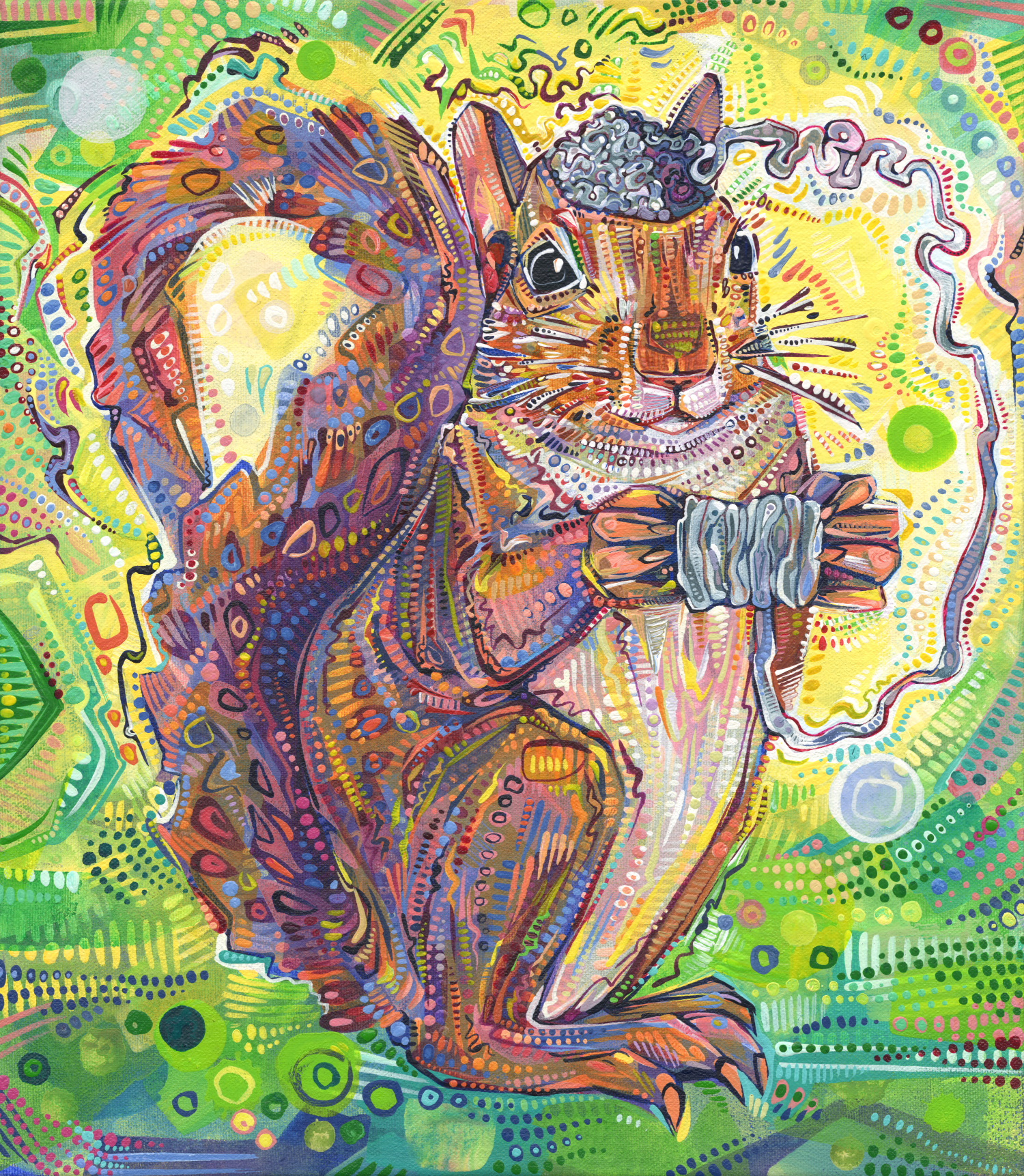
We wanted the pecans. The squirrels also wanted the pecans. And therein, as they say, lay the problem.
Let us start another way.
Say the pecan tree is a symbol sprouting in the grassy lawn of my youth. A symbol of what? you ask. Let’s say a symbol of my family’s dominion. Our domain. Our sacred domicile. We planted the tree in January of 2000. This was almost a year exactly before my sister was born. At the time, my brother and I were but small children, patting loose handfuls of dirt over the hole where my dad had tucked the tree in the center of our yard. A “family tree” he declared it. And so it was. A tree that would grow alongside us children. It couldn’t have been more than five feet when we planted it, but it would stretch and stretch and eventually reach my second-story bedroom where at night it would brush against the windows, haunting me with horrible visions of ghouls trying to break in.
Come fall of each year, the pecans would appear, encased in their green pods. Then they would drop and drop. And we would go beneath the tree and pick them up, place them on the pavement of the driveway, and crush them under our shoes. We would separate the nut from the fragments of the tough shell. There would be hundreds of these pecans littering the yard. And they would all be ours. That is, they would all be ours if we did not have competition.
So, say the squirrels, too, are a symbol. Of encroachment and transgression. Of theft and enmity. You may think, please, what harm could a squirrel do? But if you’re thinking that, you have never had every last pecan plucked from your family tree before you could taste even one of those hallowed treats that were yours by birthright.
Year after year the pecan tree would sprout its heavenly fruits, and we would wait, patient gatherers beneath the giving tree, for them to drop onto the spongy blanket of our yard where we could graze upon them. But alas, year after year, before they fell, the squirrels would go madly through the branches and feast on what was rightfully ours. We never got a taste.
This was a problem. It would not do that our tree — our family tree nonetheless — was being looted by rodents. After years waiting anxiously and expectantly for those nuts, dreaming up the pies and breads we would bake with them, only to find once again, the empty remains of the annual pecan massacre strewn beneath the stripped tree, my dad decided he’d had enough of this painful disappointment. He decided to take this matter into his own hands. And he did this with a pellet gun.
*
Now, I must inform you that I grew up in the middle of Tulsa, Oklahoma, a mid-sized American city. My neighborhood was filled with doctors, lawyers, and engineers and located between two shopping districts filled with upscale restaurants and the kind of stores in which you’re afraid to touch anything for fear someone might come out and fine you for even thinking you could afford these products. All this is to say, though guns were normal to own in this part of the country, this was not the sort of neighborhood in which one might normally whip them out and stage a Western-style shoot-out in the front yard. But my dad was only defending my family’s honor. He was working against the tremendous insult that these villainous squirrels were hurling at us.
You might be thinking my dad had a case of what people these days are quick to call a ‘scarcity mindset.’ You are thinking why weren’t there enough pecans for both the squirrels and your family to eat? And maybe there would have been. Maybe there was another way to go about dealing with the competition, but that’s not the point.
Enter one of the central characters of this story: the Principle of the Thing. You may know her, The Principle of the Thing. Many friendships have ended, houses have fallen, and wars have been fought, over her — The Principle of the Thing. Well, you might say my dad is the patron Saint of Principle of the Thing. He would not let the squirrels take what was his even though his family ate fine without supplementing our diet with buckets of pecans.
I saw my dad as the great arbiter of morality. He saw lines in the ethical sands of the earth. These were lines that could not be crossed. Things were black and they were white, they were wrong and they were right. Naturally, when one was wronged, the wrong must be righted, thus balancing out the karmic scale and returning the world to moral equilibrium. The squirrels had upset this equilibrium.
The pellet gun was a long, skinny thing with a pretty wood stock and a barrel that stretched out like the needle of a booster shot, terrifying and precise. My dad sat in a chair in the room next to mine, a narrow office where we stored linen and kept our home computer. He waited for a squirrel to go out on a branch in search of a green pod. Time passed, and my dad swiped one hand over the crest of his sweating bald head. He stroked his beard. Where were they? Time passed some more and eventually a squirrel came as they always did and began tugging on an unripe pecan case.
From the window, my dad had an easy shot. The branches couldn’t have been more than a meter from the tip of his gun. He took aim. It was a sucker punch, a cheap shot, a shaft, a low-down dirty job, but someone had to do it.
And BAM.
It was done.
It was the second “shot heard round the world.” Such finality in the sound of a bullet. The squirrel’s lifeless body fell from the tree, floating to the ground as angels cried and mournful horns played TAPS in the distance. Its body bounced once, twice on the ground. The squirrel’s eyes had the sort of regretful yet reconciled look you see in rennaisance paintings of Jesus on the Cross and each of his paws stretched out from his sides — a rodent, crucified.
To add insult to injury, my dad took the blood from the squirrel’s wound and spread it in a ring around the base of the tree as a warning to other squirrels. Then he went back inside and put the pellet gun away. The deed was done. The wrong had been righted, and the world was once again at that sacred equilibrium.
*
For those of you who don’t know, squirrel government is oligarchical; a small legislative council of squirrel leaders, chosen based on the wealth of their nuts, determines policies for the rest of the scurry. The council meetings are sporadic as very little out of the ordinary happens in the lives of urban squirrels and therefore, amendments to the squirrel constitution are rarely needed.[1] But in the case of incidents like the assassination of one of their kind at the pecan tree, emergency meetings are called.
I knew all this since, from where my bedroom was situated so close to the pecan tree, I was privy to the conversations and happenings of the squirrels. I had begun a private study of Squirrelish in my free time. See, I was often grounded in the years of my youth for what my family termed “bad behavior” or “acting out.” My dad, as I’ve said, was a strict believer in the Principle of the Thing, which also meant consequences were to be doled out in equal proportion to the crime. In my boredom, I found great solace flipping through the pages of a Squirrelish dictionary I’d found at a garage sale.
The night my dad shot the squirrel, who happened to be an oligarch by the name of Jester Squirrelington III, a gathering of the Council was called. They kept me up all damn night. I chewed my cheek as I transcribed the conversation and peered out my window at the shadowy forms of the squirrels quarreling over what was to be done.
“Jester is dead,” began the Head of the Council. “May he rest at peace forever beneath the Pecan Tree in the sky.”[2]
“You speak of peace as if it were guaranteed,” said the oligarch known as Graham Squirrelman. “But I will not waste my life on earth for the promise of peace in the life to come. We need nuts now. Not tomorrow, not the next day, not at some point in the obscure and vast future — but NOW!”
“What do you propose we do, Graham. The bald man has the gun. We have only our bright eyes and bushy tails, and what are they in the face of such violence,” said the Head of the Council. He jumped up a few branches as though he might gain more authority by sitting on a higher branch in the canopy.
“The bald man spread Jester’s blood across the tree. The humans have gone too far this time,” Graham said. “We must fight back.”
“And do what?” the Head replied.
Graham twirled his tail in thought. He spoke like a fighter, but everyone knew Graham only cared about food, his belly showed his gluttony.
“I have heard tell of a utopia two blocks over,” this came from the Council’s scribe, Oren Squirellster. “The humans call it a ‘park.’ There, it is said squirrels gain much from harmonious living among humans. Food is plentiful. I suggest we go forth and make the journey. When a gun has been shot, war has begun. We can’t very well bring a stick to a gunfight.”
“Chchch-tick-tchck” the Head of the Council muttered to himself. It is a nearly untranslatable idiom that means something along the lines of “a nut in the hand is worth two in the bush” or “a nut will keep through the winter, but it is better to keep your head.”
The squirrel Council began to hum with chatter. I couldn’t follow the conversation in all the chaos. It wasn’t until the Head called out “SILENCE!” that the night returned to its usual calm. “We will make the journey,” he said. “We set off at sunrise. Tell your families, we will not fight. We have worked too long for this wealth. Of course humans envy it. When they look at our wealth they only see their own poverty.”
The council muttered in agreement—even Graham conceded the point—and each scurried down the tree, going back to their respective families to spread word.
*
The Squirrels left the very next morning. I woke to the sound of a trumpet blaring and when I looked out my window, I saw them all go. It was a mass migration. Some of them carried sacks of nuts on their backs, but many went with nothing. They did not look back over their shoulders at my family tree. They only looked forward.
I thought of Exodus. Not the bible, but the scene in the animated movie The Prince of Egypt where all the cartoon Israelites leave Egypt and this little boy starts singing “Ashirah L’adonai.” They all follow Moses out of plague-stricken Egypt and Pharaoh just watches them go. I felt a little like Pharoah. Maybe my dad was God. Like the old-Testament God. The mean one. Maybe the squirrels were the Israelites. Maybe none of us were anyone. All I know is that the next time I saw Graham, he was at the park a few blocks over. He’d gained even more weight from all the food that people left after their birthday parties and picnics in the park.
“Aren’t you Graham Squirrelman?” I asked him. At first he acted like he didn’t know me. But eventually I pestered him long enough that he replied.
“Daughter of the Bald Man,” he said. “I am unhappy to see you again.”
“Isn’t your life better over here though?” I asked.
He put one paw on his round, furry tummy. “Life is life over here.” He sighed. “Life is just life.”
[1] The squirrel constitution is composed of three simple decrees.
- Whatever walks on two legs is an enemy.
- No animal shall wear clothes.
- No animal shall kill another animal.
A squirrel historian found that this constitution dates back to 1945, the same year of the publication of George Orwell’s Animal Farm. The same historian determined that a copy of the book had been read by a bilingual squirrel scholar in the 1940s who adapted and shortened the laws for squirrel kind.
[2] It was with much difficulty that I was able to procure a translator of Squirrelish. As I’ve said, I did have some functional knowledge of the squirrel’s language, but I felt I needed a real practitioner to be sure I translated their speech as respectfully as possible. I placed an ad on the internet and was contacted by a gentleman who swore he knew their language. He said he’d learned it after spending several years living in the great forests of the North East alongside a scurry of squirrels. The man wanted to charge me $50 per word translated. When I protested that I was but a mere student and writer, he lowered the price to $25. Such are the costs of inter-species communication.
ELIZABETH J. WENGER is a queer writer from Tulsa, Oklahoma. Her works have been nominated for the Pushcart Prize and Best of the Net Anthology. She is the winner of the Baltimore Review Winter Prize in flash nonfiction and was shortlisted for the Breakwater Review Fiction Prize. Her essay collection was selected as a finalist for the Black Lawrence Press Hudson Prose Prize. Wenger earned her MFA at Iowa State University’s program for Creative Writing and Environment. Her website is wengerwrites.com.
GWENN SEEMEL‘s art doesn’t appear on social media, but it has been featured in Newsweek as well as on the cover of an Oxford University Press book. The artist lives in Lambertville, New Jersey, and they received a 2026 Fellowship from the NJ State Council on the Arts. See more at gwennseemel.com.
