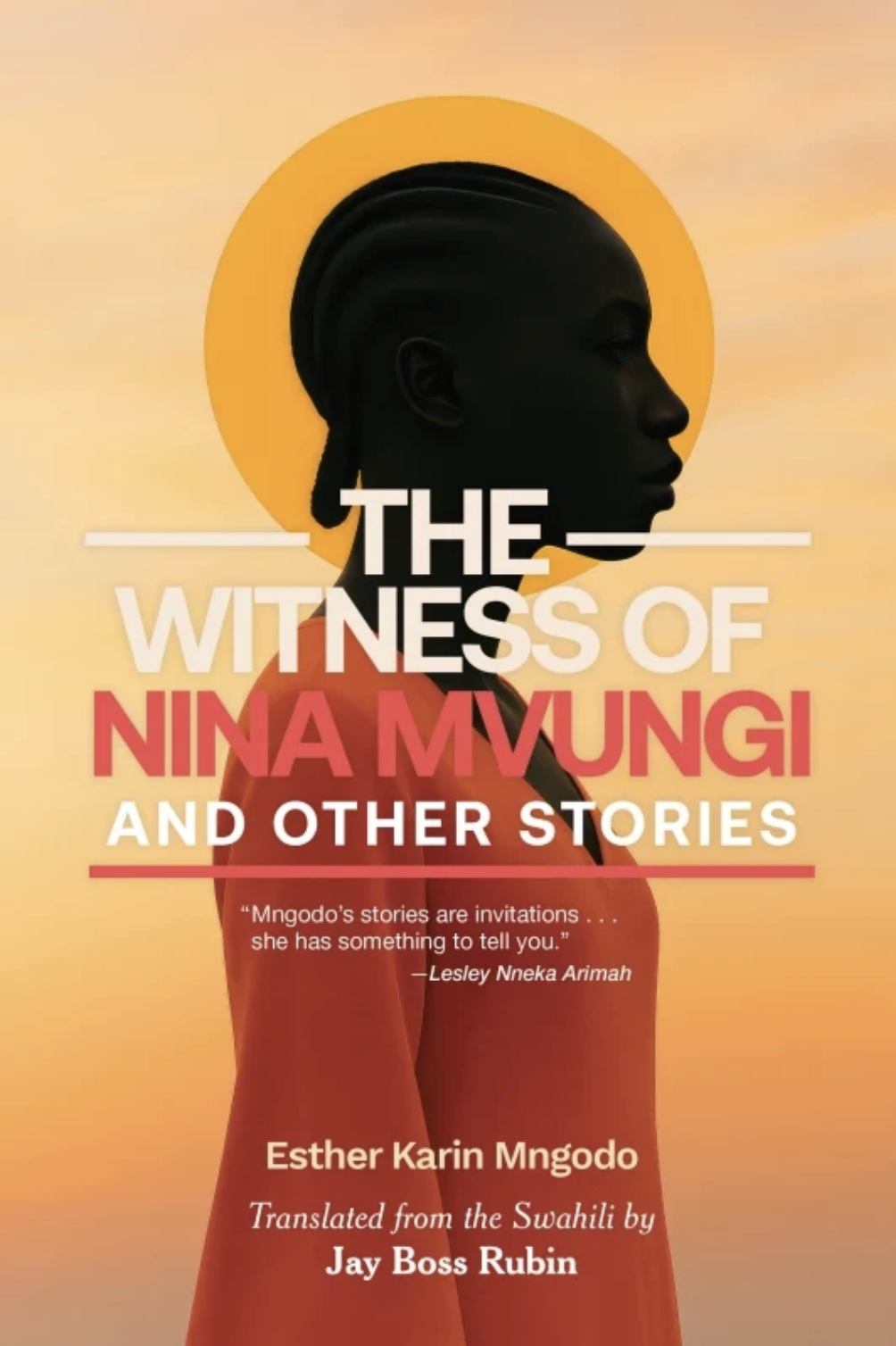
Taking a feminist approach to subjects like motherhood, class, colorism, and the implications of human-caused climate collapse, The Witness of Nina Mvungi and Other Stories (Hanging Loose Press, 2025) is the first collection of speculative fiction by award-winning Tanzanian author Esther Karin Mngodo to be translated into English from Swahili. The stories were translated by Jay Boss Rubin, and the book won the Loose Translation Award in 2024. The volume’s seven stories are lightly intertwined and hold up a mirror not just to modern-day Tanzania but to the contemporary tensions and moral quandaries people face around the world, regardless of country or culture.
The stories primarily center women who move through their everyday lives, navigating familiar emotional territories of love, friendship, motherhood, jealousy, and grief. In the opening story, “The Fish Market,” an encounter with a merchant in a market far from the protagonist’s home sets off a wave of grief about a lost child. In “The Garden of Tomatoes,” the discovery of a suspected affair between the narrator’s husband and a servant takes a sinister turn. And in “First Date,” one of the standout stories in the collection, college-student Magdalena’s rendezvous with a man she met online turns into a reckoning with the past.
At first, the supernatural and speculative elements seem to hover just around the edges of these stories before suddenly and chillingly taking center stage. Blood drinkers and ghosts stalk the unhappy couple in “The Garden of Tomatoes.” Parents sell the fingers and limbs of their children with albinism on the black market in “Rare Goods.” And in the title story, “The Witness of Nina Mvungi,” godlike spirits debate whether to intervene in an unhappy woman’s life and weigh the consequences of doing so.
I was most haunted by “Without Sun,” a story set in 3045 in which Diana, a former actress, counts down the days before the apocalypse. The world has been plunged into darkness due to nuclear war and environmental fallout, and rising sea levels have turned Dar el Salaam’s formerly landlocked neighborhoods into coastal properties. Over the course of the story, Diana screams into the darkness, converses with her ginger cat, and finds out a devastating secret kept from her by her husband, one that may keep her off an evacuation rocket destined to a new world.
Across the volume, Mngodo deftly captures the emotional struggles of her characters, and that is what makes these stories so compelling. Far from being didactic, they deal with deeply ambiguous and contradictory themes of life, which creates a lingering impact on the reader. Long after I finished the book, I found myself considering the fate of the characters and the choices they confronted.
This book is not only an engrossing work which highlights women’s experiences of being “Black, Africans, Mothers, and Tanzanians and so on” (in Mngodo’s words) but is an example of an innovative approach to literary translation. While Mngodo is fluent in English, she wrote these stories in Swahili. She then engaged in a collaborative, generative translation process with award-winning translator Jay Boss Rubin. In his introduction to the book, Rubin explains how they first connected on Swahili-language Twitter before meeting at a translation workshop in the fall of 2022 and beginning a multilingual exchange.
Much of the translations took place in shared Google docs, where, Rubin notes, “Our explanations and elaborations grew and grew, and the word counts in the margins soon outpaced the word counts in the stories themselves.” The translation process became fully collaborative, from initial draft to approval of copyedits, and as the meaning of the words evolved towards the target language of English, Mngodo would often go back and revise the source text, complicating the notions of each.
Knowing that the book and the versions of the stories within it emerged from such a conversational process adds an additional layer for the reader. The slim volume is an artifact of a literary friendship and a document in an ongoing conversation across language, cultures, and time zones. In their collaboration as translator and author, Rubin and Mngodo have brought forth a rare creation: a deeply complex, multilayered text that is also a breathtaking delight to read.
ELEANOR C. WHITNEY is a writer, musician, and community builder based in California’s high desert. She is the author of Riot Woman, which takes a celebratory but critical look at the Riot Grrrl movement, and Promote Your Book, a guide to book marketing and literary community building. She holds an MFA in creative nonfiction from CUNY Queens College. Her work has appeared in the Weird Sister anthology, published by Feminist Press, Literary Hub, The Rumpus, and Architectural Digest. She is a Nonfiction Editor at MAYDAY magazine.
