The Mother Part
At the Free Palestine march, Anil saw the sign first:
If you are anything like my mother, Agnes Kimber, who says that Palestinians are animals, then you are my enemy too.
We couldn’t see who was holding it. They were up at the front. They wanted everyone to know.
“How about that?” I said.
“There it is,” Anil said.
It was cold but it was a good day for marching. We were going from Westlake to the Federal Building. A sunny winter day always felt a little warm in Seattle.
We tried to get to the front to see the person holding the sign.
“You think they told her?” Anil said.
“That she’s going up on their sign?”
“Yes.”
“I don’t know if they’re talking much these days.”
“They’re talking enough for her to say that.”
“She could’ve said that any time.”
“I think it’s new,” Anil said. “I think she said it yesterday. That’s just how it feels.”
We had no luck getting up front.
“In the old days, we would’ve seen right away who was holding that sign,” I said.
“You wouldn’t have seen that sign in the old days.”
At one point during the march, the Agnes Kimber sign was right next to a sign with a picture of Nelson Mandela and his words about the freedom of the Palestinians. Mandela and Agnes Kimber. They walked side-by-side for a while.
The march curved around the market and we caught a glimpse of who was holding the sign. It was a young guy, about twenty-five maybe. He looked very lonely, but it might’ve just been that I’d had four blocks to think about his sign.
When we got to the Federal Building, we got a better look at him. He was chanting loudly, and I thought he would look lonely even without the sign.
“Come on,” Anil said.
We walked up to him. Anil clapped him on the back and said he was sorry.
The young man looked at us. His face was like his sign. He wanted to know who his enemies were. If children were dying, then he had enemies and he wanted to know who they were.
“I told her I was going to make this sign,” he said. “Do you know what she said? She said she would be proud. She said she would be proud of it if I did.”
“Was it hard to make it after that?” I said.
“I had to do it. I felt bad to make it, but I felt worse to not make it.”
The man with the Mandela sign came up to us.
“Thank you,” he said, pointing to the young man’s sign. “I am Palestinian.”
The young man didn’t know what to say. You could see that he hadn’t done any of it to be thanked.
“It is hard to have a mother for an enemy,” the man said.
“It gets easier,” the young man said. “I don’t know if that’s good, but it gets easier.”
He went back to chanting, charging Biden with genocide.
“He’s forgiving her,” I said to Anil.
“You call that forgiving?”
“It’s a slow process.”
The Palestinian man went to get his friend to show him the sign. When his friend saw it, he began to cry.
“Is it the animals part?” I said.
“No, we hear that all the time,” the first Palestinian said. “It is the mother part.”
“That’s what I thought.”
His friend embraced the young man. He said something in Arabic.
“He says she is still your mother,” the first man said.
“I know,” the young man said.
The second man said something else.
“He says Palestine is your mother too.”
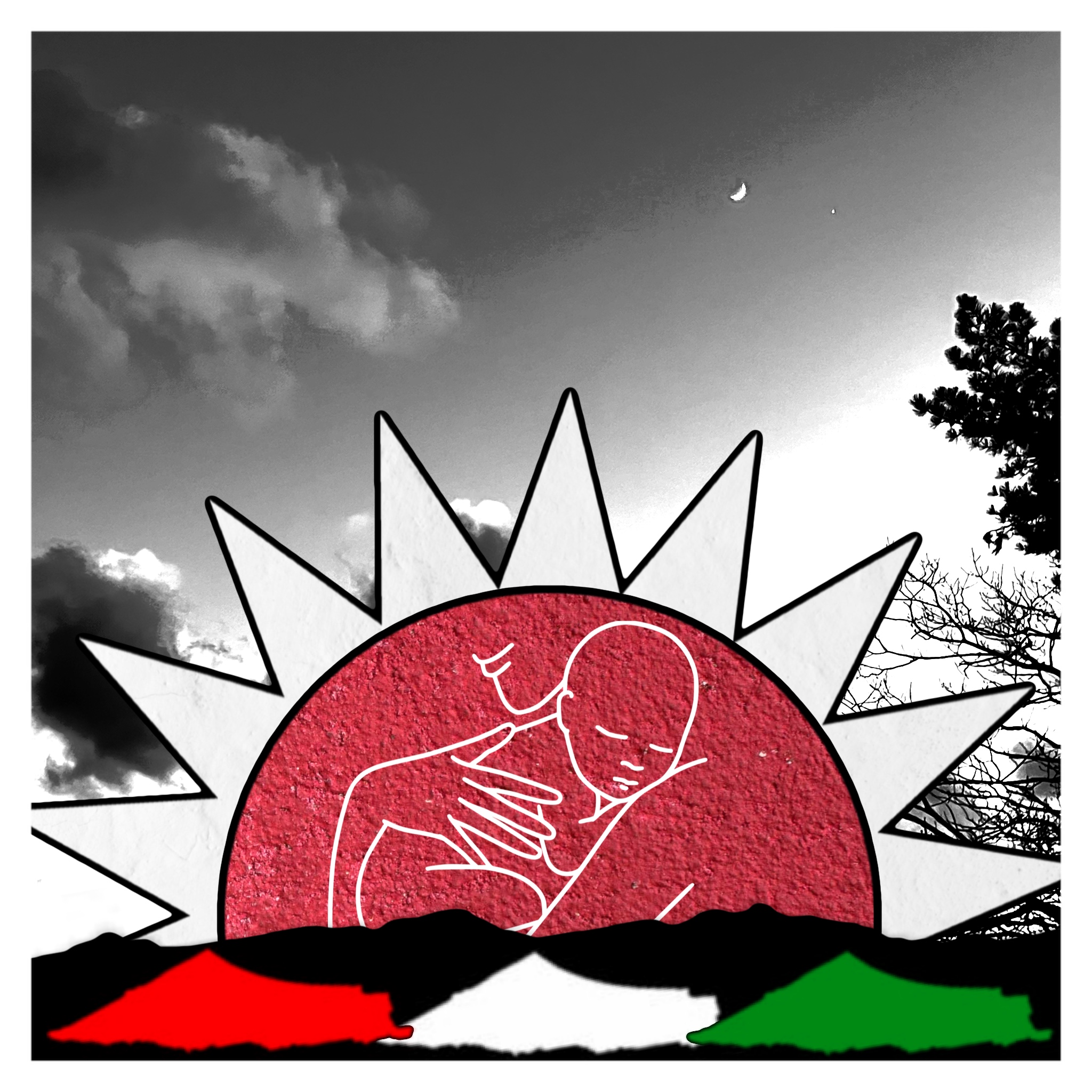
“Thank you,” the young man said, but he seemed to be somewhere else. Somewhere where he didn’t know how to hold either mother. He went back to chanting. He looked at home among loud noises for now. I thought perhaps it was the soft voices he didn’t know what to do with, the little breaths a mother gives a child at dawn.
SIAMAK VOUSSOUGHI is a writer living in Seattle. They have had some stories published in Kenyon Review, Missouri Review, Bennington Review, Columbia Journal, West Branch, Gulf Coast, and MAYDAY. Their first collection, Better Than War, received a 2014 Flannery O’Connor Award for Short Fiction and their second collection, A Sense of the Whole, received the 2019 Orison Fiction Prize.
