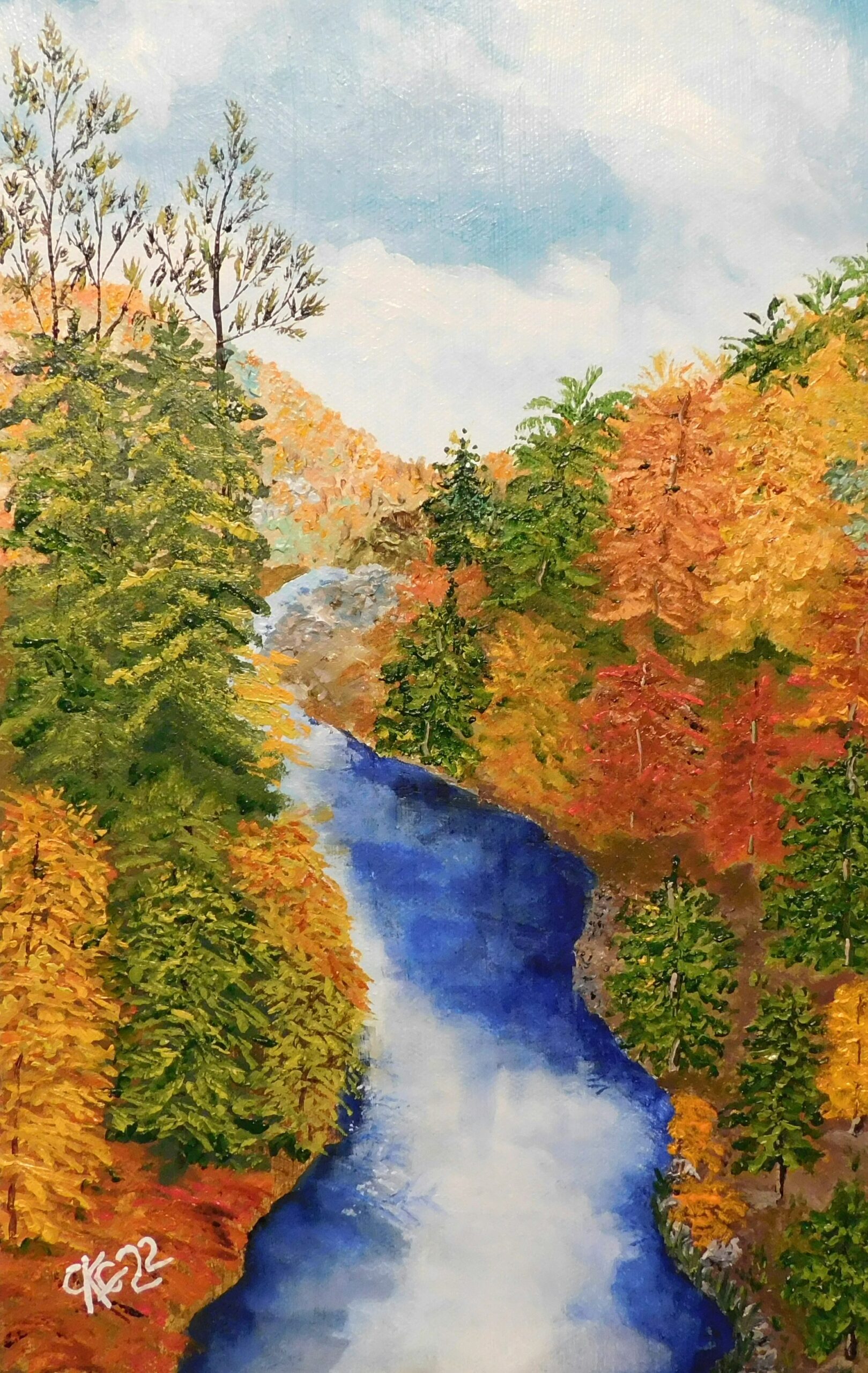
On his usual walk he came to a stretch where boulders were freshly dumped along the riverbank. No mystery: he knew this was to stop the erosion that had become a worry. There had been a public meeting about it; he’d meant to attend but forgotten. According to the account he read online, the room was split between those who said the boulders would be ugly and those who argued it would be worse to let the shoreline continue to be gnawed away by erratic weather and higher water than anyone remembered. It’s all changing. Seeing the boulders for the first time, he had the idea they stood for the jumbled weeks, and months, and years, ahead of missing what was coming to an end. Also, that it would finally fail. The current has forever to discover and exploit microscopic cracks and depthless indentations and other secret vulnerabilities.
Stop pretending all the time, he told himself again as he walked. But what a hard habit to break. At intervals along the path he saw small swarms of gnats and imagined they were figuring double-helixes in slants of sunlight. He also noticed a fresh crop of weedy saplings poking up through the low foliage, the grasses and modest wildflowers that fringed the path where any thicker growth was periodically cut back. His mind went to an old-fashioned anthology his grandmother once gave him as a birthday present—did he still have it in a box somewhere?—and he imagined the saplings straining, like Blake’s sunflower, toward something besides raw energy. Amazing how certain rhymes stick forever.
What he wished was that something would do more than survive. He had seen an egret once on this same walk, a white egret, stock-still in the shallows. As he took out his phone to get a picture, it rose in flight, and the image he captured was unreal: origami angel against mauve overcast. Peering at it on the little screen, he’d thought of working as a set-maker, the lowest rung on the drama-club ladder, for high school plays. It had been decades since that memory last percolated up. He thought of using a coping saw to make a plywood wading bird that might be lifted on wires threaded through pulleys. The backdrop would have to be skillfully painted to approximate the effect.
A bit later he came upon a volunteer from the community association kneeling in the scree, wearing gardening gloves and working with a sharp trowel. She was hacking at some sort of weed that was encroaching on the path. When he paused to say hello, dropping a shadow down beside her, she remained crouched but greeted him over her shoulder. As if he’d expressed an interest, she explained that this was an invasive species and the committee—she mentioned the committee as if he would surely know about it—was determined to keep the stuff in check. He asked, Is the soil acidic or alkaline? but lost her answer in the rustle of leaves as she shifted position to gain leverage on a root. Hard consonants eluded him these days and frequencies above, or so the audiologist told him, two thousand hertz. Missing key words tended to make him go into himself even more than before, which he realized couldn’t be good as he grew old, truly old. Yet it didn’t feel bad. On the contrary.
And so he allowed the volunteer to shrink to the size of a beetle and scurry off, leaving him at the leg of his mother’s mother. They were in her garden, as it had been, and the tall woman was quietly teaching. This bed is sour, she said, acidic, and that one sweet, alkaline. These terms of hers must have slept, like spores, fifty years in his dry throat before being awakened by the river air. He felt embarrassed to have spoken them as if they meant something to him beyond a stray recollection. But he was being evasive, diminishing memories of that sort. They must add up to something, he just wasn’t sure what. She had been a lean, reserved, well-meaning woman, his grandmother. She had lost children; her husband had died oversees in the war. But she never spoke of hardships. What impressed him were all her hard-cover books. Also the efficient way she had of flipping over a lawn mower, taking an old screwdriver to the blades and undercarriage, peeling away matted grass, like a handyman.
After he left the spot where the volunteer was digging, and after he passed beyond the length of riverbank newly fortified with trucked-in boulders, he reached the end of the river path and strolled out onto the softball field. There was no game that evening, just a couple of kids throwing a frisbee. Sunset arrives so late in the first week of July that above that sudden open space the sky’s blue was undiminished from what it had been at the height of the day. And what should that particular shade of blue be called, or rather named after? Confectionary of some sort. A novelty ice cream flavour dreamed up to sucker the frisbee kids. Cotton candy. Blue whale gummy. Froot Loops.
No holding himself back now. He surveyed the trees around the field, and decided they were Medici. Three hundred years they’d held sway and whatever rule came next couldn’t hope to rival their regime’s self-possession. It had been a windless day, and humid, but he sensed the evening breeze beginning to test its voice, offering a phrase or two tentatively into the stillness—a commentary, not finding fault with him, but asking, With all due respect, if you’re going to put it out that sky-blue is delectation, if you’re going to propose that tall trees are historic mastery, then what have you to say about the grass? This brought him up short. Grass is grass, and knows very well it is grass, and doesn’t like being likened to anything. It would bristle at his effrontery if he tried. At which point he would have to rely on the breeze to extend a deferential palm—good grass, good grass—and quiet with a stroke.
JOHN GEDDES is a writer who lives in Ottawa. His novel, The Sundog Season, published in 2005, won the Ottawa Book Award. More recently, his story, “Home Position,” won Grain‘s annual short fiction prize for 2023, and his poem, “Curfew,” Arc Poetry Magazine‘s Diana Brebner Prize for 2022.
