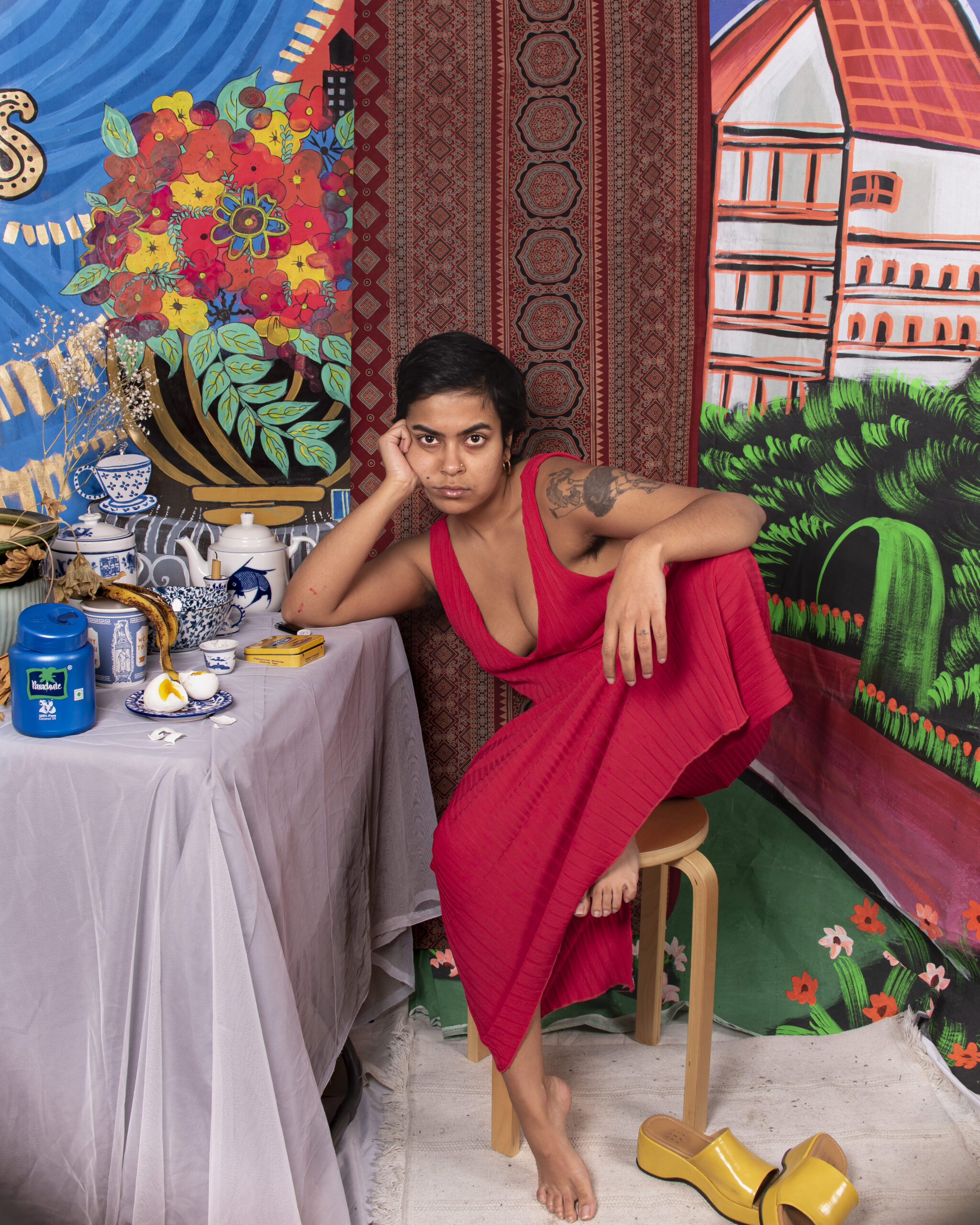
The white walls of Cheryl Mukherji’s studio apartment demand you to completely ignore them and direct all your attention to her art. To her art that is painted on them, concealing them; leaning against them, hiding them; or lying next to them, complimenting them. A visual artist and writer currently working as a photo editor at Apple, Mukherji is known for her creative works that are intimate, personal and specific. She graduated from Bard College in 2020 with an MFA in Advanced Photographic Studies. Cheryl’s exploration of the concept of origin and heritage is grounded in her mother’s character and her presence within the family album through the use of photographic, textual, video and print media.
In my interview with Cheryl at her studio in Brooklyn, we talked about art, life and work, and we laughed about how she thanks her stars for not being stuck with bad roommates, roaches or rats like any average New Yorker.
Palak Godara: If you could describe your artwork with only three adjectives. What would they be?
Cheryl Mukherji: Slow, research-based, inwards.
PG: Could you throw light on people, situations, and experiences in the past—that eventually led to you becoming an artist?
CM: I think a huge push towards making the decision that I want to be a photographer was meeting my friend/teacher/mentor—Ranjan Sharma, who I first met through an amateur photography competition that was being exhibited at the India Habitat Center. I was like 16 or something. That was the first time I was showing my work or having a conversation with someone who knew more about photography and I think that particular conversation, meeting and just talking to him about photography and understanding how to see things really shaped the way I wanted to move towards being a photographer.
There are also other experiences obviously—which are not very definitive, where I was like AHH! This is the moment when I realized that I want to be an artist. But there were smaller moments that balled together into bigger things over time and affirmed the fact that—OH! I’m supposed to be here! Even on most days, I’m like why am I here and why am I doing this? But then there are also moments where I feel like—I would rather not do anything else but be an artist or do art!
PG: In your opinion, how is art important to society?
CM: Art is important to society but I also think that—just the need to look at society as this one entity where it is never the case. I think we just wanna use the umbrella term of the word “society.” When I think of society, I think about the immediate environment or the secondary environment that a person or an artist Interacts with. Art is shaped by society and art reflects society. What part of society is the people, the subjectivity—I think in terms of talking? Talking about art as one entity is like taking two balls and hitting them against each other, where there are also other elements and other parts. Art reflects society and the subjectivity of society, the differences in society, the problems in society but I don’t think either has a symbiotic relationship. Because there are loopholes, there are politics and there are these systems.
PG: If you could give your life so far a title, what would that be?
CM: “What Is My Next Meal?”
PG: In what setting or environment do you find yourself the most creative and productive?
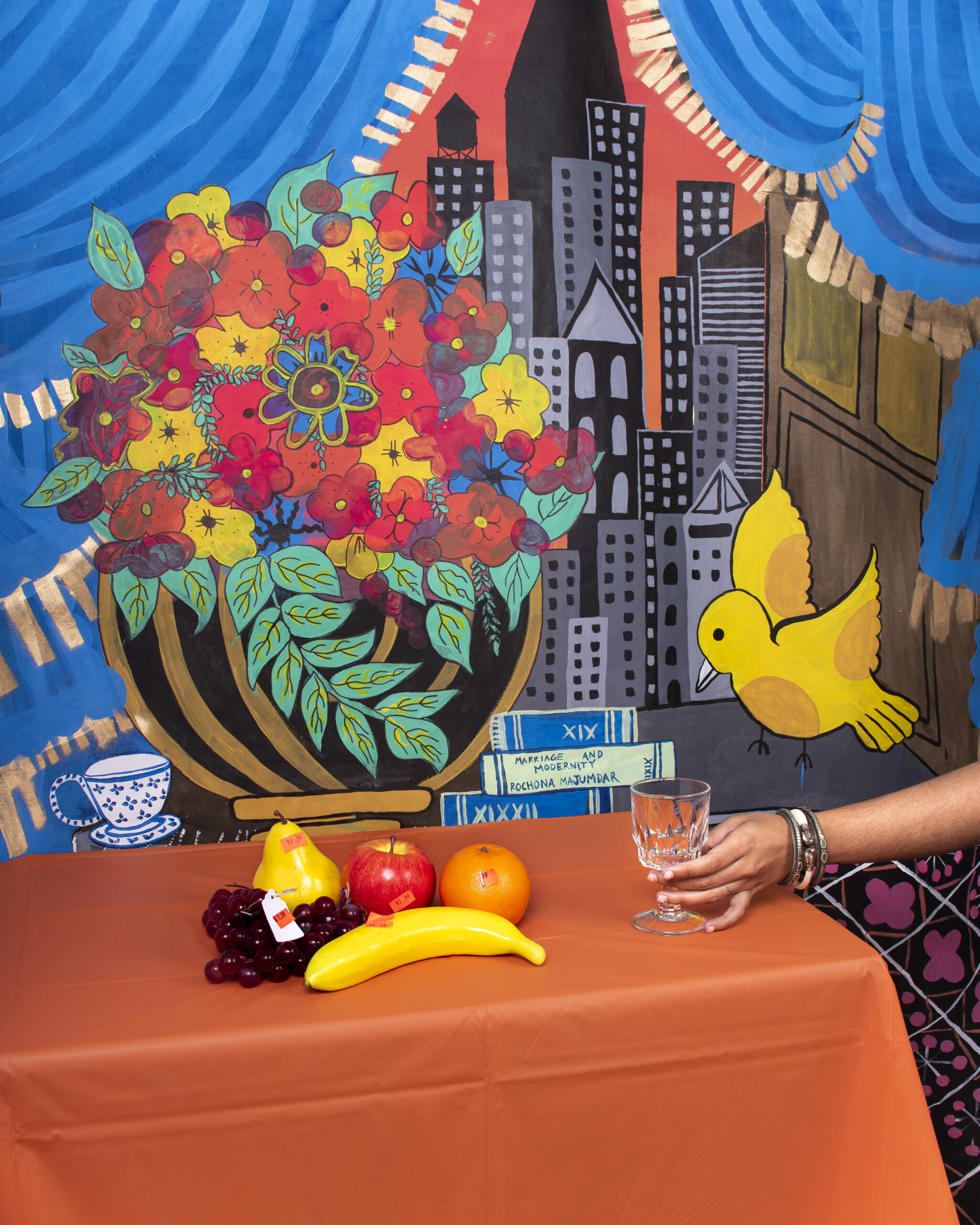
CM: In my apartment, in this studio, or any dedicated studio space, I’ve been productive. I’ve come to realize that I cannot make art in the same space that I sleep in because then the work becomes sleeping (laughs). Also, on train rides, when there’s an hour to go into the city and I’ve nothing to do. So I’m just making notes and sapping my thoughts throughout. Each minute on the train feels like a lot, especially when you’re running late. So yeah, trains also act as an environment where I find myself productive.
PG: How would you explain your bond with your studio? What parts of the studio do you spend the most time in and why?
CM: So my apartment space didn’t really start as a studio. I mean I did want to work here and this space was enough to accommodate that as well. The bond with this place has obviously developed over time. I was in a phase where, during my undergraduate years, I was just hoarding things. I wasn’t sure what the space would be like, I would just find things and I would just pick them. I was not thinking if I really liked them but I just collected. I spend the most time at this desk of mine. I do think I need better back support—something like an ergonomic chair maybe!


PG: Could you take us through the behind-the-scenes of your work titled “I don’t oil my hair anymore”—a piece of extraordinary writing underscoring an ordinary everyday act of—oiling hair?
CM: I think I wrote this back in 2019 when I was still at Bard. This was the first time I was putting my text out in art. I do write but together they hadn’t come into practice. So I wrote this piece. It was a completely different iteration, edited over years but I somehow thought that this writing did not fit into the thesis work that I was doing—so I kinda shoved it at the back of my thesis work, “Shape of an Answer.” But ultimately I made a zine out of it, and if you open it, it reveals a poster, which is a photogram made in a dark room of tufts of my hair that I cut. I believe that if you’re in an art school in New York, you have to cut your hair at some point and make art about it! So you can put it like a poster, otherwise, it exists in a zine. A friend of mine helped me edit it, design it and brainstorm ideas and stuff!
PG: What do you wish to achieve as an artist? What’s the purpose or goal of your work?
CM: I’ve talked about this with my therapist a lot. I often question the value of my work and where it lies, where there’s one side where I recognize that I’m putting myself and my work out there, and I’m really grateful to be in shows, to be written about, to be seen and starting to get some sort of visibility and conversations around the work. While on the other side, I still felt, there was something missing or something I wasn’t able to achieve, and instead of getting rid of that doubt I just want to get to a place where I can accept that I will keep coming back to this thought. This thought about—where this work is successful or what I want to achieve with this work. At the crux of it, I think I truly want to achieve an honest conversation with myself, an honest confrontation with what I’m trying to talk about, and if I’m able to do that I think that’s great! Achievement is…. If only art achieved anything, we would be, like, living in a garden. The purpose and goal are also, as I said, to be as honest and to take responsibility for what I’m trying to convey. However ugly, bad, or worse it gets.
PG: What does your usual day look like?
CM: I’m currently employed as a photo editor at Apple and my day starts at noon due to different time zones. I think I like to spend my days very intuitively. Although I love making to-do lists, I love to live intuitively where I would wake up, go for a walk, definitely do my skincare, make food, and do the dishes. I have a cleaning routine in the morning and a night ritual. I’m a very homebody-domesticated person. So I mostly keep myself at home, and my job allows me to do that. But if I feel like—I’ll go out in the evening, see my best friend who lives in the same neighborhood, or go get a drink. I don’t have a set schedule. Maybe I should, because a lot of people seem to do better when they have things by the clock, but I think I find a lot of joy in living my life intuitively. I take great pride in living without a 9 to 5 schedule. Also, sometimes I just wake up from a nap in the afternoon and randomly pick old projects and start working on them again.
PG: Being an immigrant and an outsider to American culture, how tough or easy is it to communicate through your art which embraces a totally different culture altogether?
CM: I think I do think that my work is informed very much about my culture and me growing up in India, north India specifically. And it’s a tempting choice for people here when I work in America—to state that Cheryl is an Indian artist making work about India. But it’s untrue. I don’t reference my South Asian identity in my work directly or anything. I do talk about my mother, it’s informed by it but it’s not about my South Asianness. It is always the initial conversation and the first step to communicating. For instance, “How do you do?” And then there are visual cues. How Western or American photography is and just sort of trying to break away from that or think about other ways of seeing or familiar ways of looking at things that are not very much informed by Americanness. So those are the conversations that are constantly there that provide you the opportunities to do whatever you want! If someone is not gonna understand you, might as well talk to yourself.
PG: What stimulates your creativity?
CM: I think cooking stimulates my creativity. However, I think that if you’re privileged enough to just live your life as an artist or have the opportunity to just sit down and get inspired or go on a vacation to get inspired, that’s great!
Right now, for me, there’s very little space between life-making or world-building and art-making. So whatever I’m learning or whatever I’m stimulated by—I react to it. I look at a tree and wonder what it would look like in my work. That’s why cooking is such a huge stimulator. My work is a lot about relationships, family, my own self, and being away from home. I believe, how I choose to make my art is also how I choose to live my life as well. Maybe later in life, things change, but I’ve literally just gotten out of school like three years ago and I’m thinking that maybe art-making is world-building. There is no clear demarcation between my life and my art. So much of what I do in life seeps into my art. Cooking and reading are great things which I derive my stimulations from. For a long time I read bad books—I mean, books I couldn’t resonate with but now I know what I truly enjoy. Recently I was reading a book on living rooms from the perspective of all disciplines. I was like—this is me—I just love thinking about a very specific thing from all lenses. So books like these really stimulate me and I feel like I want to respond to this piece of text. I don’t think I’m trying to do anything original because there is nothing original at the end of the day. I’m just trying to have conversations with people.
PG: Do you make art primarily for your audience or for yourself?
CM: My audience includes me and also the people who I talk about in my work. People think that your audience is the people who buy your work and then frame it in their apartment. That is not my audience. They are definitely the buyer or the collector of the work. You could make art completely for yourself. But I think it’s the job of an artist to leave an entryway for your audience. I do make work for myself but I do leave an entryway and guide them from where they can enter.
PG: Is there a specific environment or material that’s integral to your work?
CM: I think, no specific environment. It can be done anywhere. Also, no specific materials that I rely on. I think I’m a photographer and I approach my work through photography. Photography is the place I emerge from. The bare minimum that I need is a pen and paper at least and a camera always helps. I kinda lost all of my stuff in a robbery a couple of years ago and it should make me more protective of my stuff but I’ve harped this distance from my work—I feel like it’s gonna go if it has to go.
PG: Tell me about your favorite medium.
CM: Also, no favorite medium. I don’t like to stick to one. But whatever’s handy I guess.
PG: What do you dislike about the art world?
CM: What I dislike about the art world is the illusion of it.
PG: Describe your dream project.
CM: I’ve thought about that a lot. The time that I put into thinking about my dream projects should’ve been put into doing the dream project instead. I think a dream project would be just a day spent doing the things that I intuitively gravitate towards. Just waking up, moving, going for a walk, like how ideally I think I would want to live. Because it indirectly informs the work I do. And right now I’ve been thinking a lot about inwardness, domesticity, and the matrimonial work that I’m currently working on. But my dream project would be to just live that day. A curious, fulfilling day where I make my food, clean my apartment and read my book and listen to some music, go for a walk, and buy myself some flowers. That’s the dream project. I don’t think I’ve ever done that before. I have had beautiful, fulfilling days when I felt, Wow! What a great day! But then I come back to the quietness of my house, and there are hours spent on the phone scrolling, not eating, not showering, and sometimes not even brushing my teeth. But at last, it’s not about living a standard productive day but more about nourishment!
PG: Describe the best piece of art that you have ever created. Why do you think of it as the best?
CM: I don’t see my work as a place where my art pieces are individual monuments. Like this is the best monument or this is the best individual thing I’ve made. I think all my works have common footnotes and every artwork is a conversation to the next art. It’s just all connected. So I don’t think I have a favorite artwork. They are all my babies!
PALAK GODARA is a fashion journalism student at Parsons school of Design, New York City. She loves the concept of magazines and confesses her bias towards glossy ones. When she is not relishing a Pret Pesto Caprese Baguette or walking 20,000 steps around the city, she is interning at Photobook Magazine as a writing intern. Palak, in the past, has written opinion essays for Public Seminar, book reviews in collaboration with Catapult Books, fashion trend pieces for Photobook Magazine and Parsons’ weekly digests. As a 21 year old writer living at the Mecca of publishing, she continues to learn, observe, grow, experience life and then eventually write about it, rewrite, edit and proofread. Check out her work here at https://palakgodara2.journoportfolio.com/. Find her on Instagram @_palakgodara.
CHERYL MUKHERJI is an Indian visual artist and writer based in Brooklyn, New York. In her work, Cheryl explores the idea of origin and inheritance, which is embedded in the figure of her mother and her presence in the family album, using photography, text, video, and printmaking. Cheryl was a finalist and the subsequent winner of the 97th Annual at the Print Center, Philadelphia, 2023 and a finalist at the Outwin Boochever Portrait Competition, 2022 at the National Portrait Gallery, Smithsonian. She is also a freelance photo researcher and editor. Find her work here at cherylmukherji.com.
