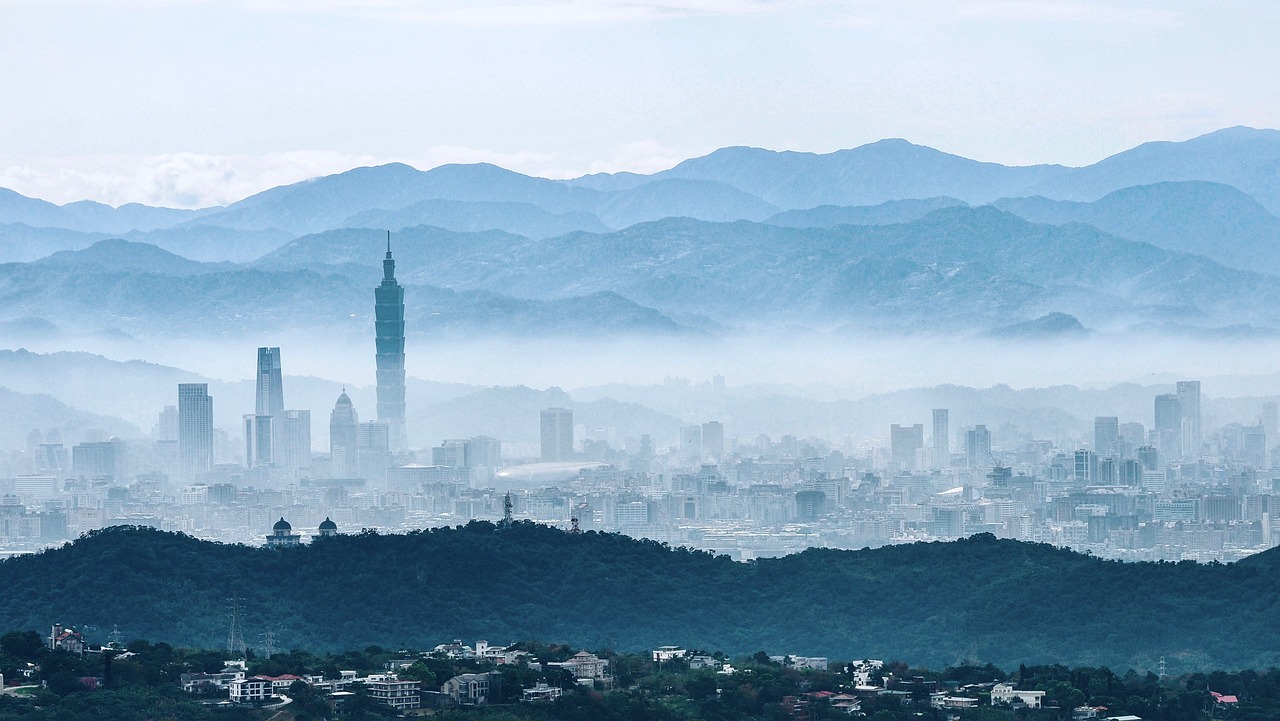
What is the hardest place to drive to? “It’s not the edges of the world,” said Father, “It’s the place you commute to every day. You can never drive to Taipei City.”
Father used to be a construction worker. A construction worker never took weekends off. A day without rain was a workday, and only bad weather kept him home. My older brother and I would be in school on the weekdays, and Father spent Saturdays and Sundays on construction sites. When everyone happened to be home, Father always made an effort to bring us out on family outings. Three alleys away from our home was where his parking space was. He always took the ten-minute walk alone and drove his RV to the front of our house, before ringing the doorbell twice, telling us to hurry up and come downstairs.
Those two piercing rings of the electronic doorbell used to be my favorite sound. Throughout my entire childhood, I got to hear it only a handful of times – it always made me wait for so long.
When I came out of the apartment building, I was always greeted by the silver RV, its engine revving up. On the other side of the road, potted plants and traffic cones had taken over the parking area by the white line. Those plants were the reason Father always had to park so far away – I crossed the road and squashed the pennyworts and moss roses in the pots with my feet. Father took his time moving his construction equipment to the back of the RV and wiping down the seats. By the time he cleaned up the vehicle, I had already obliterated the plants in every pot.
My brother and I climbed into the RV. Father was already sitting in the driver’s seat next to Mother, wearing the hat he had gotten for free when he bought the vehicle. He turned around and asked us, “Where would y’all like to go?”
My brother and I tried to remember every place we thought would be fun and shouted out their names with excitement: The (Yuanshan) Children’s Amusement Park! The (Daan) Forest Park! Let’s go to a movie theater in Shi-men Ting and watch Jurassic Park! Father shook his head and responded to each of our suggestions with a frown. I wanted to bring up a few more places, but my brother had already given up. He was disappointed, but he’d known that this would be Father’s response. He put his hands behind his head and waited for Father to speak.
“We won’t be able to get into Taipei City.”
I didn’t know the difference between Father’s Taipei City and the city of Taipei I knew, nor did I understand what would stop us from simply driving to Taipei through the city gates. Father watched me throw a tantrum, waited for me to calm down, and stepped on the gas pedal. The buildings and trees outside the window finally started to move. It was the era before GPS and Google Maps – Mother had to look at a paper map while Father followed her directions. They never agreed on which road to take, and their argument about when to turn left quickly escalated into a fight about how Mother should treat her in-laws. As they shouted at each other over everything they dreaded about their marriage, they drove by Yuanshan, missed the exit to Daan, and somehow found themselves in Shi-men Ting.
“So … could we go watch a movie now?”
“Absolutely not.”
It was hard enough to find a parking spot near our home, let alone in a bustling downtown neighborhood. All streets and alleys wide enough for strollers had lines painted on them in different colors. Red lines meant no parking; white lines meant yes parking but were always fully parked; yellow lines also meant no parking, even though people always pulled over by them to pick up passengers. Father had a friend who once parked by a yellow line near a movie theater, thinking that his car would be fine for at least an hour. After restlessly sitting through an entire movie, the friend emerged from the theater: his car was nowhere to be found. On the asphalt road, he saw the phone number of a tow yard, written in red chalk. That was all it took for him to forget how great the movie had been.
A few years before Father bought the RV, his construction company had given him a truck. It was three times larger than a normal car. Father needed the truck to transport his formwork boards, but he also drove it outside of work.
The truck caught people’s eyes wherever it went. The first time I saw it was also after two rings of the doorbell. Father hollered at us to hop on, but the truck could only seat two passengers. Father got out of the driver’s seat, grabbed my brother and me by the waist, and brought us to the back of the truck. As my brother and I stood on the cargo bed, Father found four narrow pieces of plywood, set them upright around us to form a box, and tied them up with a rope. From a distance, my brother and I looked like two small fruits misplaced in an oversized wooden crate.
The truck started moving. The cargo bed elevated my brother and me so high above the ground that we decided we would be kings of the roads for the rest of the day. We let the wind rake our hair and turned to our side, waving at the cars we passed, as if we were the emperor inspecting his city in the imperial ages, riding in a procession of eight palanquins – that could surely get us into the City, right?
No, of course not.
Within five minutes, the truck was pulled over. I turned around and saw a policeman concerned for my brother’s and my safety. He had no choice but to write Father a ticket and order my brother and me to squeeze into the passenger seat with Mother. I was small enough to fit in Mother’s arms. My brother wasn’t so lucky – he had to sit on the gearbox. He howled in pain as Father shifted gears from neutral to first, then to second, then to third, slamming the gearstick on the inner sides of his thighs.
The truck couldn’t get us into the City. How about a motorbike, small and nimble?
Father also owned a Keeway 125. It had traveled through the woods and across the mountains. I pictured Father riding it in the countryside, wearing his sunglasses, with his girlfriend sitting behind him and hugging him around the waist – until I remembered that this beautiful couple would eventually get married and become Father and Mother. They were now riding the same bike, with my brother squeezed between them, and me seated on the fuel cap. Father wrapped me in his warm, powerful arms, protecting me from falling to the ground around sharp turns. As the ride got longer, the fuel tank started heating up, searing my bottom as if it were a sizzling steak.
To no one’s surprise, we got flagged down by the police after we’d just managed to cross the Keelung River. An officer and a traffic volunteer hiding in an alley spotted us and gestured for us to stop. People passing by turned and marveled at us. An entire family on one bike? How dangerous!
Father had no choice but to make our future outings happen at night. Under the moonlight, we rode to Sansiantai to watch the sunrise, and to Alishan to see the galaxy. No matter where we went, Father would always remember to bring his compact camera and take pictures – as proof that we indeed had visited those distant places together … wait, where did the pictures go?
I’d turned them in as part of my summer break homework.
And where did the homework go?
I’d recycled it.
Father did not have the energy to hop on another long bike ride and visit any of those places again. Taipei City was still off-limits, so he searched for places near our home within Neihu District. On another rare day when everyone was home, we boarded the silver RV, and Father hit the gas pedal and drove us into the lush mountains. Signs of human life gradually faded away. The roads got steeper and steeper, and I got carsick after only the first few turns around the corners. “Here we go again,” mumbled my brother, “Another hiking trip.”
What’s so wrong about hiking? Come on, hiking is good for our health! The rocky ride finally came to an end at Bishanyan, but a few hundred more stone steps waited for us to climb before we could reach the temple on the mountain. As we were catching our breath, Father put on his sunglasses, leaned against the railings, and gazed at the Taipei Basin – Taipei 101 hadn’t been built yet – as if he were a popular idol shooting a TV show. My brother and I ran around him like monkeys, looking for ways to entertain ourselves on the observation deck. A few tower viewers stood by the railings. We wanted to look at the city and begged Mother for a few coins.
I tried my best to look for Father’s Taipei City through the lenses – the temple was always the last stop of our hiking trips, and I didn’t want to wait another few months for the next opportunity to find the city wall, the obstacle that had been preventing Father from driving us anywhere. I slowly turned the tower viewer westward, away from the hills. The Keelung River divided Neihu and Songshan Airport, behind which stood old apartment buildings with illegal rooftop structures, their metal roofs gleaming under the sun. To the west of these rooftops, skyscrapers pierced through the skyline, standing like pillars between heaven and earth.
“Taipei is right there,” Mother said, pointing at Taipei Main Station and SKM Mall.
But by the time the lenses turned off, I still couldn’t find the city wall I had imagined, a sturdy wall made of mud bricks. I didn’t spot anything – not even the thinnest railings – that enclosed the city.
Where’s the City? Where’s the wall that has been blocking Father’s way? If I couldn’t find it, I wouldn’t be able to crush it like the potted plants and beg Father to bring me to the City.
Perhaps the City was invisible. I finally noticed its wall, standing between Father and me.
The Bannan metro line opened when I was in middle school. One day, a friend called the landline at my house, asking me if I wanted to hang out together in a couple hours. I grabbed some small changes and met him in front of a bus stop. We took a short bus ride and transferred onto the metro. Standing on the train and zooming through the tunnels, listening to the PA system announce the unfamiliar names of place after place, I was suddenly overcome with a juvenile excitement – I was about to see the city wall, and it would finally open its gates to me! “Are we heading to Taipei?” I blurted out to my friend.
“We’ve been in Taipei the entire time!” my friend said, puzzled by my question, “Don’t tell me this is your first time going out.”
We got off the metro at Taipei Main Station. Surrounded by skyscrapers, billboards, and people dressed up to push the boundaries of fashion, I was overwhelmed by a suffocating sense of modernity that poured forth from every direction. My friend saw me standing dumbfounded and dragged me into the shopping district. I acted like a curious animal that had just escaped the zoo, peering through every display window, covering the glass with my fingerprints. The storefront signs were covered with familiar English letters that had been assembled into words that meant nothing to me. “This N place sells shoes,” my friend told me. He pulled me away from the racks of sneakers and pointed at a few other storefronts, “The one that starts with S sells watches, and the one over there with a J is a backpack store.” Staring at the beautiful English letters on the store signs, I suddenly realized that my friend had already been wearing them on his body. And what was I wearing? Cheap clothes Mother had bought from wholesale vendors.
That was how little effort it took me to get into Taipei. A few coins were all I needed to travel beneath the ground and blend in with the rest of the city.
From then on, the city became the only place I went to with my friends when we didn’t have school. The noise from the metro train tracks screeched like a rebellious scream – this was what being young should sound like, not the meandering cicada chirps in the mountains.
There were a few times when Father was home over the weekend. He woke up before everyone else, drove the RV in front of our home, loaded the back with food and camping gear, and rang the electronic doorbell twice. “Where would you like to go?” he asked me, offering to drive me anywhere.
I pretended that I didn’t hear him. Instead, I grabbed my new metro card, squeezed between him and the wall, and headed out. “How about Taipei?” Father’s voice followed me from behind.
I continued my walk toward the metro station and hopped on a city-bound train.
That was when the two rings of the electronic doorbell became mere noise. Father gave up after I ignored him a few more times. Across the street, the potted plants that I had ravaged started to regain their life. Nobody bothered with them anymore. They finally had the opportunity to be beautiful, to be lush.
After I got a boyfriend, I cared even less about reporting my whereabouts to my parents. Father continued to ask me if I was going to Taipei every time I was about to head out. I didn’t want to lie to him, but I couldn’t tell him that I was seeing another man, so I remained quiet. Mother sent me off, telling me to dress warmly and come home early – she knew who I was going to meet. My boyfriend was waiting for me in his car by the street. I sprinted downstairs, opened the front door, and hopped onto the seat next to him. Unlike Father, he never asked me where I’d like to go or promised to take me anywhere. Instead, he quietly held the steering wheel, gently stepped on the gas pedal, and drove us toward the destination we had decided upon together.
Closing the door of my boyfriend’s car felt like shutting the gates of a city, blocking Father outside. As we drove on the highway, I gazed down at the river beneath the bridge. It separated Neihu from Taipei City. Perhaps, it also marked the boundary between Father and me.
One late night, I was hanging out with my boyfriend when I got a call from Father. “Where are you?” he barked, “If you don’t get back right now, don’t bother coming back at all!”
I decided I wouldn’t let him continue screaming at me. “You don’t think I have anywhere else to go?” I shouted back into my phone, hung up, and ignored all his calls after that. My boyfriend tried to calm me down and eventually talked me into going home. He dropped me off in front of my house. The front door of the building opened before I even rang the doorbell.
The door to our apartment was left open. The lights in the living room were turned off. Father was sitting alone on the couch in front of the Buddha statue, his pale face glimmering in the pink light from our family altar.
“Why are you here? Weren’t you not coming back?”
I didn’t know how to respond. I went back to my room without brushing my teeth, crashed on my bed, and texted my boyfriend goodnight.
The boyfriend I texted goodnight changed from one to the next. Father always waited in front of the open door, sitting alone in front of the glowing altar. If it was too late into the night and I still hadn’t returned, Father would drive to the city and look for me, without worrying about losing his precious parking spot. One evening when I went clubbing with my friends, I got so drunk that I insisted on staying after my friends were ready to leave. Before I passed out, I managed to call home and mumbled the name of the neighborhood the club was in. Father hung up, found a paper map, and searched road after road in the grids. When he got to the neighborhood, he couldn’t find a parking space and had to drive around the block in loops, waiting for me to sober up and call him back.
I managed my way out of the club on all fours, opened the door, collapsed on the seat, and threw up everywhere.
“Why are you here?” It was my turn to ask him the question. “Didn’t you always say you couldn’t drive to Taipei?”
Father didn’t respond and quietly drove me home.
Many years later, when I was waiting for the metro during rush hour, I spotted three construction workers on the platform, lining up with the rest of the crowd, quietly waiting for the train. They each carried a sack over their shoulders, and their clothes were covered in mud. They stood so rigidly, trying their best to avoid brushing against other people. The door opened, they squeezed into the train, uttering ‘excuse me’s to everyone they bumped into, and hid themselves in the corner. They chatted in low voices in Minnan, ‘Too bad we don’t have a car, it’s such a hassle’ ‘It’s going to be so hot tomorrow too,’ before getting off at three different stops. As they were exiting the train, they carefully kept away from other passengers, just as other passengers kept away from them. And when the last worker got off, carrying his heavy sack of equipment, I saw him let out a huge sigh of relief, as if he had just offloaded everything from his shoulder and could finally relax.
I saw an image of Father, with his heavy sack of equipment over his shoulder, carrying his drill, hammer, and all the other tools I couldn’t even name. Father was hired by developers and managed by his crew leaders. Father followed architects’ blueprints and built Taipei City into a metropolis. Then, Father quietly packed up and left, like the metal scaffolding and green barricades that had survived the blazing sun and ferocious storms, giving space to English letters and modern symbols, leaving behind nothing but a splendid, dazzling city.
Father was the one who built the city. Father was also the one kept out of the City.
After Father retired, my brother took his RV and drove it to work. The old silver vehicle finally became a regular visitor to Taipei City. I continued to take the metro every day. Father no longer had reason to ring the doorbell twice. Once in a while, after taking out the trash, he would stand in front of the building, ring the doorbell, and ring it again. One of his sons would let him in and quickly return to their rooms, leaving him in the company of the squeaking door and the dim hallway light.
He liked to talk about the days when Neihu wasn’t yet a district of Taipei. There were only farmlands and ditches, and he had to walk a long way to go to school, wading through the water, hiking through the woods, as if he were an early settler on an expedition. For Father, Taipei City was the bustling area around the Main Station marked by the city gates. There were malls, theaters, and restaurants. The roads were paved with dry asphalt, with trees neatly lined up on their sides.
Of course, Father had visited his Taipei City with people of his generation. But after they stopped going to the City for too long, the City had no choice but to outgrow them and leave them behind. In response, they too opted to abandon their City, instead building a wall around themselves in the outskirts, living in their memories from three decades ago, a bygone time when they rode their bikes to Shi-men Ting, ate Snow King ice cream, and watched old movies.
I hopped off the bike, its fuel cap burning hot. Three decades of time suddenly flashed before my eyes when my feet touched the ground. I saw an image of Father, whose slicked-back hair had thinned and turned gray, whose suit and sunglasses had been replaced with a sweatshirt and pinhole glasses for cataract patients. He could no longer grasp the handlebar and his family’s safety in his wrinkled hands. Instead, he quietly squatted down, picked up the vegetable basket, and tossed the trash bag. The vehicle he drove changed from one to the next, and he managed to accumulate mile after mile on the road. At the same time, the roads he traveled on became closer and closer to his house, until there was no longer any vehicle for him to steer, leaving him stranded at home, waiting for his two sons to come back at night and enjoy a meal he had cooked for them – his sons who had to drive past the red road lines and traffic lights he had dreaded, exit his Taipei City, and cross the Keelung River, before finally ringing the doorbell.
“Are you still in Taipei? Would you like to have dinner together?”
I hurried home, only to be welcomed with an empty apartment. A while later, the clinking sound of keys broke the silence. Father returned with his sports backpack, and Mother was wearing a pair of red canvas shoes. They brought home bags of pineapple cake and Sachima pastry from Tamsui, and they both had an animal hat from the zoo on their heads – Father an elephant, Mother a penguin. I learned that they had watched a movie together in Shi-men Ting, bought a dozen ceramic cups in Yingge, and got each other sneakers at the store with the letter N. Returning from their date, they each had a big, innocent smile on their faces, as if they were little children welcomed by their parents, after coming home from a pleasant hiking trip.
“You’re home! Let us make dinner for you.”
They put down the shopping bags and headed to the kitchen. I stared at their senior metro cards on the table. The cards could take them anywhere they wanted during their retirement years. They would reach the edges of their world, and they had found entrance into the little world enclosed by the walls of my heart.
Indeed, there is always a destination we can never drive to, and there is always a place where Father cannot bring his sons to with his powerful hands on the steering wheel. Today, when we find ourselves on the broad road to the unfamiliar yet dazzling City, Father always remembers to take off his sunglasses and gives me a gentle smile, quietly watching me take a steady step, then another, then another.
HSIEH CHIH-WEI (謝凱特, b. 1986) is a Taiwanese essayist, short story writer, and children’s book editor. A graduate of the MFA program at National Dong Hwa University, Hsieh is the recipient of numerous Taiwanese literary prizes, including the 2019 Lin Rong-san Literary Prize, the 2019 Taipei Literature Award, and the 2020 TIBE Book Prize. “You Can Never Drive to Taipei City” is an excerpt from Hsieh’s memoir My Ant-Man Father, which has been translated to Czech by František Reismũller.
TONY HAO is a Connecticut-based literary translator from Mandarin Chinese to English. His words have appeared in The Common, Crayon (sister magazine of Litro), and Yale’s Journal of Literary Translation. He is the 2024 Literature from Taiwan mentee of American Literary Translators Association (ALTA)’s Emerging Translators Mentorship Program.
