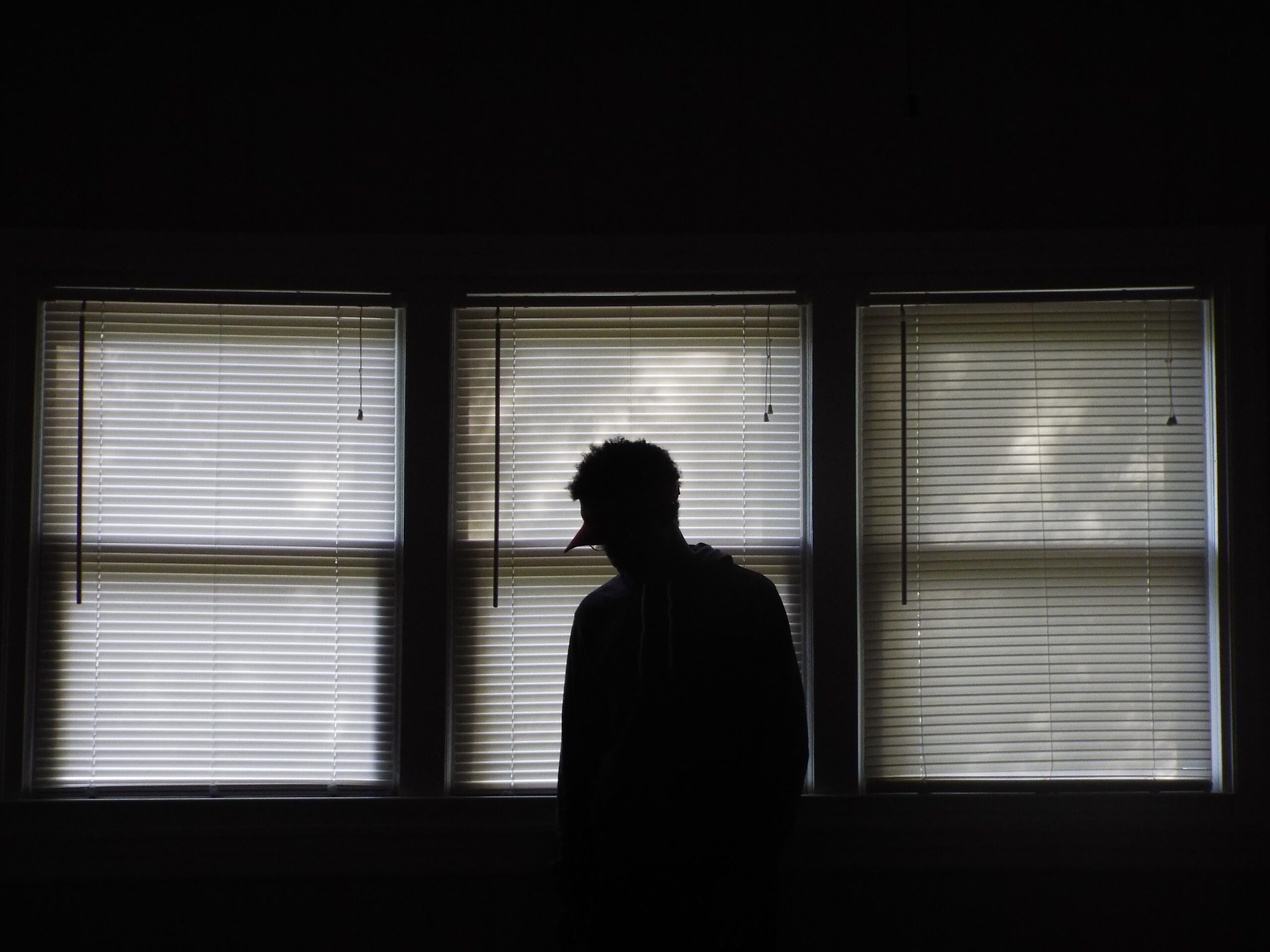
“A simple description, Lewis, that’s all I’m asking.” He bangs that ridiculous cane on the floor, thunk thunk. Vertical strokes meant as punctuation, little jabs to splash some color on his words. Only sometimes the jabs get loud, angry. “Is that too much for you?” He says it with a giggly quaver to let me know this is all in the bounds of congenial banter and good cheer—he’s just a little impatient, no big deal.
“Well,” I say, “she’s maybe almost as tall as you, thin, longish brown hair.”
That earns me a scornish pause. Raised eyebrows say he’s waiting for more, but I don’t tell him more. “Yes?” he says. He slides forward on the couch, leans in like he’s watching a lackluster dogfight and some blood, just a drop or two, has been spilled.
“Yeah,” I say, “she looks, you know, okay.”
Another pause, and now I’m fidgeting under his gaze. If you want to call it a gaze—his eyes are on me, though not dead on my face, they’re missing a little, but doing their best. Gray-tinted glasses, full lips in a knowing, handsome smile, that look of mild amusement, still trying to project that all is cool between us.
The cane is twisting now, digging a little mark into the finish on the oak floor. He holds it in front of his belly, which has gotten pretty hefty—when he sits down, it sits on his lap. He sandwiches the cane in the flats of his palms and rubs back and forth in a kind of drilling motion, like natives in TV documentaries do with sticks on bark to make fire. I’ve seen these canes, now and then, all my life—long and skinny, painted peppermint white and red—but I can’t get used to Josh fumbling around with one. To me it looks like a theater prop, and he wields it like one, twisting and rocking and tapping and gesturing. He just got it a month ago, and I don’t think he’s gotten used to it either. For years those little cells at the backs of his eyeballs have been dying off, one by one, ping, ping. First his night vision was gone; then, even in daylight, details started dropping away; eventually he couldn’t make out the print in a book, even with his digital magnifier. He quit driving, started bumping into things, and now this. Neither of us says the b-word, but that cane kind of screams it.
“I know the basics,” he says. “Five-eight, hundred-and-twenty, brown eyes, brown hair with red highlights, penguin tattoo, simple jewelry, wears cotton in muted tones with little jolts of orange and yellow. She emails me the info, and my robo-reader recites it to me in the most condescending monotone you ever heard.”
“I don’t see a tattoo.”
The humor drains from his face, his voice flattens. “It’s down low on her back. Way low.” He gives the floor a clunk. “Or so she says. I figure she mentioned it as a kind of carrot.” He takes a slow, full-of-wisdom breath. “Let’s face it, courtship is all carrots, marriage is mostly sticks.” He’s never been married, though he came close once. He’s always been an abundant source of know-it-all epigrams. Not much else has changed about him either, stylewise, characterwise, since his vision went south. Same charm that pulls you into his warm, easy orbit in minutes; same exasperating drive to reveal all that’s awry in his hurting heart, that pushes you away in an hour or two. Somewhere in there he’ll still usually grab his guitar and start picking bluegrass, which is, believe it or not, a treat. “Never mind,” he says, “my point is, she already gave me the simple facts. Unless she’s lying, I already have the bare bones of what she looks like. I need you to flesh it out. Look at her, then give me some sense of her physical appearance…. How old does she seem to be?”
“I’m sure you have it written on your cheat sheet.” He just stares, deadpan, so I take another look at the two pictures on his computer monitor, one of her standing sideways in some sort of mall—there are people around—the other a face shot. “Mid-thirties, maybe a bit more.”
“She said thirty-one—probably fudging a little. Keep going.”
I don’t want to keep going. “Her body is, well I told you: thin. She’s got tits, not big or anything, but they’re okay. And her face, it’s thin too.”
He breathes noisily through his nose, trying to filter some patience from the dank air of his grungy apartment. “You are coming up short on visual description. I know you’re no Brainiac. You were, what, a phys ed major in college?—who the fuck is a phys ed major? But come on, Lewis, when it comes to verbal agility, you are not a piker. You’re a salesman, for shit sakes.”
A salesman knows when to hold forth and when to hold his peace. I hold my peace.
“Let’s try another approach. How do you feel about her?”
How I feel is ambushed. “I gotta get going,” I say. I see the reaction in his face and feel bad. “I mean soon, I have to go pretty soon.”
He ignores the signal. “When you look at the picture, are you attracted?”
“She’s not beautiful, but she’s, you know, in the ballpark.”
“Which ballpark?”
“The ballpark of okay. Of hey, I’d go meet her, see what happens.”
“Is this, like, on a desert island kind of go-out-with-her ballpark, or a major urban metropolis kind of one?”
“Josh, she looks pretty good, good enough to give it a shot. Talk to her. If you like her, see if she’ll join you for a cup.”
Now he’s thoughtful, maybe feeling a little ambushed himself. The cane is drilling again, and his face starts cycling through emotions. Worry, annoyance, sadness, amusement, worry again. Even when his vision was good he didn’t like silence, was always filling it with nervous chatter. Nowadays it terrifies him, as though everything he can’t see might start closing in on him if he doesn’t keep it snared in a web of words. Yet here it is, silence, a dark sea animal floating between us. Maybe he doesn’t even notice it.
But I do. I’m beginning to feel heckled by it. “Seeing as how you can’t see her”—I say it with an edge—“why does it matter what she looks like?”
Now that the question is out of my mouth it seems cruel, I’m not sure why. I can see it has unleashed something in him. His face gets ugly, just for a flicker; then a startling shift and he looks very young and so lonely I can feel the ache of it in my chest.
“I get stuck, Lewis. If I’d been born like this, it wouldn’t be such a big deal. But it was always my eyes that fell in love first. That’s how it was with Evelyn. I’d breathe her in through my eyes, give myself to her with my eyes. Sometimes it didn’t matter what we were saying if we were looking at each other, reading each other.”
“Evelyn’s eyes,” I say, remembering them. Penetrating. Judgmental. “She could see through lead. They kinda creeped me out.”
He takes another breath full of exasperation, but continues. “I don’t know what to do anymore. I can make contact, online, on the phone. I can connect, relate, get friendly, blah blah. But I can’t cross over… I can’t find my way to romance without eyes. I need help seeing.”
It’s finally getting through to me, what he’s really saying, his predicament. I don’t quite know what to say. “Nobody else can do that for you, Josh. You must understand that. I can’t tell you whether or not to want her.”
“We grew up together. We used to meet girls together. You know how I am, you like the same things in a girl that I like.”
That can’t be true. Maybe it was true before, when we were kids, hanging at the beach, trying to get up the nerve to talk to girls lying on their towels a couple body lengths away. Josh was always the one to catch their eye, take the risk of saying something. I’d wait, looking cool and aloof, trying to avert my eyes from all that oily pink skin radiating heat and expectation, hoping I’d know what to say when it was my turn to speak.
I give him my best shot: “All’s I can tell you is, for me, she makes the cut.”
The first couple times he started talking to them, those girls on the beach, I felt annoyed, embarrassed. He’d say awkward, dumb things, fumbling his way toward connecting with strangers, while I sat in the safety of silence. If and when things warmed up, and we dragged our towels close to theirs, I’d wait for a cue from him, then join in. I was the one with the long, athletic body—a major asset on the beach—so, once the conversation was in high gear, a lot of their flirting was directed to me, and I’d usually end up with the prettier girl. In some way I never understood, that pleased him.
I expand a bit: “There’s, like, a visual threshold. Know what I mean? As I see it, she’s past that threshold, she’s in.”
“That’s good. That’s a good thing. Right? You’d go out with her.”
“I’d go meet her, find out what she’s really like.”
He breathes deep, like he’s about to step out onstage in front of a hundred people. He’s envisioning. “Yeah, that would be the next step. Meet her. Sit with her at the Squirrel Cage, sip coffee, chat and, uh, listen for those coy glances and heavy eyelids and quirky tilts of the head.”
“Come on,” I say, “you’ll know if it’s there, if things are clicking and she’s feeling attracted. She may have to extend herself more than halfway—a touch of the hand, that kind of thing. But she’ll do that. If something is happening she’ll let you know.”
He’s silent again. No doubt looking into the future with his mind’s eye, rehearsing. This kind of imaginative seeing comes easy to him. It always did. Maybe that’s a curse, because now I see defeat in his body as he runs through one and then another scenario on that screen in his head, and each time steps off a cliff and falls, clutching that stupid cane all the way down.
“Come with me,” he says. I don’t respond. “Lewis, I need you there. It won’t work otherwise. You don’t even have to say anything. I need your eyes.”
“That’s crazy. I’m gonna sit there and, what, whisper descriptive details in your ear?”
“We can figure out some way to communicate, just between the two of us.”
“That’s nuts. What’s she gonna think? She’ll see a second guy there. I’m not a guide dog.”
“Yeah. Yeah, you’re right. I don’t know. I…” His right hand lets go of the cane, moves up to his forehead, squeezes at the skin there, fiddles with his hair. “Maybe you could come afterwards, you know, to pick me up. You could sit and chat a bit, assess how she looks in person, and how she sees me.” His gaze comes back at me again, a fat brown eyebrow raised, a shrug of the shoulder, and it occurs to me that maybe this is what he’s had in mind all along.
“I don’t want to be pushed in the middle of this, Josh. This is about you and what’s-her-name.”
“Denise.”
“I’m not the guy for this. I don’t want to be there, looking into the eyes of some Denise you want to be intimate with.”
“‘Be intimate.’ We never talked that way in high school. We just said it right out.”
“That’s because we weren’t doing it.”
“That’s me—talking and not doing.”
“I don’t like the set-up, Josh. I’m not comfortable with it.”
“You don’t hardly have to do anything!” No veneer of pleasantness now—he’s pissed.
“You, me, and some Denise together is a bad recipe. It always was.”
“Don’t be a dickhead, Lewis.” He takes a breath, and the silence creeps back in, just for a moment. Then he speaks quietly, with an emotion in his voice that finds its way to my own sadness. “Don’t go dredging up old shit.”
I stare at him, trying to make sense of what he wants, of who he is. When did I first realize that I don’t like him anymore? “So okay, let’s say I show up, I meet her, chat with you and her. What if she’s not interested? I give you a signal, a word, a nudge of the knee?”
“How about you just lay low and, like I said, assess. We’ll evaluate afterwards.”
“And what if she has her eye on me?”
“Let’s not get ahead of ourselves, asshole.”
“I’m thinking I could scrawl my number on a piece paper and slip it to her—you’d never know.”
“Knock it off, Lewis.”
“I could ‘be intimate’ with her two or three times, and move on.”
“I forgave you for that,” he says. “You know I truly forgave you.”
“Like you had a choice.”
His face is full of murder, but his voice stays calm. “I’ve never really blamed you. Me and Evelyn, it was over by then—she just figured it out before I did. You were a means to the end of something, that’s all.”
I feel small, then angry. “Bullshit,” I say. “That’s not what she told me.”
“I mean, it’s not like she was going to hang around with you more than a month or two. No woman ever does.”
I reach down inside for some sort of comeback, but there’s nothing there. So I say it again. “Bullshit.”
“Why do you come by, Lewis?” I don’t say anything. “What are you doing here?”
“I’m leaving. That’s what I’m doing.” I head for the door.
“When are you coming back?” He’s worried now.
“Never. When I fucking feel like it.”
“What about the girl?”
“What about her.”
“Will you help?”
“Fuck you, you’re on your own.” I pull the door open. “Go meet her, coward. She looks okay—if you can stand somebody with teeth like that.”
He chuckles. “Come on, Lewis.”
I’m halfway out the door. I want to say something, but an old terror is slithering up my ass. I leave the door open, look back at him sitting on the couch, his belly hanging out like a seven-month pregnancy. Silent. I head for my car, quietly.
“Lewis?” I hear him say. “Lewis!”
MICHAEL PEARCE’s stories and poems have appeared in The Gettysburg Review, The Threepenny Review, The Yale Review, Conjunctions, Epoch, Nimrod, The Sun, and elsewhere, and have won some national prizes (New Ohio Review, Dogwood, Oberon, The Tennessee Williams & New Orleans Prize in Fiction, and others). His collection of poems, Santa Lucia by Starlight, won the Brighthorse Prize in Poetry and was published by Brighthorse Books earlier this year. He has worked as a furniture designer and builder, a university lecturer, and as Director of Cognition Exhibits at the Exploratorium science museum in San Francisco. He lives in Oakland, California and plays saxophone in the Bay Area band Highwater Blues.
