In The Beginning, There Was Translation
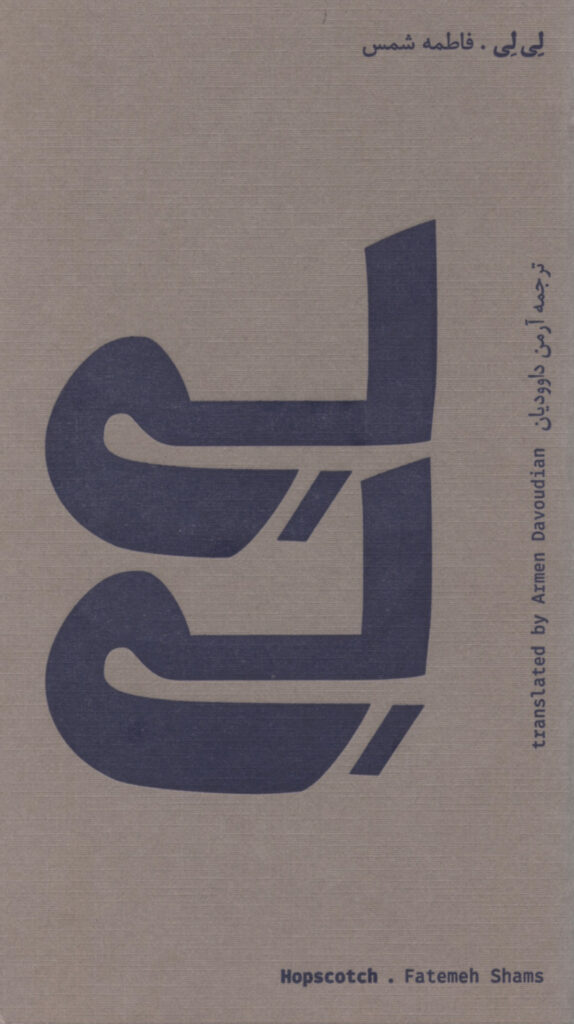
Hopscotch (Falschrum Books and Ugly Duckling Presse, 2024) is a collection of 13 poems in Persian by Fatemeh Shams, accompanied by their English translations by Armen Davoudian, and a series of evocative photographs by Stefan Maneval. This collection delves deeply into the themes of exile, memory, and the internal relation between writing and translation. Shams’s work is a moving reflection on the nature of displacement and the continuous search for meaning through language.
Capturing the Essence of an Evolving Experience
What if a poet tries to capture the essence of a human experience that constantly changes its forms, implications, and dynamics? In Homer’s Odyssey, Proteus is the elusive shape-shifting sea god who constantly changes form to avoid capture. To unveil his true identity, the protagonist, Menelaus, must hold on to him tenaciously as Proteus morphs into various creatures, from a lion to a serpent to a stream of water. Only by persisting through these transformations can Menelaus force Proteus to reveal his true self and impart the knowledge he seeks. In Fatemeh Shams’s poetry, exile is akin to Proteus—a constantly changing entity that she grapples with to understand its true essence. Her verses depict exile as an ever-morphing force, one that she must continually confront and endure. Sometimes she has some control over it, and other times, she is suffocated by it, mirroring the relentless struggle to grasp the true nature of displacement and the self in her poetic exploration.
From the metaphor of playing hopscotch to being pulled by the ebb and flow, Shams uses an array of imagery to explore the evolving nature of exile. The collection opens with a poem where the poet depicts herself playing hopscotch shoulder to shoulder with the absence of someone or something. The metaphor extends as the player pauses, one foot dreaming of returning to the past while the other remains stuck in the present. Memory, in this context, is depicted as a roofless cube, symbolizing the vulnerable, limited, and fragmented nature of recollection in exile.
While playing hopscotch is a way to navigate exile with playfulness, actively evoking childhood memories to the present, her other formulation of exile, in the metaphor of ebb and flow, depicts moments in which there is no control over what is being remembered and how. She writes: “on the other side of the ocean / the tide / pulls me in / on this side / the tide / spits me out /… I ride in the depths of a feeble association” (Ebb and Flow, 31).
Moreover, Shams’s poetry finds moments of temporary salvation in the simplicity and beauty of life’s fleeting experiences. The poetics of love-making, depicted through trembling and tangled bodies, and the accidental miracles—such as a rainbow reflected on bodies or the trail of a swan’s feathers on water—offer glimpses of transcendent beauty and moments of grace. These experiences provide solace and a sense of connection amid the disorienting reality of exile.
The Ever-Presence of Absence
As an exilic poet, Shams contemplates absence. Absence travels with her, like a light pack, where what it can’t carry is more notable than what it can. This is akin to how the unseen aspects of a city can be more significant than what is visible: “to all the cities in whose streets I had never kissed you and never will” (Suitcase, 29). The absent ones traveling with her—the ghosts in a city that help her with fading associations—all contribute to a poetics of inability. In her poems, inability is social and political to the core, moving beyond its usual connotations to encompass the broader experience of displacement and the struggle to maintain one’s identity and connections. “I tell her we’ve all become tongue-ties: my finger, the x-ray, the stitches, the border police, the fingerprint scanner” (Fingers at the Border, 27).
The themes of physical and digital access to one’s homeland and memory are pivotal in Shams’s work. In a world where a poet’s memories are rendered inaccessible by an oppressive government, Shams delves into the essence of our physical connections to these memories. She interrogates how other places can evoke distant associations while simultaneously creating emotional dissonance. Shams poignantly reflects, “What good are stamped dates and reminders when I cannot touch them?” (Fingers at the Border, 27)
Shams also vividly portrays the digital barriers that exiles face when trying to connect with loved ones in their homeland. The reality of millions of Iranians living in exile or the diaspora is beautifully captured in her poetry, where communication is often hindered by government surveillance and censorship. Shams writes:
“Two weeks into spring my mother says:
Inflation is rampant, still no mail
The officials are pocketing Eid gifts.
The VPN breaks down
So does my mother’s face.” (Berlin, 9)
The “VPN breaks down” not only signifies a technical failure but also symbolizes the emotional and relational disintegration that occurs when political forces interfere with personal lives.
Bridging Traditions and Experimentation
Shams’s poetry is informed not only by her extensive scholarly studies of Persian exile poetry but also by her creative conversation with the modernist and avant-garde traditions of Iran’s 20th-century poetry. Her work echoes the voices of canonical figures of Persian modern poetry such as Ahmad Reza Ahmadi, Bijan Elahi, Sohrab Sepehri. In this sense, Shams is building bridges between experiences that have attempted to explore human estrangement, employing them to explore the philosophical, linguistic, and psychological effects of exile. Her experiments are not limited to Persian modern and exile poetry, but interact with global literature. Informed by imagism, she embeds and politicizes the form to experiment with imagery within a foreboding context of political suppression:
“everything in its place
the spare keys with the little plastic rainbow
the kitchen knives from small to large
your mismatched coffee mugs
… everything in its place
except the pool of dried blood [from your forehead]
that had been washed
from the floor” (Meriç, 11).
Exilic Language
Throughout the collection, the theme of translation intertwines with Shams’s relationship with her mother tongue and the various languages she encounters in her exilic life. This constant interplay highlights the fluidity and complexity of linguistic identity for those living in exile.
Shams’s work suggests that the essence of her poetry lies in the line written between two voices, each slightly misaligned. This misalignment is not a flaw but a feature, a space where meaning is constantly negotiated and redefined. The poet challenges the conventional notion of translation as a mere transfer of meaning, proposing instead that it involves acts of rewriting from scratch. Translation becomes an endeavor to introduce a new misalignment, reflecting the inherent discrepancies even within the original text.
In the final poem, Shams plays with a famous phrase from the Old Testament: “In the beginning there was translation / one soul clinging to another / in a bed of words intimate and unfamiliar, one mouth fused to another / a child born out of wedlock in a notebook’s scarlet embrace” (Translation, 35). This powerful imagery encapsulates the core of Shams’s poetic exploration—translation as a fundamental aspect of human connection, self-exploration, and writing.
It is through such an existential understanding of translation that the poems have also been translated into English. The concept of translation in Hopscotch transcends mere linguistic conversion; it is an act of re-interpretation and exploration within a poem’s world. Davoudian’s approach underscores the duality inherent in the act of translation, where each language brings forth a different facet of the same poetic essence.
Hopscotch ultimately redefines the relationship between original and translation. Shams’s poetic vision offers a profound meditation on the nature of language, identity, and the continuous act of translation that shapes our understanding of the world. Stefan Maneval’s photographs, interspersed throughout the collection, add another layer of depth to the reading experience. These images serve as visual counterparts to the poems, capturing the essence of exile and the fragmented nature of memory.
FATEMEH SHAMS is the author of two books of poetry in Persian and a critical monograph in English on poetry and politics, A Revolution in Rhyme (Oxford UP). When They Broke Down the Door (Mage, 2016), a collection of her poems translated by Dick Davis, won the 2016 Latifeh Yarshater Award from the Association for Iranian Studies. Her poetry has been featured in Poetry magazine, PBS NewsHour, World Literature Today, and the Penguin Book of Feminist Writing, among other venues. She is Associate Professor of Persian Literature at the University of Pennsylvania.
ARMEN DAVOUDIAN is the author of the poetry collection The Palace of Forty Pillars. His poems and translations from Persian appear in Poetry magazine, the Hopkins Review, the Yale Review, and elsewhere. His chapbook, Swan Song, won the 2020 Frost Place Competition. He grew up in Isfahan, Iran, and is a PhD candidate in English at Stanford University.
MAHDI GANJAVI (Poet, Literary Translator, and Scholar) is a distinguished historian specializing in education, literature, print, and translation within the Middle East. A former Postdoctoral Fellow at Northwestern University School of Education and Social Policy (SESP), he currently teaches book history at the Faculty of Information, University of Toronto. His scholarly writings have appeared in the Encyclopaedia Iranica, Iranian Studies, American Archivist, and Review of the Middle East Studies. Ganjavi’s translations of likoos, a syllabic poetry of Southeast Iran, have appeared in Modern Poetry in Translation and Asymptote. A compilation of 100 translated likoos was recently published by Asemana Books. His translations of high modernist, eco-poetry, and New York School English poetry into Persian have been published in several literary magazines such as Neveshta, Namomken, and Zamaneh. Find Mahdi at mehdiganjavi.com and on Twitter/X @mehdiganjavi.
